
MAPFHS · MEDSP-071 · SOEDS
IGNOU MAPFHS Project (MEDSP-071): Elective Choice, Topic, Synopsis, Report and Submission
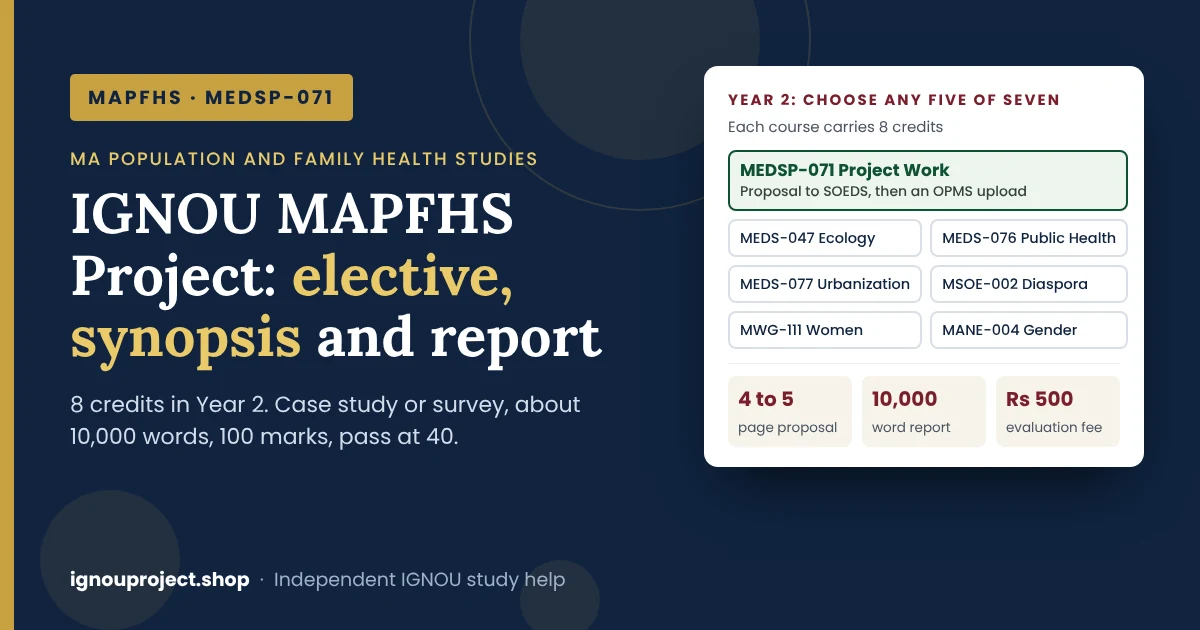
The IGNOU MAPFHS Project is MEDSP-071 Project Work, the 8-credit research course of the MA in Population and Family Health Studies, taken as one of five second-year electives rather than as a compulsory course. Choosing it means an approved proposal, a case study or survey, and a report of about 10,000 words marked out of 100.
In one paragraph
What is the IGNOU MAPFHS Project (MEDSP-071)?
The IGNOU MAPFHS Project is MEDSP-071 Project Work (Population and Family Health Studies), an 8-credit course in the second year of the Master of Arts in Population and Family Health Studies (MAPFHS), offered through open and distance learning by the School of Extension and Development Studies (SOEDS) at Indira Gandhi National Open University. The MAPFHS Programme Guide of January 2024 lists it among seven second-year courses from which a learner chooses five, and states that project work is an elective, not a compulsory course. A learner who elects it studies a population or family health question by the case study or survey method, sends a proposal to SOEDS for approval with a signed proforma and the supervisor’s bio-data, and then submits a report of about 10,000 words. The report is the whole assessment: it carries 100 percent weightage, and 40 percent is needed to pass.
Two documents set the rules. The Programme Guide fixes the credit value, the elective status and the evaluation. The MEDSP-071 Project Work handbook, a 2024 booklet prepared at SOEDS by Prof. B.K. Pattanaik and Dr Sarda Prasad and hosted on eGyanKosh, carries the working MAPFHS project guidelines, from research method to the wording on the envelope. The programme is young: Notification No. 132 of 26 December 2023 launched MAPFHS from the January 2024 session, so very little has been written about this population and family health studies project outside those two papers.
| Programme | Master of Arts (Population and Family Health Studies), MAPFHS; ODL, English medium, 24 to 48 months, annual examinations |
|---|---|
| School | School of Extension and Development Studies (SOEDS), Block 15-F, Maidan Garhi |
| Project course | MEDSP-071 Project Work (Population and Family Health Studies) |
| Credits and year | 8 credits, Year 2 |
| Status | Elective: one of seven Year 2 courses, of which five are chosen |
| Methods taught | Case study method and survey method |
| Proposal | 4 to 5 typed pages, with the Annexure II proforma and a 2-page supervisor bio-data |
| Proposal target dates | 30 April for January admissions, 31 October for July admissions; accepted through the year |
| Report length | About 40 to 50 typed pages at 1.5 spacing, not more than about 10,000 words excluding appendices, 10 percent variation allowed |
| Evaluation | 100 marks; the report carries 100 percent weightage; pass at 40 percent |
| Evaluation fee | Rs 500, the rate for project courses above 4 credits |
| Submission, December 2026 | Online through the Online Project Management System (OPMS); 30 November 2026 reported as the last date |
The elective arithmetic
The Year 2 choice: five electives from seven, and where MEDSP-071 fits
For the IGNOU MAPFHS Project, the arithmetic decides more than the topic does. Year 1 is fixed: MEDS-071 to MEDS-075, five compulsory theory courses of 8 credits each, 40 credits in all. Year 2 offers six theory electives and the project, again 8 credits apiece, and the learner takes any five of the seven to reach the programme total of 80 credits. The project therefore never adds work on top of the degree. It takes the place of one theory course.
The six theory electives are MEDS-047 Ecology, Environment and Urban Development; MEDS-076 Public Health and Nutrition; MEDS-077 Urbanization and Urban Development Challenges; MSOE-002 Diaspora and Transnational Communities; MWG-111 Women in the Economy; and MANE-004 Gender and Society. A learner who elects MEDSP-071 keeps four of these. One practical pairing stands out: MEDS-076 runs closest to the family health themes most projects choose, so a learner who keeps it can draw on its nutrition and mental health blocks while writing.
| Question | Four theory electives plus MEDSP-071 | Five theory electives |
|---|---|---|
| How the fifth course is assessed | One report, 100 percent weightage, pass at 40 percent | Assignment (30 percent) and term-end examination (70 percent), 40 percent needed in each separately |
| First step | Topic, supervisor and an approved proposal | None beyond re-registration |
| Fieldwork | Yes, unless the approved design relies on records | No |
| Contact with the Study Centre | One counselling session is set aside for the project | Up to six counselling sessions per theory course |
| Suits | ASHA and Anganwadi workers, health inspectors, block extension educators, NGO staff: anyone with access to a community or a service | Learners who prefer a fixed syllabus and an examination date |
The Programme Guide’s target group reads like a list of people who already sit beside the data a project needs, and that is the strongest case for the elective: access an outsider would spend weeks arranging.
Choosing what to study
IGNOU MAPFHS project topics drawn from the Year 1 blocks
A sound topic for the IGNOU MAPFHS Project usually starts from a Year 1 block the learner already knows well, because the theory chapter and the review of literature then rest on material already studied. Annexure I of the handbook offers sample topics, and they lean towards development studies at large: one reads “SWOT Analysis of Delhi Metro (Or Any Development Programme / Project)”, and the sample title page in the same booklet uses “Evaluation of National Rural Health Mission”. The list shows the range the School accepts; it is a prompt, not a closed menu.
That sample title needs one update before reuse. The National Rural Health Mission has been a sub-mission of the National Health Mission since 2013, so the same idea now reads better as a study of one NHM component in a named district. The table below maps MAPFHS project topics to the course blocks they draw on.
| Topic family | Course base | Example title | Natural method |
|---|---|---|---|
| Fertility and family planning | MEDS-071 Block 3; MEDS-072 Block 5 | Use of spacing methods among married women in a selected block | Survey |
| Maternal and child health | MEDS-072 Block 5 | Utilisation of antenatal care services in a primary health centre area | Survey |
| Ageing and the elderly | MEDS-073 Block 2 | Awareness and use of old age welfare schemes in an urban ward | Survey |
| Migration and health | MEDS-071 Block 5; MEDS-074 Block 4 | Health care access of seasonal migrant families at a construction site | Survey or case study |
| Water, sanitation and amenities | MEDS-074 Block 5 | Household sanitation practices in a resettlement colony | Survey |
| Nutrition services | MEDS-074 Block 2; MEDS-076 Blocks 4 and 5 | Functioning of an Anganwadi centre: a case study | Case study |
| Programme review | MEDS-075 Block 5 | Implementation of a National Health Mission component in one district | Case study |
Before settling a title, three questions save weeks later. Can the data be collected in the time left before the intended upload window? Will the institution or community concerned allow it, in writing if needed? And is the unit of study small enough to describe properly in about 10,000 words? A title such as “Maternal health in India” fails the last test at once; “Antenatal care in two sub-centres of one block” passes it.
Method first
Case study or survey: deciding the method for MEDSP 71
The MEDSP-071 handbook gives its longest stretch to method. The case study method begins on page 6 and the survey method runs from page 10 up to the proposal section on page 19, so the School clearly expects the proposal to name one of the two and to use it properly. Choosing between them is the first real decision of the IGNOU MAPFHS Project, ahead of the synopsis, because the method decides the sampling, the instrument and most of the methodology chapter.
| Point | Case study method | Survey method |
|---|---|---|
| Unit of study | One institution, programme, village or family group, examined in depth | Many respondents from a defined population |
| Typical MAPFHS use | An Anganwadi centre, a sub-centre, a self-help group, one scheme in one block | Women of reproductive age, elderly residents, migrant households |
| Main instruments | Interviews with staff and users, records, observation | Questionnaire or interview schedule |
| Sampling | Purposive choice of the case, explained | A stated method and size, drawn from a stated frame |
| Analysis | Description, comparison with norms, themes | Tables, percentages and simple statistical tests |
| Common weakness | Drifts into a description with no question | Too few respondents for the claims made |
The MAPFHS project methodology section of the proposal must then name four things: the locale, the sampling, the data collection instruments and the statistical tools. MEDS-075 already covers each of them, in Block 2 on measuring and sampling, Block 3 on data collection and Block 4 on data analysis, so the proposal can cite the course rather than reinvent the vocabulary.
Published figures help set a study area in context. The National Family Health Survey district fact sheets, Census tables and Sample Registration System estimates let a learner compare a block or ward with the state. Whether a project may rest on such secondary data alone is a different question; it is one to settle with the supervisor before the proposal goes in, not after approval.
Before any fieldwork
Writing the MAPFHS project synopsis, with a worked example
On the IGNOU MAPFHS Project the proposal and the synopsis are the same document, and it is short: the handbook asks for one typed copy of 4 to 5 pages. Its headings are fixed in the handbook and appear in this order:
- Title, naming the population and the place.
- Introduction, saying why the issue matters there.
- Objectives, three or four that the data can answer.
- Problem Statement, the gap or question the study takes up.
- Research Methodology, with locale, sampling, data collection instruments and the statistical tools to be used.
A MAPFHS project proposal skeleton, worked through
Title: Utilisation of antenatal care services among women in two sub-centre areas of a selected block. Objectives: to measure the share of women who completed the recommended antenatal visits; to identify the reasons for missed visits; to examine the role of the ASHA worker in follow-up. Problem statement: coverage figures for the district hide wide gaps between villages, and the reasons for those gaps are not recorded locally. Methodology: survey method; locale named; women who delivered in the past year listed from sub-centre registers with permission; interview schedule; percentages and a chi-square test for association.
The example is an illustration, not an approved model. Each objective maps to something the schedule will ask, and the methodology names all four required items. A synopsis built this way is also the plan for the report, because the approved proforma is bound into that report as its second page.
When to send it
The handbook advises learners admitted in the January session to submit the proposal by 30 April, and those admitted in July by 31 October, so that approval, report writing and evaluation fit within the programme. It does not attach a year to those dates. Since MEDSP-071 is a second-year course, many learners treat the second-year date as the working target, but proposals that miss it are still accepted throughout the year. The proforma notes that correspondence on the proposal goes to the address the learner writes on it, so that line deserves care.
The approval paperwork
IGNOU MAPFHS Project approval: supervisor, proforma and envelope
Approval for the IGNOU MAPFHS Project depends as much on the paperwork as on the idea, and the supervisor is the first piece of it. The proforma asks the learner to state whether the supervisor is an academic counsellor, and the supervisor’s bio-data is how SOEDS checks eligibility.
MAPFHS project supervisor categories in the 2024 handbook
- Academic counsellors of the MAPFHS programme at Study Centres, with relevant experience.
- Teachers, researchers, population experts or development professionals in development studies or a related discipline, such as population studies, geography, administration, political science or rural development, among others. A PhD is preferred; an MPhil or master’s degree with five years of experience also qualifies.
- Faculty at the headquarters, in the School of Extension and Development Studies.
The handbook fixes a token honorarium of Rs 500 for the supervisor, payable by the University and open to revision, claimed on the remuneration bill annexed to the booklet. A change of supervisor at any stage means a new proposal on a fresh proforma signed by the new supervisor.
What goes in the envelope
- The Proforma for Approval of Project Proposal (Annexure II), filled in and signed by both the student and the supervisor.
- One typed copy of the proposal, 4 to 5 pages. The learner keeps a second copy.
- The supervisor’s bio-data, about 2 pages.
The handbook asks for “Project Proposal-MEDSP-071” on the top right corner of the envelope, addressed to the Project Coordinator (MAPFHS), School of Extension and Development Studies, Block 15-F (Swami Vivekanand Bhawan), IGNOU, Maidan Garhi, New Delhi 110068.
Read the small print
MAPFHS project rejected? Five document slips and four avoidable gaps
Most setbacks on the IGNOU MAPFHS Project begin with forms copied without checking, because the official documents for this young programme contain slips. A learner who searches “MAPFHS project rejected” after a returned proposal usually finds the cause in one of the items below.
- The proforma header. The Annexure II proforma is titled “Proforma for Approval of Project Proposal (MEDSP-075)”. There is no MEDSP-075 in MAPFHS; MEDS-075 is the Year 1 research methodology course. Write MEDSP-071, the code the same handbook uses on its envelope and remuneration bill.
- The title-page code. The handbook’s report format tells the learner to show “project course code: MDVP-117”, which is the project code of a different SOEDS programme. The title page should read MEDSP-071.
- The course type. The MAPFHS programme page labels MEDSP-071 “Theory (8 Credits)”. The Programme Guide lists it as project work and evaluates it by report alone. The 8 credits agree everywhere; the label does not change the assessment.
- The fee. The Programme Guide and Notification No. 132 give Rs 6,000 a year, Rs 12,000 in all. The current programme page gives Rs 7,000 a year, Rs 14,000 for the full programme, examination fees extra. The current page prevails.
- The duration. The Programme Guide states a maximum of four years in Section 1.7 but refers to five years in its schedule and examination sections. The programme page gives 48 months, which is the figure to plan against.
BK Sahni, who has guided 5,00,000 students till date, puts the proforma code at the top of the checklist: a form typed straight from the booklet carries MEDSP-075 into the School and invites a query that has nothing to do with the research. The same care applies to one elective code, printed as MGW-111 in the Programme Guide, MWG-111 on the programme page and MWG-011 on eGyanKosh.
The four avoidable gaps are simpler. A supervisor holding a master’s degree without five years of experience falls outside the handbook’s categories. A methodology paragraph that skips the locale, the sampling, the instrument or the tools leaves the evaluator guessing. A topic too wide for the data invites a non-approval. And a report whose title or design has drifted from the approved proposal sits badly next to the approved proforma bound inside it.
The report
MAPFHS project report format, word limit and marks
The IGNOU MAPFHS Project report runs to about 40 to 50 typed pages at 1.5 line spacing, and the handbook caps it at approximately 10,000 words, excluding appendices and exhibits, with 10 percent variation permitted either way. In practice the MAPFHS project word limit is therefore about 9,000 to 11,000 words. The handbook sets this order:
- Title page with the course code MEDSP-071, the title, the student’s name, enrolment number and address, the School and the year.
- The approved Project Proposal Proforma, as the second page.
- The certificate of originality, signed by the student and the supervisor (Annexure III).
- Introduction, with the objectives and the problem statement.
- Review of the literature.
- Research methodology: locale, sampling, data collection instruments and statistical tools used.
- Analysis of the data, followed by the conclusion.
- Appendices and exhibits, which sit outside the word count.
The handbook names Introduction, Review of the Literature, Methodology and Conclusion; the analysis of the data sits between the last two, under the label used in the booklet on eGyanKosh. The report is hard bound, in original, on A-4 paper, and it is not returned, so a personal copy matters.
The total is 100 marks, and 40 percent completes the course. Under the Programme Guide’s grading, 80 percent and above is an A, 60 to 79.9 percent a B, 50 to 59.9 percent a C and 40 to 49.9 percent a D.
Getting it evaluated
From hard copy to OPMS: how the IGNOU MAPFHS Project is submitted now
Submission of the IGNOU MAPFHS Project is where the 2024 handbook and current practice part ways. The handbook describes one typed, hard-bound copy sent with a cover letter, with “PROJECT REPORT- MEDSP-071” written on top of the envelope. Current practice is an online upload, and that is the route to follow.
For the December 2026 term-end examination, IGNOU Regional Centres carried a notification dated 19 October 2026 on online submission of projects and dissertations through the Online Project Management System (OPMS). Coverage of that notification reports access through the learner’s Samarth account, the whole report scanned into a single PDF for each course, a copy of the fee receipt attached, and 30 November 2026 as the last date. OPMS project submission is new this session, so the notice itself should be read first. The MAPFHS project last date for any later session is the one in that session’s notice, never a date printed in the booklet.
| Item | Source |
|---|---|
| The complete report as one PDF, approved proforma on page two | Learner, from the approved proposal |
| Signed certificate of originality | Student and supervisor (Annexure III) |
| Project evaluation fee of Rs 500 and its receipt | Paid through the Samarth portal in the notified window |
| Upload window and last date | The current session’s notification |
The MAPFHS project evaluation fee is Rs 500, the rate the Common Prospectus sets for project work above 4 credits. The coverage of the December 2026 notice says a report submitted without the project fee is not considered for evaluation, so the fee is a submission step in its own right.
Quick answers
Quick answers on MEDSP 071
Are MEDSP 071, MEDSP 71 and MEDSP-071 the same course?
Yes. MEDSP-071 is the official code, and learners also search for it as MEDSP 071, MEDSP 71, MEDSP-71 and MEDSP71. On every form and on the title page, write MEDSP-071.
Is the IGNOU MAPFHS Project compulsory?
No. Section 3.7 of the Programme Guide says the IGNOU MAPFHS Project is offered as an elective, not a compulsory course. A learner may count it as one of the five Year 2 electives or take five theory courses instead.
Is there a PGDPFHS project as well?
The eGyanKosh listing for the PG Diploma in Population and Family Health Studies carries the five courses MEDS-071 to MEDS-075 and a programme guide, with no project collection. MEDSP-071 sits in the MAPFHS second-year listing. A diploma learner moving to the MA confirms the position with the Regional Centre.
Is there a MAPFHS project viva?
The Programme Guide describes evaluation of the project report alone, at 100 percent weightage, and does not describe a MAPFHS project viva. A learner who receives a notice calling for one follows the notice.
Is there an official MAPFHS project sample?
No complete MAPFHS project sample report is published. The handbook does include a sample title page, the Annexure I sample topics, the proforma and the originality certificate, and the booklet itself can be downloaded free from eGyanKosh.
Can the supervisor be changed after approval?
Yes, but the handbook treats it as a new proposal: a fresh proforma signed by the new supervisor, sent with that supervisor’s bio-data.
Check before acting: the IGNOU MAPFHS Project rules on this page come from the MAPFHS programme page on ignou.ac.in, the January 2024 Programme Guide and the handbook in the MEDSP-071 Project Work collection on eGyanKosh. Submission windows, the OPMS route and fee dates change by session, and the latest notification always prevails.
The same proposal-to-report sequence is explained for other programmes in the IGNOU project hub on this site, and the closest sibling course, from the same School, is covered in the MA Urban Studies project guide. For learners stuck between topic and approval, ignouproject.shop offers independent help with framing a feasible population or family health question and a clear methodology before the proforma goes to SOEDS.
Independent study-help disclosure: ignouproject.shop is run by Shri Chakradhar Publication Pvt. Ltd. and is not the official website of IGNOU or SOEDS. This article summarises published university documents for guidance only; official notifications on ignou.ac.in prevail over anything written here.

BK Sahni iD 0009-0005-8092-459X
Founder, Shri Chakradhar Publication Pvt. Ltd. & its IGNOU Project study-help brand, helping IGNOU distance-learning students since 2010 and having guided 5,00,000 students till date across MBA, MCom, MA & more. Author of IGNOU exam guides, solved assignments & project reference books.
Disclosure: Shri Chakradhar Publication Pvt. Ltd. and ignouproject.shop are independent third-party study-help services, not the official IGNOU website. Always verify final dates and rules on ignou.ac.in.
Leave a Reply