

Written by: Editorial Team, Shri Chakradhar Publication — Academic Content Editor (specialising in IGNOU project guidance since 2018).
Reviewed by: Senior Academic Reviewer — postgraduate in Management with hands-on experience guiding MMPP-001, BMPP-001 and MCOP-001 student projects.
Last Updated: May 2026
Editorial Policy: Content is reviewed against official IGNOU guidelines, programme guides on eGyanKosh, and current Student Evaluation Division notices. We do not promise approval or guaranteed marks.
If you have been searching for clear answers on the IGNOU Project — synopsis format, report structure, course code, submission link, evaluation fee, or last date — this guide brings every requirement into one place, course by course. Whether you are an MBA student facing MMPP-001, a BBA student handling BMPP-001, an M.Com student working on MCOP-001, or preparing an MAEDU, MARD, MLIS, MAPC or MSCENV project, you will find the exact format, document checklist, and submission steps drawn from IGNOU’s official 2026 guidelines.
Below, you will get the synopsis structure, project report format, course-wise project codes, online submission process, project evaluation fee, viva rules, and the most common reasons projects get rejected — all explained without jargon.
| ✅ Updated for 2026 | 📘 Based on official IGNOU project instructions | 🎓 Course-wise help available |
Quick Answer — What is an IGNOU Project?
| An IGNOU Project is a research-based or practical academic submission required in selected IGNOU programmes such as MBA (MMPP-001), BBA (BMPP-001), M.Com (MCOP-001), MAEDU, MARD, MLIS, MAPC, MSCENV and others. Students select a topic, prepare a synopsis or proposal, get supervisor approval where applicable, write the final project report following IGNOU’s prescribed format, and submit it online or as instructed by the Regional Centre or Student Evaluation Division. |
Quick Help Options:
- 📥 Download IGNOU Project Format PDF — front page, certificate, declaration templates → IGNOU Project Format PDF download
- 💬 Get IGNOU Project Help on WhatsApp — course-wise synopsis & report support → WhatsApp Contact
- 📥 IGNOU Sample Synopsis PDF → IGNOU Project Synopsis Sample
- ✏️ Request Project Report Formatting Support → Project Formatting Help
What is an IGNOU Project?
| Definition: An IGNOU Project is a research-based or practical academic submission required in selected IGNOU programmes. It may also be called a dissertation, internship report, practicum file, or field work journal depending on the course. Students prepare a synopsis, obtain supervisor approval where required, write the project report following IGNOU’s prescribed format, and submit it online or as per programme guidelines. |
An IGNOU Project trains you to identify a real problem, gather evidence, analyse it, and present defensible conclusions — the same skills employers and PhD supervisors look for. It is not a copy-paste exercise; it is the practical capstone of your distance learning programme.
Depending on the course, the project may take the form of a management problem analysis (MBA, BBA, M.Com), an educational research dissertation (MAEDU), a rural development field study (MARD, PGDRD), a library science investigation (MLIS), a media or journalism study (MAJMC), an environmental science project (MSCENV), a nutrition or food science study (MSCDFSM, DNHE), or a tourism research project (MTTM, BATS), among others.
One important point: do not follow a generic format blindly. Always cross-check the project guidelines for your specific programme and course code. Programme-specific instructions issued by IGNOU’s School of Studies and the Student Evaluation Division always prevail over general advice from any third-party guide, including this one.
Who Needs to Submit an IGNOU Project?
Not every IGNOU learner has a project component. Project work, dissertation, practicum, internship, or field journal submission is required only in selected programmes. The table below maps the most common project-based programmes to their project codes.
| Programme / Course Area | Project Code / Component | Student Action |
| MBA / MBAFM / MBAHM / MBAMM / MBAOM / MBF | MMPP-001 (8 credits) | Prepare synopsis → get approval → write report |
| BBA | BMPP-001 (8 credits, Sem V) | Synopsis approval mandatory before project work |
| M.Com / M.Com Online | MCOP-001 | Follow M.Com project guidelines from the School of Management Studies |
| MLIS | Project / dissertation component | Verify project code from latest MLIS programme guide |
| MAPC | Practicum / project components | Confirm with study centre & regional centre |
| DNHE | Project / practical component | Follow programme-specific instructions |
| MAJMC | Project / dissertation work | Refer to latest MAJMC programme guide |
| MSCENV | Project / dissertation work | Verify course code before preparing |
| MSCDFSM | Project / practical / internship | Follow School of Continuing Education guidelines |
| MAAN | Dissertation / project component | Field-orientation strongly recommended |
| MAER | Project / dissertation component | Verify latest instructions |
| MAEDU | Dissertation / project-related work | Follow School of Education guide |
| MARD | Project / dissertation component | Choose rural-development relevant topic |
| PGDRD | Project work | Follow Regional Centre instructions |
| MTTM | Project / internship component | Verify course requirements |
| BATS | Project / practical component | Check programme guide |
| MSCGG | Practical / project component | Confirm with official source |
| MSCZOO | Practical / project component | Verify course-wise requirements |
Sources: IGNOU MBA MMPP-001 programme guide; BBA BMPP-001 project guide; eGyanKosh M.Com (MCOP-001) project booklet. Refer to eGyanKosh to download project programme guidelines.
Customized Solutions: IGNOU MBA Project MMPP-001 | IGNOU MCom Project MCOP-001 | IGNOU BBA Project BMPP-001 | IGNOU MAEDU Project | IGNOU MLIS Project
IGNOU Project Process: 8-Step Roadmap

The IGNOU Project process becomes far easier when you follow it in the correct order. The most common mistake is starting the final report before checking whether synopsis approval is required for your course.
Step 1 — Confirm Your IGNOU Project Course Code
Start by confirming the exact project course code printed in your programme guide. MBA students usually work with MMPP-001, BBA students with BMPP-001, and M.Com students with MCOP-001. Other programmes have different codes. Verify against four sources before proceeding:
- Your programme guide (provided at admission)
- The project manual or project guide booklet
- Regional Centre updates for the current session
- Official IGNOU website and Student Evaluation Division notices
Step 2 — Select a Relevant, Researchable Topic
A good IGNOU project topic should be specific, researchable, and clearly connected to your programme. Avoid topics that are too broad, too theoretical, or impossible to complete within the available time.
Weak topic: “A Study on Digital Marketing.”
Strong topic: “A Study on the Impact of Influencer Marketing on Customer Purchase Decisions for Online Book Retailing in Tier-2 Indian Cities.” This version is specific, has identifiable respondents, and allows survey-based data collection.
Step 3 — Prepare the IGNOU Project Synopsis / Proposal
The synopsis is a short academic proposal that explains what you intend to study. It typically covers the title, introduction, rationale, objectives, methodology, sample size, tools of analysis, expected outcome, bibliography, and guide details. A clear synopsis makes approval faster.
Step 4 — Get IGNOU Project Approval from Guide / Supervisor
Most IGNOU project courses require synopsis approval before the final report can begin. For MMPP-001, the official MBA project guideline states that synopsis approval is necessary before actual project work is taken up. Choose a guide who meets the eligibility conditions in your programme guide and is familiar with your subject area. Refer MMPP-001 programme guide on eGyanKosh
Step 5 — Write the Final IGNOU Project Report
Once approved, write the final project report in line with your approved synopsis. The report must not drift away from the approved topic and objectives. A good report includes the introduction, review of literature, research methodology, data analysis, findings, conclusion, suggestions, references, and appendices.
Step 6 — Check Plagiarism, Originality & Formatting
Your project report must be original. Copying old reports, internet content, or another student’s work is treated seriously. The MMPP-001 guideline states action will be taken as per university policy if a project is found plagiarised. Read the UGC Plagiarism Regulations 2018 for details.
Before final submission, run a checklist on originality, grammar, formatting consistency, page numbers, table of contents, certificate, declaration, references, and annexures.
Step 7 — Submit Your IGNOU Project Report
Submission mode varies by programme and session. Some programmes use the online project upload portal; some online-mode programmes use the LMS; ODL programmes may still involve hard copy submission to the Student Evaluation Division. The scanned PDF should be a single clear file for one subject or course, properly sequenced. Refer to the official IGNOU project submission portal.
Step 8 — Track IGNOU Project Status & Attend Viva (if applicable)
After submission, track your IGNOU project status through the official process. Viva-voce is conducted in some cases under guidelines issued by the concerned faculties through the Regional Centre. Keep your guide bio-data and approved synopsis handy in case the viva panel asks.
| 💬 Need help with your IGNOU Project? Talk to our academic support team for topic selection, synopsis drafting, report formatting, and submission guidance. Contact us on WhatsApp. |
IGNOU Project Synopsis Format
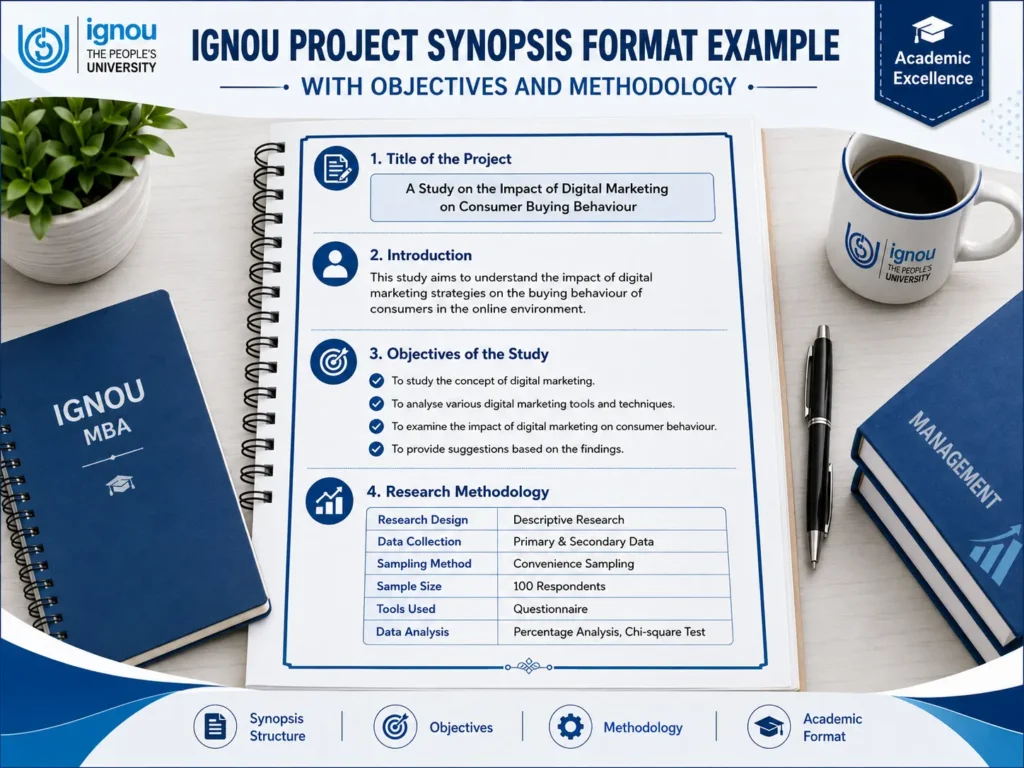
The IGNOU project synopsis is the blueprint of your final report. A weak synopsis usually leads to delay, revision, or rejection. A strong synopsis is short, focused, and academically clear — typically 8 to 15 pages depending on the course.
Title of the Project
The title should clearly indicate the subject, scope, and purpose. A good title is specific, researchable, connected to the programme, and not too long. Example: “A Study on Customer Satisfaction Towards Online Book Purchasing Among Distance Learning Students.”
Introduction / Background
Briefly introduce the topic and explain its relevance. For a project on online education, this section may summarise the growth of digital learning, learner behaviour shifts, and why understanding satisfaction matters now.
Rationale of the Study
The rationale answers four questions: Why is this topic important? What problem does it address? How is it connected to your programme? What academic or practical value does it offer?
Objectives of the Study
Objectives must be clear, specific, and measurable. Avoid vague objectives that cannot be tested. Three to five objectives is the typical range.
- To study the factors affecting customer satisfaction with online book retailers.
- To analyse student awareness of IGNOU’s online academic support services.
- To examine the relationship between service quality and repeat-purchase behaviour.
- To identify major challenges faced by IGNOU students during project preparation.
Research Methodology
Explain how the study will be conducted: research design, data source, sample size, sampling method, tools of data collection, and analytical techniques. Keep methodology realistic — an overly complex design rarely gets completed in time.
Sample Size & Data Collection
Specify whether you will use primary data, secondary data, or both. Primary data may include questionnaires, structured interviews, surveys, or observation. Secondary data may include books, peer-reviewed journals, government reports, official websites, and published research.
Tools & Techniques of Analysis
Mention the analytical tools you will use — percentage analysis, averages, charts, tables, correlation, regression, chi-square, or comparative analysis — depending on programme requirements and your statistical comfort.
Expected Outcome
Describe what the study is likely to reveal. Do not claim findings before research is completed; instead, frame this as the anticipated contribution.
Bibliography
List the books, journals, official IGNOU sources, government publications, and websites you plan to consult. Use a consistent citation style (APA is widely accepted).
Guide / Supervisor Details
Attach guide details in the prescribed format. Most programmes require a guide bio-data. IGNOU’s online upload instructions list approved proposal proforma, synopsis, guide bio-data, and originality certificate as required documents wherever applicable.
| 💬 Want a properly structured IGNOU Project Synopsis? Request IGNOU Project Synopsis Help on WhatsApp. Message Synopsis Help. |
IGNOU Project Report Format
The IGNOU project report format may vary by programme, but most academic project reports follow a similar structure. Always check your course-specific project manual before final submission.
IGNOU Project Front Page (Cover Page) Format
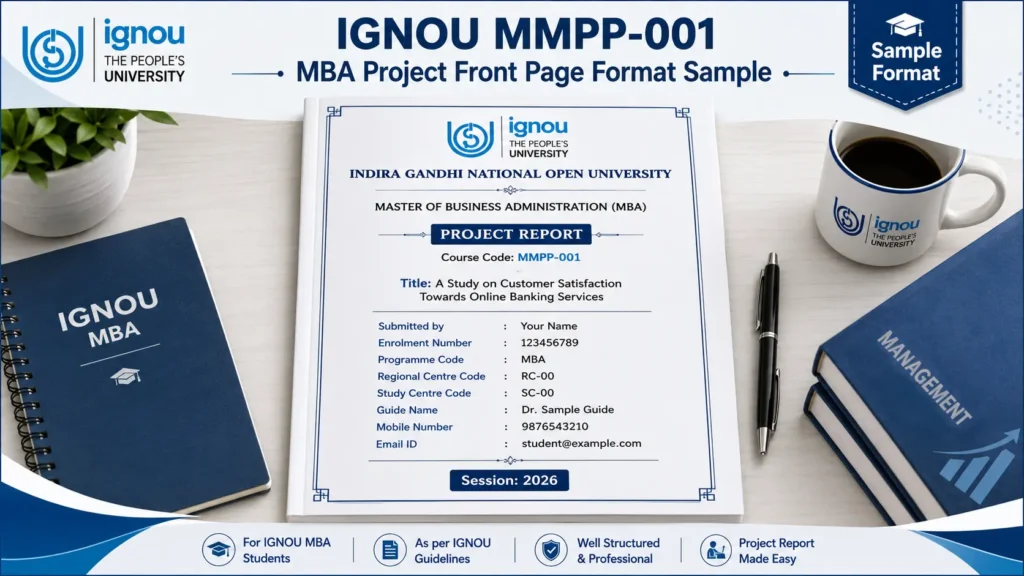
The front page is the first impression for the evaluator. IGNOU’s online upload instructions specify that the first page of the PDF must carry: project title, learner name, programme code, enrolment number, regional centre code, course code, mobile number, and email ID.
- Title of the project report
- Name of student
- Enrolment number (not registration number)
- Programme code
- Course code (MMPP-001 / BMPP-001 / MCOP-001 / etc.)
- Regional centre code
- Study centre code (if required)
- Guide name
- Session / year
- Mobile number and email ID
IGNOU Project Certificate
The certificate confirms that the project has been completed under guidance and submitted as part of programme requirements. It is typically signed by the guide.
Acknowledgement
Thank your guide, faculty, institution, respondents, and others who helped. Keep this section brief and sincere — half a page is enough.
Declaration / Originality Certificate (Plagiarism)
Confirms that the project is original and has not been copied or submitted earlier for another course. Originality matters because plagiarism may lead to rejection or disciplinary action. Sign and date this page.
Table of Contents
List chapter titles, subheadings, and page numbers. A well-laid table of contents helps the evaluator navigate the report quickly.
Introduction
Explain the background, topic relevance, problem statement, scope, and importance of the study.
Review of Literature
Summarise previous studies, articles, books, and reports related to your topic. This shows you understand the existing research landscape and where your work fits.
Objectives (Final)
Match the objectives in the approved synopsis. Do not introduce unrelated new objectives in the final report.
Research Methodology (Final)
Explain research design, data collection, sample size, sampling technique, tools used, and limitations of the study.
Data Analysis
The analytical heart of the report. Use tables, charts, and graphs supported by clear interpretation. Never paste data without explanation.
Findings
Findings should flow directly from the data analysis and connect to each objective.
Conclusion
Summarise the overall result. Do not introduce a new topic in the conclusion.
Suggestions
Practical recommendations linked to your findings. If your study shows low student awareness of a service, suggest specific communication channels — SMS, email, regional centre notices — to improve it.
References / Bibliography
List all sources cited in the report. Use one consistent citation style throughout.
Appendix
Attach questionnaires, raw data, interview schedules, additional tables, consent forms, and supporting material.
For MBA MMPP-001, the IGNOU guideline specifies the project report should be approximately 50 to 60 double-spaced typed pages, not exceeding approximately 18,000 words, excluding appendices and exhibits, with rational variation permitted.
| ✏️ Need IGNOU project report formatting help? Get your front page, certificate, declaration, table of contents, and references arranged in the prescribed format. Message Formatting Help. |
Synopsis vs Project Report — Quick Comparison
Students often confuse the synopsis and the project report. They serve different purposes and are submitted at different stages.
| Aspect | IGNOU Project Synopsis | IGNOU Project Report |
| Stage | Prepared before project work begins | Prepared after research is complete |
| Length | Usually 8 – 15 pages | Usually 50 – 80 pages (course-dependent) |
| Purpose | Proposal — what you plan to study | Final document — what you found and concluded |
| Approval | Requires guide/supervisor approval before report writing | Submitted for evaluation; viva may follow |
| Key sections | Title, rationale, objectives, methodology, expected outcome | Introduction, literature review, methodology, data analysis, findings, conclusion, suggestions |
| Data included? | No actual data — only research plan | Yes — full primary/secondary data with analysis |
| Submitted to | Guide / coordinator for approval | Student Evaluation Division / Regional Centre / online portal |
Documents Required for IGNOU Project Submission
Missing documents is one of the top three reasons IGNOU project submissions face problems. Keep the following ready before you upload or post your project.
IGNOU Project Submission Checklist
- Approved project proposal proforma
- Approved synopsis
- Bio-data of guide (wherever applicable)
- Originality certificate / plagiarism declaration
- Final project report (single PDF, clearly scanned)
- Fee receipt (wherever applicable)
- Correct front page details
- Correct enrolment number, programme code, course code
- Properly sequenced pages with student and guide signatures
IGNOU’s online project upload instructions confirm that learners should incorporate the approved proposal proforma, synopsis, guide bio-data, and originality certificate wherever applicable.
IGNOU Project Submission Guidelines
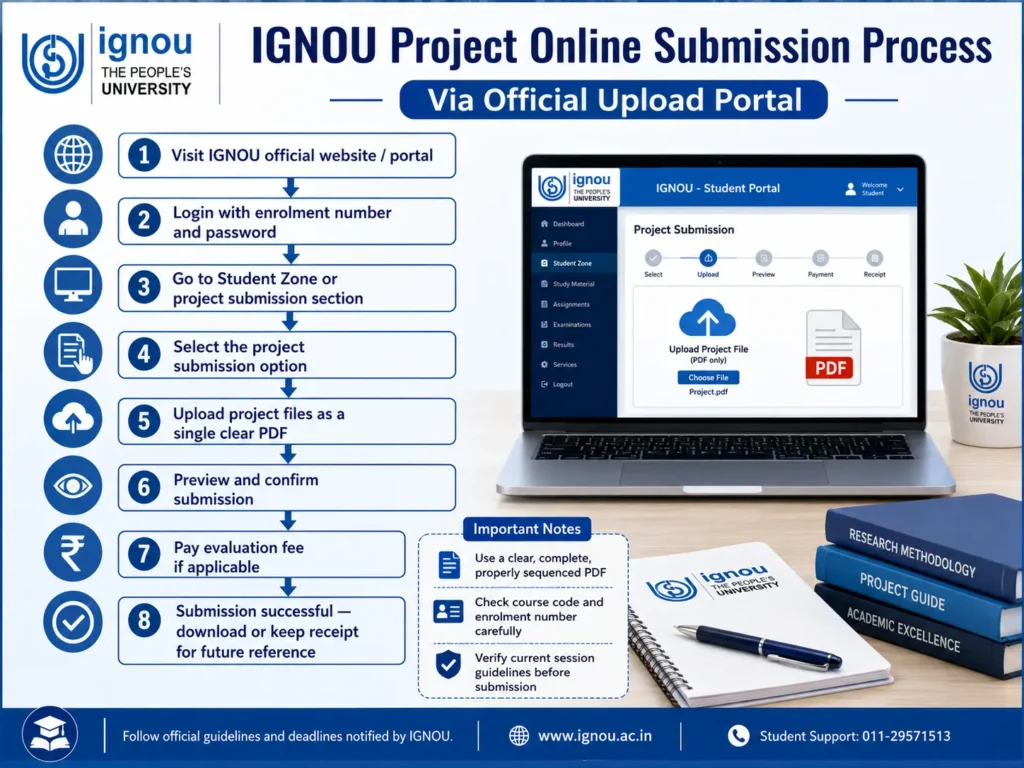
IGNOU project submission depends on programme type, mode of study, session, and course-specific instructions. Do not rely only on old screenshots, WhatsApp forwards, or unofficial blog posts — always cross-verify with the official portal or your Regional Centre.
Online Submission via IGNOU Project Upload Portal
If online submission is allowed for your session, upload your project in the prescribed manner. The project should usually be scanned as a single clear PDF. The file must not be:
- Blurred or low-resolution
- Incomplete or missing pages
- Wrongly sequenced
- Password protected
- Tagged with the wrong course code
- Missing approval documents
- Uploaded without the required fee receipt
Hard Copy Submission (Where Applicable)
Some programme guidelines — including MBA and BBA PDFs — mention submission to the Registrar, Student Evaluation Division, IGNOU, Maidan Garhi, New Delhi, for ODL students. Always verify the latest submission mode from the official website, your Regional Centre, and the current session notice before sending or uploading the report.
IGNOU Project Evaluation Fee
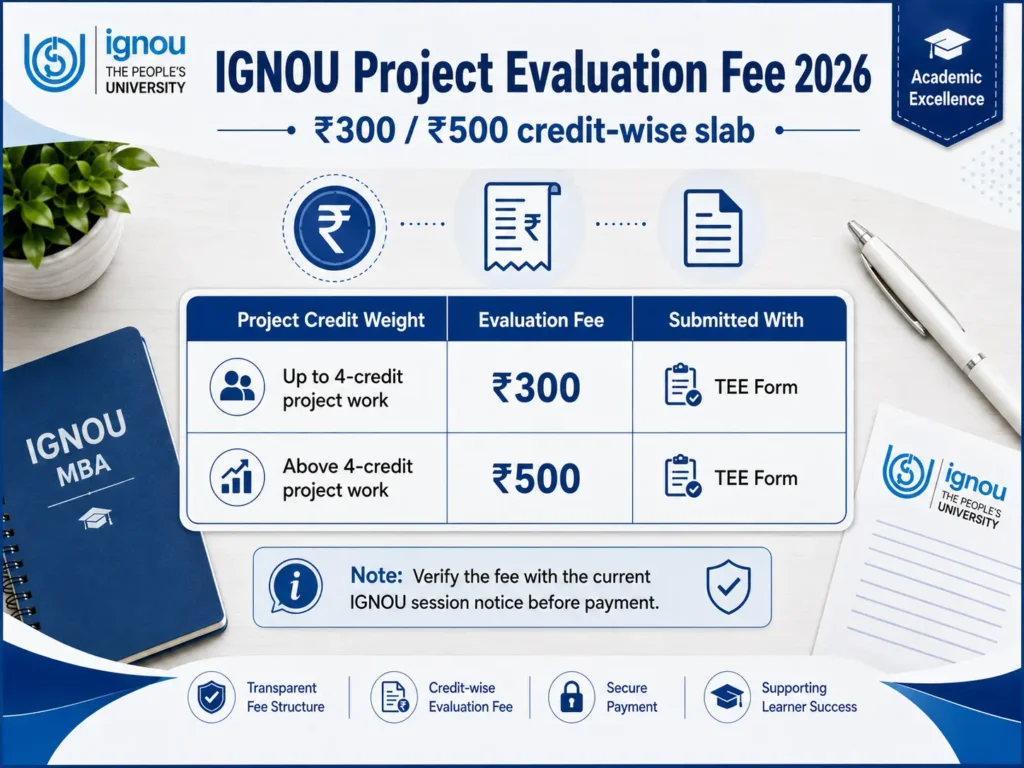
IGNOU’s online project upload instructions specify the project evaluation fee structure effective from the January 2023 admission cycle:
| Project Credit Weight | Evaluation Fee | Submitted With |
| Up to 4-credit project work | ₹300 | Term End Examination (TEE) form |
| Above 4-credit project work | ₹500 | Term End Examination (TEE) form |
Note: Verify the fee with the current IGNOU session notice before payment. Refer to the official IGNOU TEE form portal.
Common IGNOU Project Submission Mistakes
- Uploading an incomplete PDF
- Missing originality certificate
- Using the wrong enrolment number
- Entering registration number instead of enrolment number
- Uploading another student’s project
- Not attaching the approved synopsis
- Forgetting guide signature
- Submitting after the last date
- Using the wrong programme or course code
- Ignoring Regional Centre-specific instructions
| 📋 Before submitting, request a free IGNOU project submission checklist review from our academic team — avoid missing documents and last-minute errors. Message Submission Review. |
IGNOU Project Topics: How to Choose the Right Topic
Choosing the right IGNOU project topic is the foundation of a strong project. A good topic is useful, manageable, and clearly connected to your course.
Choose a Topic Related to Your Programme
A management student should pick a topic in business, finance, marketing, HR, operations, banking, consumer behaviour, or organisational study. A rural development student should pick rural livelihood, government schemes, community development, or local governance. A library science student should pick library services, digital resources, user behaviour, or information management.
Keep the Topic Researchable
A topic should allow real data collection. If you cannot reach respondents or access secondary data, the final report will weaken. Good topics typically have clear respondents, available data, measurable objectives, practical relevance, and a clean fit with the course.
Avoid Topics That Are Too Broad
Broad topics create confusion and dilute analysis. For example, “A Study on Banking” is too wide. “A Study on Customer Satisfaction with Mobile Banking Services Among Working Professionals in Delhi” is researchable, has a target sample, and produces a focused report.
Pick a Topic with Available Data
Before finalising, ask: Can I collect data from respondents? Is secondary data accessible? Can the study realistically be completed within the available time? Is the topic suitable for the programme? Will my guide approve it?
Choose a Topic Your Guide Can Approve
A guide may ask for topic modification if it is vague, too broad, unrelated to the course, or difficult to research. Discuss the topic with your guide before finalising the synopsis — it saves weeks of rework.
| 💡 Need topic ideas? Get a course-wise IGNOU project topic list for MBA, M.Com, BBA, MLIS, MAPC, DNHE, MAJMC, MSCENV, MSCDFSM, MAAN, MAER, MAEDU, MARD, PGDRD, MTTM, BATS, MSCGG and MSCZOO. Course-wise Topic List. |
Course-Wise IGNOU Project Guidance
Different IGNOU programmes need different project approaches. Using the same template across courses is a common cause of revisions and rejections. Below is a course-wise overview with suggested focus areas.
IGNOU MBA Project — MMPP-001
MBA students should prepare the project in their chosen area of specialisation wherever possible. The project may take the form of a case study, inter-organisational study, field study, or management problem analysis. The MMPP-001 guideline frames the course as a practical application of multidisciplinary management concepts, tools, and techniques to solve organisational problems. Common topic areas include marketing strategy, financial performance, HR practices, supply chain efficiency, customer experience, digital transformation, and operations improvement. [INTERNAL LINK: IGNOU MBA Project MMPP-001]
IGNOU M.Com Project — MCOP-001
M.Com and M.Com Online students should follow MCOP-001 guidelines and prepare a commerce-focused research project. Suitable areas include accounting practices, taxation, financial management, investment behaviour, corporate governance, consumer behaviour, digital payments, business management, financial decision-making, and audit practices. [INTERNAL LINK: IGNOU M.Com Project MCOP-001]
IGNOU BBA Project — BMPP-001
BBA students should select topics in commerce and business — marketing, finance, human resources, international business, accounting, taxation, e-commerce, or emerging business areas. The BBA project guideline confirms that synopsis approval is necessary before project work begins, and the course carries 8 credits in Semester V. [INTERNAL LINK: IGNOU BBA Project BMPP-001]
IGNOU MLIS Project
MLIS students should focus on library science, digital libraries, user studies, information behaviour, cataloguing systems, e-resources, library service quality, knowledge management, or library automation. Verify the exact project code and format from the latest MLIS programme guide because it has been revised in recent cycles.
IGNOU MAPC Project
MAPC (Master of Arts in Psychology) involves practical, internship, and project-related components depending on your course structure. Possible focus areas include applied psychology, counselling case studies, organisational psychology, clinical case analysis, educational psychology, and community mental health. Check the latest guidelines from your study centre and Regional Centre, as practicum requirements vary by region.
IGNOU DNHE Project
DNHE (Diploma in Nutrition and Health Education) students should select topics related to nutrition awareness, health education, community awareness, dietary practices, women and child health, public health communication, or anaemia and malnutrition prevention, where applicable.
IGNOU MAJMC Project
MAJMC students can pick media-related topics: digital journalism, news consumption patterns, media ethics, advertising effectiveness, public relations campaigns, social media behaviour, communication strategy, regional media, or community radio. All topics must be supported by data — interviews, content analysis, or surveys.
IGNOU MSCENV Project
MSCENV (Environmental Science) project topics may cover pollution monitoring, sustainability, climate awareness, biodiversity, waste management, environmental education, water quality, urban green spaces, or environmental policy implementation. Ensure data collection is practical for your geography.
IGNOU MSCDFSM Project
MSCDFSM students should select topics in food service management, dietetics, food safety, community nutrition, hotel food operations, hospital diet planning, or institutional food practices, depending on programme requirements.
IGNOU MAAN Project
MAAN (Master of Arts in Anthropology) students should select anthropology-relevant topics with field orientation, ethical data collection, and academic rigour. Tribal communities, urban ethnography, kinship studies, and applied anthropology are typical areas.
IGNOU MAER Project
MAER students should verify the latest programme guide and select a topic aligned with their subject area and an approved methodology — qualitative, quantitative, or mixed methods.
IGNOU MAEDU Project
MAEDU (Master of Arts in Education) students typically work on educational research: teaching methods, distance education models, learner support, digital learning adoption, curriculum design, evaluation systems, or educational administration. Action research is also accepted in many cases.
IGNOU MARD Project
MARD (Master of Arts in Rural Development) students should focus on rural livelihood, self-help groups, local governance (Panchayati Raj), rural education, agriculture, MGNREGA implementation, women empowerment, or community development. Field-based data significantly strengthens the report.
IGNOU PGDRD Project
PGDRD (Post Graduate Diploma in Rural Development) students should choose practical rural development topics with local data and policy relevance — typically connected to current development schemes.
IGNOU MTTM Project
MTTM (Master of Tourism and Travel Management) students may pick destination management, tourist satisfaction, hospitality services, eco-tourism, heritage tourism, sustainable tourism, or travel behaviour during post-pandemic recovery.
IGNOU BATS Project
BATS (Bachelor of Tourism Studies) students should check their programme guide and pick tourism or travel-related topics that match the project’s scope and credit weight.
IGNOU MSCGG Project
MSCGG (Geoinformatics) students should select topics related to GIS applications, remote sensing, mapping, spatial analysis, urban planning, or natural-resource management.
IGNOU MSCZOO Project
MSCZOO students should pick topics in zoology, ecology, biodiversity, environmental biology, animal behaviour, or laboratory/field-based studies, as per programme requirements and available facilities.
Common Reasons IGNOU Projects Get Rejected
Most project problems happen because students miss simple instructions. A project may face delay, modification, non-approval, or rejection due to avoidable mistakes.
Top reasons IGNOU projects are rejected or returned:
- Wrong project format used for the course
- Missing synopsis approval (where required)
- Incomplete documents (no guide bio-data, no originality certificate)
- Blurred or low-quality scanned PDF
- Wrong enrolment number (or registration number used by mistake)
- Wrong course code on front page
- Plagiarism — copied content from internet, books, or another student
- Late submission after the announced deadline
- Mismatch between approved synopsis and final report
- Missing TEE fee receipt where applicable
- Not following programme-specific guidelines (using a generic template)
For BBA, the official guideline reiterates that synopsis approval is necessary before project work begins. IGNOU’s online upload instructions also warn that if the project report is not found in order as per project guidelines, it will not be considered, and the learner is responsible for the lapse. Refer to the official BBA BMPP-001 guideline PDF.
IGNOU Project Help: When Should Students Take Expert Guidance?
You can prepare your project independently if you are comfortable with research design, formatting, and submission rules. Many IGNOU learners, however, are working professionals, first-time researchers, or balancing multiple courses — and need structured academic support.
| What we see at our project help desk Across the January–February and June–July submission cycles, the three issues we help most often are: (1) synopsis topics being too broad and getting returned for revision, (2) front-page details mismatched with the IGNOU online portal requirements, and (3) MMPP-001 reports being over the 18,000-word ceiling because students treat the literature review like a textbook chapter. Recognising these patterns early saves you 4–6 weeks of rework. |
Expert guidance may help with:
- Selecting a focused, researchable topic
- Drafting an approval-ready synopsis
- Framing precise research objectives
- Choosing realistic methodology
- Designing a clean questionnaire
- Arranging chapters logically
- Formatting the final report per IGNOU’s prescribed style
- Grammar and clarity editing
- Reducing plagiarism risk through proper paraphrasing and citation
- Preparing front page, certificate, and declaration
- Reviewing submission documents before upload
- Understanding course-wise requirements (MMPP-001, BMPP-001, MCOP-001, and more)
Ethical academic support guides you — it does not provide copied reports, fabricated data, false approval claims, or guaranteed marks.
| 💬 Need help preparing your IGNOU Project? Contact the academic support team on WhatsApp for course-wise guidance. WhatsApp Project Help |
IGNOU Project FAQs
1. What is an IGNOU Project?
An IGNOU Project is a research-based, practical, field-based, or academic report required in selected IGNOU programmes such as MBA (MMPP-001), BBA (BMPP-001), and M.Com (MCOP-001). Students usually prepare a synopsis, obtain approval where required, write the final report, and submit it as per official guidelines.
2. Is synopsis approval required for every IGNOU project?
Synopsis approval is required in many project-based courses, but requirements differ by programme. For MMPP-001 and BMPP-001, official guidelines clearly state that synopsis approval is necessary before project work. Always check your programme guide for the exact rule.
3. How do I choose an IGNOU project topic?
Choose a topic relevant to your programme, keep it specific and researchable, ensure data is available, and discuss it with your guide before finalising the synopsis. Avoid broad themes like “a study on banking” — narrow it to a measurable focus area.
4. What is the format of an IGNOU project synopsis?
A synopsis usually includes: title, introduction, rationale, objectives, methodology, sample size, data collection method, tools of analysis, expected outcome, bibliography, and guide details. Typical length is 8 – 15 pages.
5. What is the format of an IGNOU project report?
A project report generally includes: front page (cover), certificate, acknowledgement, declaration / originality certificate, table of contents, introduction, review of literature, methodology, data analysis, findings, conclusion, suggestions, references, and appendix.
6. How many pages should an IGNOU project report be?
The length depends on your programme. For MMPP-001, IGNOU specifies approximately 50 – 60 double-spaced typed pages, not exceeding approximately 18,000 words, excluding appendices and exhibits. BBA BMPP-001 and other programmes have separate page guidelines — always check your project guide.
7. Where do I submit my IGNOU project? (IGNOU project submission link)
Submission mode depends on the programme and current session instructions. Students may submit through the IGNOU project upload portal, the LMS for online programmes, the Regional Centre, or the Student Evaluation Division, as per the latest session notice.
8. What documents are required for IGNOU project submission?
Common documents include: approved synopsis, approved proposal proforma, guide bio-data, originality certificate, final project report (single clear PDF), fee receipt where applicable, and correct front page details.
9. What happens if my IGNOU project is incomplete?
IGNOU’s online instructions state that incomplete project submissions will not be considered for evaluation and may be removed from the portal after the last date. Always cross-check the document checklist before uploading.
10. Is plagiarism checked in IGNOU projects?
Yes. IGNOU’s MMPP-001 guideline states that action will be taken as per university policy if a project report is found plagiarised. Submit original work only and cite all sources properly.
11. Can I submit my IGNOU project online?
Online submission is available for many programmes and sessions through IGNOU’s project upload portal. Always check the current portal status, your Regional Centre notice, and your programme-specific guidelines before submission.
12. What is the IGNOU project evaluation fee?
From the January 2023 admission cycle, IGNOU’s online project upload instructions list ₹300 for up to 4-credit project work and ₹500 for above 4-credit project work, to be submitted with the Term End Examination (TEE) form.
13. How do I check my IGNOU project status?
Check your IGNOU project status through the official IGNOU portal, your Regional Centre updates, or by contacting the SED Project Section as instructed for your programme. Status updates are usually visible after 6 – 8 weeks of submission.
14. Is viva required for an IGNOU project?
Viva-voce is required in some cases. IGNOU’s online upload instructions mention that project or internship viva-voce will be conducted under guidelines issued by the concerned faculties through the Regional Centre. Keep your approved synopsis and guide bio-data handy.
15. Can I get a sample IGNOU project PDF?
Yes — sample PDFs are useful for understanding format and structure. Use them only as a reference. Do not copy content, data, or analysis from a sample project, because plagiarism detection will catch it.
16. Can the same project topic be used by two students?
A similar broad area may be selected by different students, but each project must be original in title, objectives, data, analysis, and writing. Copying another student’s project is not acceptable and can lead to rejection.
17. What should be written on the first page of the IGNOU project PDF?
Per IGNOU’s online upload instructions, the first page should include: project title, learner name, programme code, enrolment number, regional centre code, course code, mobile number, and email ID.
18. What is the difference between an IGNOU project synopsis and project report?
A synopsis is the proposal prepared before the project — it explains what you plan to study. A project report is the final detailed document prepared after completing research, analysis, findings, and conclusion. The synopsis has no actual data; the report contains all collected data and analysis.
Final Submission Checklist
Before clicking submit (or sending the hard copy), confirm every item below.
- Topic matches the programme and approved synopsis
- Synopsis is approved by guide (where required)
- Guide bio-data is attached
- Final report follows the approved synopsis (no scope drift)
- Originality certificate is signed and dated
- Page numbers are correct and table of contents matches
- PDF is clear, complete, and properly sequenced
- Course code on front page is correct
- Enrolment number is correct (not registration number)
- TEE fee receipt is attached (where applicable)
- Submission mode is verified from official source for current session
Conclusion
Preparing an IGNOU Project becomes manageable when you treat it as a sequence rather than one huge document. Confirm your course code, pick a researchable topic, build a clear synopsis, get it approved, write the report against that approved synopsis, run plagiarism and formatting checks, then submit through the correct channel for your session. Three takeaways carry the most weight: programme-specific IGNOU guidelines always prevail; your synopsis is the foundation of the final report, not an afterthought; and most rejections come from preventable mistakes on the front page, course code, or document checklist.
For course-wise help — including MBA MMPP-001, BBA BMPP-001, M.Com MCOP-001, MAEDU, MARD, MLIS, MAPC, and other project-based programmes — explore our detailed guides or reach our academic support team directly on WhatsApp. We will help you prepare an approval-ready synopsis, format your report per IGNOU’s prescribed style, and double-check your submission documents before upload.
| 🎓 Need course-wise IGNOU Project support? Topic selection · Synopsis drafting · Report formatting · Plagiarism-safe editing · Submission checklist review WhatsApp Academic Support |
Disclaimer
This page is for academic guidance only. Students should verify final deadlines, submission mode, project evaluation fee, course code, synopsis approval process, and programme-specific requirements from the official IGNOU website, Regional Centre, Study Centre, or the latest project guidelines. This website is not the official IGNOU website and does not claim guaranteed approval, guaranteed marks, or official affiliation.
Leave a Reply