
MAUS · MEDSP-045 · SOEDS
IGNOU MAUS Project (MEDSP-045): Proposal, Supervisor, Report and Submission
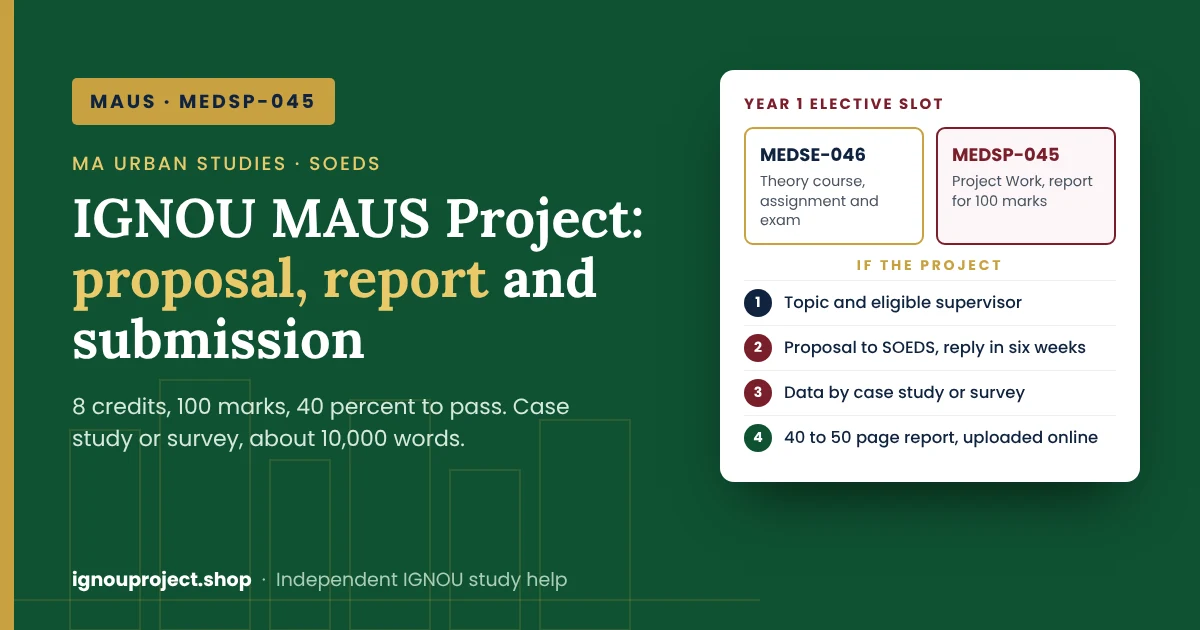
The IGNOU MAUS Project is MEDSP-045 Project Work, an 8-credit first-year elective of the Master of Arts (Urban Studies), taken in place of MEDSE-046. The learner gets a case study or survey proposal approved by SOEDS, works under an eligible supervisor, and submits a report of about 10,000 words, marked out of 100.
The course at a glance
What is the IGNOU MAUS Project (MEDSP-045)?
The IGNOU MAUS Project refers to MEDSP-045 Project Work, the research course of the Master of Arts (Urban Studies) offered by the School of Extension and Development Studies (SOEDS) at Indira Gandhi National Open University. The official MAUS programme page places it in Year 1 at 8 credits and marks it as an elective; the alternative in the same slot is MEDSE-046 Development: Issues and Perspectives, also worth 8 credits. A learner who elects the project picks an urban planning or development topic, finds an eligible supervisor and sends a proposal with the signed proforma to SOEDS for approval. Once it is approved, data is collected by the case study or survey method and written up as a report of 40 to 50 typed pages, about 10,000 words. The MEDSP-045 handbook sets the project at 100 marks with a minimum of 40 percent to pass.
The MA Urban Studies project is easy to misread because it sits in the first year, not the last. Most IGNOU master’s projects arrive near the end of a programme; this one competes for space with MEDS-041 to MEDS-044 in Year 1. Those four theory courses carry 6 credits each, so the elective brings the first year to 32 credits, the same total the handbook describes for the diploma it was written for.
| Programme | Master of Arts (Urban Studies) (MAUS), ODL mode, English medium, 24 to 48 months |
|---|---|
| School | School of Extension and Development Studies (SOEDS) |
| Project course | MEDSP-045 Project Work; the MAUS programme page prints the same course as MEDS-045 |
| Credits and year | 8 credits, Year 1 |
| Status | Elective; the other option is MEDSE-046 Development: Issues and Perspectives (8 credits) |
| Governing handbook | MEDSP-045 Handbook on Project Work, prepared for the PG Diploma in Urban Planning and Development (PGDUPDL), June 2013 |
| Methods named | Case study method or survey method |
| Proposal target dates | 30 April for January admissions, 31 October for July admissions; proposals are also accepted through the year |
| Approval reply | Within six weeks of receipt in the School, by email and by post |
| Report length | About 40 to 50 typed pages, not exceeding roughly 10,000 words excluding appendices, with 10 percent variation either way |
| Evaluation | 100 marks, minimum 40 percent, marked by an external examiner chosen by the Student Evaluation Division |
| Project evaluation fee | Rs 500 for a project above 4 credits, as set out in the Common Prospectus |
The paperwork problem
Which document governs the IGNOU MAUS Project?
The IGNOU MAUS Project has no handbook of its own. The rules a MAUS learner follows come from the MEDSP-045 Handbook on Project Work, which SOEDS prepared in June 2013 for the PG Diploma in Urban Planning and Development (PGDUPDL). The degree shares that diploma’s course set: its four Year 1 theory courses, its two electives and its project code are the same as PGDUPDL’s, which is why the PGDUPDL programme page and the eGyanKosh MAUS listing name the same MEDSP-045 course.
Reading a diploma handbook as a degree student creates five small conflicts. None of them is a reason to delay, but each one decides what goes on a form, so they are set out below with what the current sources show.
| Point | 2013 handbook (PGDUPDL) | Current sources | Working choice |
|---|---|---|---|
| Course code | MEDSP-045 on the cover, proforma and evaluation sheet | MEDSP-045 on eGyanKosh and the PGDUPDL page; MEDS-045 on the MAUS programme page | Write MEDSP-045, the code printed on the approval proforma |
| Who approves | Coordinator (PGDUPDL), SOEDS | MAUS page: proposal sent to the Programme Coordinators for approval | Address SOEDS and name both MAUS and MEDSP-045 |
| Programme on the originality certificate | PGDUPDL | Learner is registered in MAUS | Name Master of Arts (Urban Studies); confirm the wording with SOEDS |
| Line spacing | Length given as 40 to 50 double-spaced pages, but the report notes say typed in 1.5 space | No newer MAUS instruction found | Treat the 10,000-word ceiling as the real limit; page count follows the spacing used |
| Submission | One bound copy by registered or speed post to the Registrar (SED) | Online upload in windows notified by the Student Evaluation Division | Follow the current session notice; post only if a notice asks |
BK Sahni, who has guided 5,00,000 students till date, treats the code mismatch as the one worth settling first: the proforma, the evaluation sheet and the eGyanKosh record all print MEDSP-045, and a form that uses a different code is a form someone has to query. The rest of the MAUS project guidelines in the handbook (proposal headings, supervisor rules, report order and marks) carry no conflict at all and apply as written. A learner who also holds or plans the diploma will find that a PGDUPDL project and a MAUS project are, on paper, the same course.
The elective decision
Is the MAUS project compulsory, or is MEDSE-046 the better option?
For the IGNOU MAUS Project, the first decision comes before any topic: whether to take it at all. It is not compulsory. The MAUS programme page lists Project Work and MEDSE-046 Development: Issues and Perspectives in the same Year 1 slot, eGyanKosh labels both as electives, and the handbook describes the arrangement directly: four compulsory theory courses of 6 credits each, plus either a theory course or a project of 8 credits, to complete 32 credits.
| Question | MEDSP-045 Project Work | MEDSE-046 theory course |
|---|---|---|
| What is assessed | One report of about 10,000 words, marked out of 100 by an external examiner | An assignment and a term-end examination; MAUS assignment booklets give the assignment 30 percent weightage |
| First step | Proposal approval from SOEDS, which can take up to six weeks | None beyond registration |
| Fieldwork | Yes, unless the topic uses existing records as a secondary survey | No |
| Suits | Municipal staff, NGO workers and anyone with access to a ward, a scheme or a service to study | Learners who prefer a fixed syllabus and an examination date |
The choice matters for a second reason. The MAUS page notes an exit option after the first year with the PG Diploma in Urban Planning and Development, and allows PGDUPDL holders lateral entry into the second year through credit transfer. Whichever elective is completed in Year 1 is therefore part of the credits that move between the two awards. The rules for changing an elective after registration are set by the University; the Regional Centre confirms whether a change is still open in a given session.
Choosing what to study
MAUS project topics that pass the handbook’s feasibility test
Topic choice for the IGNOU MAUS Project starts with feasibility, not ambition. The handbook lists seven points to weigh before settling on a title: suitability, relevance to urban planning and development, the time available, whether data can be collected within that time, the difficulties of collecting it, the cost, and the communication facilities and local language of the study area. A topic that fails any one of these tends to fail at the data stage, after approval, which is the most expensive place to discover it.
Annexure I of the handbook offers 30 sample topics and says plainly that they are prompts, not a closed list. Grouped by the kind of evidence they need, they fall into five families.
| Topic family | Handbook examples | Natural method | Where the data comes from |
|---|---|---|---|
| Urban services and users | User satisfaction with transport, housing or sanitation; parking problems; health care in slums | Survey | Questionnaire or interview schedule with residents or users |
| Local bodies and finance | Case study of a Nagar Panchayat; financial sustainability of a municipality; income and expenditure pattern; ward sabha functioning | Case study, or survey for ward sabhas | Budgets, minutes, annual reports, officials |
| Plans, schemes and missions | Case study of a city master plan; an urban poverty alleviation programme; e-governance in a town | Case study | Plan documents, scheme records, implementing staff |
| Growth and land | Real estate growth; impact of a metro on real estate; use of open spaces; historical analysis of a town | Survey or case study | Field observation, records, published data |
| People and livelihoods | Urban migrant labour; women entrepreneurs; the urban aged; health of women and children in a slum | Survey | Respondents chosen by a stated sampling method |
One sample topic needs updating before use. The JNNURM case study suggested in the list refers to a mission the Government of India replaced in 2015 with AMRUT and the Smart Cities Mission, so the same idea now works better as a study of a current mission project. MAUS project topics drawn from a learner’s own workplace (a municipal office, a housing board, an urban NGO) pass the access test most easily, provided the supervisor or the Study Centre can issue the authorisation letter the handbook mentions for data collection.
Before any fieldwork
How to write the MAUS project synopsis and proposal
The proposal is the gate for the IGNOU MAUS Project: no fieldwork counts until SOEDS has approved it. The handbook uses “project proposal” and “synopsis” for the same document, and it asks for one copy, signed by the supervisor, with a copy kept by the learner.
The MAUS project proposal format: seven headings
- Title, specific enough to name the place and the unit studied.
- Introduction, setting out why the issue matters in that city or town.
- Objectives, three or four that the data can actually answer.
- Problem statement, the gap or question the study addresses.
- Research methodology, naming the locale, the sampling, the instruments and the statistical tools.
- Limitations, if any.
- References.
For drafting the methodology heading, the handbook points learners to Block 1, Project Formulation and Management, of MEDS-044, the Year 1 course on monitoring and evaluation, and to its Block 3 on measurement and sampling.
What goes with the MAUS project synopsis
- The Proforma for Approval of Project Proposal (MEDSP-045), Annexure II, filled in and signed by both the student and the supervisor.
- A detailed bio-data of the supervisor, signed, with date of birth, office and home addresses, telephone numbers, qualifications with years of passing, and work experience with designation and organisation.
- The proposal itself.
The proforma is blunt about the bio-data: without a complete, signed copy, the proposal is not entertained, even when the supervisor is an academic counsellor of the programme.
When to send it and how long approval takes
The handbook advises learners admitted in the January session to send the proposal by 30 April, and those admitted in July by 31 October, so the project can be completed on time; proposals that miss those dates are still accepted through the year. SOEDS sends a written approval or non-approval by email and post within six weeks of receiving the proposal. In practice a July entrant who elects the project has only a few months between admission and the recommended target date, and so does a January entrant, which is why topic and supervisor need settling in the first weeks.
The supervisor
Who can supervise an IGNOU MAUS Project?
The IGNOU MAUS Project needs a supervisor who fits one of five categories in the handbook, and the person’s signed bio-data is how SOEDS checks the fit. A MAUS project supervisor can be:
- a faculty member at SOEDS headquarters;
- an academic counsellor of PGDUPDL, the PG Diploma in Extension and Development Studies or the MA in Extension and Development Studies, with relevant experience;
- a teacher or researcher in urban planning and development;
- a PhD holder in urban development, development studies, economics, sociology, public administration, political science, extension education or a related discipline;
- a master’s or MPhil holder in any of those disciplines with at least two years of experience.
An academic counsellor also states which courses they counsel, since when, and the name and code of their Study Centre. If SOEDS does not accept a proposed supervisor, the learner changes the supervisor and sends the proposal again; a supervisor change for any other reason also needs a fresh proforma and is treated as a new proposal. The handbook fixes a token honorarium of Rs 300 per student for guidance, claimed by the supervisor on the Annexure IV bill when the report is submitted.
The report
MAUS project report format, word limit and marks
The IGNOU MAUS Project report must follow the approved proposal and run to about 40 to 50 typed pages, not exceeding roughly 10,000 words without appendices and exhibits; the handbook allows 10 percent either way. That puts the MAUS project word limit between about 9,000 and 11,000 words. The language is English, the paper A4, and the report is presented in the order below.
- Title page with the project title, name, address, enrolment number and year
- Certificate of originality, signed by the student and the supervisor (Annexure III)
- Acknowledgement and table of contents
- Introduction, with objectives and rationale
- Review of literature
- Methodology: sample, tools and statistical analysis
- Results and discussion, with tables and graphs
- Conclusion, limitations and suggestions for further work
- References in APA style, listed alphabetically
- Appendices: the questionnaire or interview schedule, and copies of the approved proforma, approved proposal and supervisor bio-data
The marks are not spread evenly, and the MAUS project report format reflects that. Annexure V gives the examiner this scheme, and planning word counts in proportion to it keeps effort where the marks are.
| Part of the report | Maximum marks | Proportional word plan |
|---|---|---|
| Introduction (with objectives and rationale) | 15 | About 1,500 words |
| Review of literature | 15 | About 1,500 words |
| Methodology | 20 | About 2,000 words |
| Results and discussion | 40 | About 4,000 words |
| Conclusions | 10 | About 1,000 words |
| Total | 100 (pass at 40) | About 10,000 words |
Results and discussion alone carry 40 marks. A report that spends half its length on definitions of urbanisation and a quarter page on findings has its proportions inverted, whatever the overall word count.
Getting it evaluated
Submission, last date and fee for the IGNOU MAUS Project
The IGNOU MAUS Project report is submitted online in a window notified by the Student Evaluation Division (SED), not on a date printed in the handbook. The 2013 handbook describes the older postal route: one typed, bound copy on A4 paper, sent by registered or speed post to the Registrar (SED), IGNOU, Maidan Garhi, New Delhi 110068, with “PROJECT REPORT-PGDUPDL” written on the envelope, after which a Project Report number is allotted. It also links results to two submission bands, 1 December to 31 May for the June term-end results and 1 June to 30 November for December. That band system is how the course worked then; it is not the current calendar.
Current practice runs through fixed online windows. For the June 2026 term-end examination, the SED upload page on onlineproject.ignou.ac.in closed on 15 June 2026, and it required the report to be prepared on the approved proposal. For December 2026, IGNOU’s official X account announced the Online Project Management System (OPMS) on 16 October 2026, and education news coverage reports that learners reach it through their Samarth login with 30 November 2026 as the last date. The MAUS project submission last date for any session is the one in that session’s SED notice, so the notice itself should be read before the upload.
The MAUS project evaluation fee is Rs 500, the rate the Common Prospectus sets for project work above 4 credits from the January 2023 admission cycle. An IGNOU announcement for the December 2026 term-end examination asks for project, internship and practical course fees through the IGNOU Samarth portal by 30 November 2026.
On the MAUS project viva: the handbook describes evaluation by an external examiner, selected by the Student Evaluation Division from a list approved by SOEDS, using the Annexure V scheme, and it does not describe a viva-voce. A learner who receives a notice calling for one follows the notice.
When it comes back
MAUS project rejected? The usual reasons and the resubmission route
Most returned proposals for the IGNOU MAUS Project fail on paperwork or scope, and both are visible before posting. The handbook’s own conditions point to the common causes:
- Bio-data missing or unsigned. The proforma states that such a proposal is not entertained.
- Supervisor outside the five categories, most often a master’s degree holder without the two years of experience the fifth category requires.
- A topic the data cannot support, such as a city-wide impact claim from a handful of respondents, which fails the feasibility points in Section 6 of the handbook.
- A method other than case study or survey, the two methods the handbook advises for MEDSP-045.
- A methodology heading without locale, sampling, instruments or statistical tools, the four items the proposal format names.
A non-approved proposal comes back with comments. The revised version goes in with a revised proforma, a copy of the rejected proposal and proforma bearing the evaluator’s comments, and the Project Proposal (P.P.) number already allotted. At the report stage, the risk is different: a report that drifts from the approved proposal, or arrives without the originality certificate and the approved proforma, gives the examiner a reason to mark it down.
Quick answers
MEDSP-045 questions learners ask
Are MEDSP 45, MEDSP-045 and MEDS-045 the same course?
Yes. MEDSP-045 is the code on the handbook, the approval proforma, the evaluation sheet and eGyanKosh, while the MAUS programme page prints MEDS-045 for the same 8-credit Project Work. Learners also search for it as MEDSP 45, MEDSP 045 or MEDSP45. On forms, MEDSP-045 is the safest spelling.
Does the IGNOU MAUS Project have a viva?
The handbook does not describe one. It sets out evaluation of the report by an external examiner out of 100 marks, with 40 needed to pass. Any session notice that says otherwise takes precedence.
How long does SOEDS take to approve the proposal?
The handbook states that a written decision is sent within six weeks of the proposal reaching the School, by email and by post. Fieldwork should wait for the approval, because the report must be based on the approved proposal.
Can the supervisor be changed after approval?
Yes, but the handbook treats it as a new proposal: a fresh proforma signed by the new supervisor, with that supervisor’s signed bio-data.
Is there an official MAUS project sample?
No sample report is published with the handbook. What it does provide is the list of 30 sample topics in Annexure I, the proforma, the originality certificate and the evaluation scheme, which together define what a finished report contains.
Does a PGDUPDL learner moving into MAUS repeat the project?
The MAUS programme page allows PGDUPDL holders lateral entry into the second year through credit transfer, and MEDSP-045 is a first-year elective common to both. Credit transfer is decided on application, so the Regional Centre confirms the position for each learner.
Check before acting: the IGNOU MAUS Project rules on this page come from the MAUS programme page on ignou.ac.in, the MEDSP-045 handbook and the MAUS first-year listing on eGyanKosh. Submission windows, the OPMS route and fee dates change by session, and the latest Student Evaluation Division notice always prevails.
For learners stuck between topic and approval, the same proposal-to-report sequence is explained for other programmes in the IGNOU project hub on this site, and ignouproject.shop offers independent guidance on framing a feasible urban topic and a clear methodology before the proforma goes to SOEDS.
Independent study-help disclosure: ignouproject.shop is run by Shri Chakradhar Publication Pvt. Ltd. and is not the official website of IGNOU or SOEDS. This article summarises published university documents for guidance only; official notifications on ignou.ac.in prevail over anything written here.

BK Sahni iD 0009-0005-8092-459X
Founder, Shri Chakradhar Publication Pvt. Ltd. & its IGNOU Project study-help brand, helping IGNOU distance-learning students since 2010 and having guided 5,00,000 students till date across MBA, MCom, MA & more. Author of IGNOU exam guides, solved assignments & project reference books.
Disclosure: Shri Chakradhar Publication Pvt. Ltd. and ignouproject.shop are independent third-party study-help services, not the official IGNOU website. Always verify final dates and rules on ignou.ac.in.
Leave a Reply