
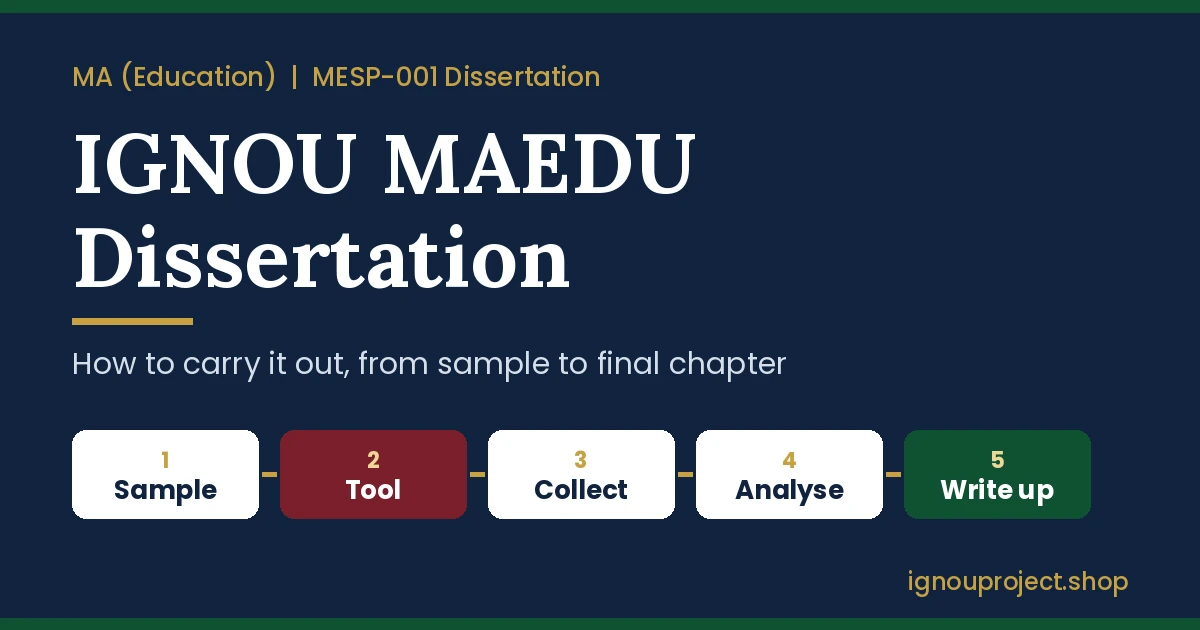
MA (Education), MESP-001: carrying out the research
IGNOU MAEDU Dissertation: How to Carry Out MESP-001 From Sample to Final Chapter
The IGNOU MAEDU dissertation is MESP-001, the 10 credit research course of IGNOU’s MA (Education). Once the proposal is approved, the work comes down to five decisions: whom to sample, whether to build or borrow the research tool, how to analyse each objective, how to turn the proposal into chapters, and what to report as limitations.
Start here
What is the IGNOU MAEDU dissertation, in practical terms?
The IGNOU MAEDU dissertation refers to MESP-001 Dissertation, a compulsory 10 credit course in the Master of Arts (Education) programme offered by the School of Education, Indira Gandhi National Open University. It is the practical half of research training. The theory sits in MES-016 Educational Research; MESP-001 asks the learner to apply that theory by conducting one complete study. The governing document is the Handbook on Dissertation Work (School of Education, January 2009). After the proposal stage, the Handbook sets out a fixed execution sequence: sampling, selecting or constructing the research tool, collecting data, analysing and interpreting it, and writing the report in three sections, namely the preliminary pages, the body and the reference section. The Handbook fixes no page or word limit. What it does fix is logic: every tool, statistic and conclusion in the MESP-001 dissertation must trace back to an objective stated in the approved proposal.
The rules side of the course, meaning the proposal questions, the submission windows, the guide limit and how the viva-voce is graded, is covered in the IGNOU MAEDU project (MESP-001) rules and grading guide. This page starts where that one stops: the day the proposal is approved and the actual research begins.
| Course code and title | MESP-001 Dissertation |
|---|---|
| Programme and school | Master of Arts (Education), MAEDU; School of Education |
| Credits | 10, the largest single course in the programme |
| When it is done | Second year, alongside the chosen specialisation courses |
| Theory base | MES-016 Educational Research: research types (Block 2, Units 5 to 9), hypotheses (Unit 11), sampling (Unit 12), tools (Unit 13), data analysis (Block 4), references (Unit 23) |
| Governing document | Handbook on Dissertation Work, School of Education, January 2009 |
| Starting condition | An approved research proposal (Appendix IX proforma of the Handbook) |
| Report structure | Preliminary section; body in four logical divisions; reference section with bibliography and appendices |
| Length | No page or word limit in the Handbook; follow any written Regional Centre instruction |
| Assessment | Report 70 per cent and viva-voce 30 per cent, with a minimum grade C required in each |
Decision 1 of 5: the method
Which research method fits your MAEDU dissertation topic?
The Handbook on Dissertation Work names five types of educational research, all taught in Block 2 of MES-016: descriptive, experimental, qualitative, historical and philosophical. The method is not a label added at the end. It decides what counts as data, which tool collects it and how it can be analysed, so it has to be settled before anything else.
The first two rows below use the Handbook’s own sample proposals (Appendix I and Appendix II). The other rows are illustrative questions of the kind MAEDU learners commonly frame.
| Method | Suits a question like | Typical tools | Typical analysis | Hypothesis |
|---|---|---|---|---|
| Descriptive survey | What are the reactions of IGNOU B.Ed student teachers towards practical courses? (Appendix I) | Questionnaire, checklist, attitude scale, interview | Percentages and descriptive statistics; content analysis of open answers | Optional; research questions often suffice |
| Experimental | Does a face-to-face workshop change the achievement of B.Ed student teachers? (Appendix II) | Achievement test, given before and after | t-test, analysis of variance or co-variance | Expected; tested in null form |
| Qualitative | How do teachers in one district handle multigrade classes? | Observation, unstructured interview, field notes | Content, inductive and logical analysis | Rarely used |
| Historical | How did a named educational institution develop? | Records, documents, archival sources | Internal and external criticism of sources | Not required for fact-finding studies |
| Philosophical | What does a thinker’s view of education imply for present practice? | Primary and secondary texts | Logical analysis | Rarely used; confirm with the guide |
Topics are easiest to defend when they come from the learner’s own specialisation, because the concepts and readings are already familiar. The programme-wise IGNOU project guide explains how the MAEDU dissertation sits alongside project courses in other IGNOU programmes.
Decision 2 of 5: the sample
How many respondents does a MAEDU dissertation need, and how should they be chosen?
The Handbook on Dissertation Work does not set a minimum sample size for the MESP-001 dissertation. It requires something stricter: the learner must describe the population, the sampling unit, the size and structure of the sample, and justify each of those choices in the methodology.
The Handbook divides sampling into two families. Probability methods (simple random, stratified random, systematic, cluster and multi-stage) give every unit a fixed chance of selection and support generalisation to the population. Non-probability methods (incidental, quota, purposive and snowball) are faster but, as the Handbook notes of purposive samples, fail to represent the wider population, so findings must be reported with care. The Handbook’s reference list also cites Krejcie and Morgan (1970), the standard table that relates sample size to population size.
This guidance comes from Section 7 of the Handbook, which condenses Unit 12 of MES-016. In practice, a MAEDU learner should fix the sample from the population first, not from convenience, and should expect the viva-voce examiner to ask why that number and that method were chosen.
| Method | Use it when | Handbook example |
|---|---|---|
| Simple random | A complete list of units exists | Lottery method or a random numbers table |
| Stratified random | The population has distinct groups that must all appear | Class VII students split across government, aided and private schools |
| Systematic | An ordered list exists and speed matters | 200 secondary teachers, sample of 40, so every 5th teacher |
| Cluster | The population is scattered and unlisted | Selected secondary schools standing in for a whole district |
| Multi-stage | The study spans a large area | 10 study centres, 5 programmes each, 20 students each: 1,000 students |
| Incidental | Only reachable units can be used | Interviewing students in easily reached schools |
| Quota | Proportions matter but randomisation is not possible | 60 boys and 40 girls in a sample of 100 |
| Purposive | One specific group is the focus | 100 IGNOU B.Ed trainees at one programme centre |
| Snowball | Members are hard to identify | Students addicted to computer games |
Decision 3 of 5: the tool
Should you build your own research tool or use a standardised one?
Use a standardised or previously validated tool wherever one measures the variable your objectives name, and build a new one only when nothing fits. The reason is workload. The Handbook on Dissertation Work attaches a full construction and try-out procedure to any self-made test or scale, and that procedure runs before the main data collection can even begin.
For a self-made test, the Handbook notes that the large try-out sample is usually taken as 370, because that size lets the test-maker read difficulty and discrimination indices quickly from Flanagan’s table. For a self-made Likert-type attitude scale, the draft is generally administered to at least 200 subjects before the final statements are selected. For a standardised tool, the obligation is lighter but still real: the dissertation must report its validity, reliability and norms.
These figures come from Sections 7 to 9 of the Handbook, which condense Unit 13 of MES-016. The practical meaning is simple. A MAEDU proposal that promises a self-constructed achievement test or attitude scale has quietly committed the learner to a pilot study on a sample that may be larger than the main study. That commitment should be made knowingly, with the guide, before the proposal is signed.
BK Sahni, who has guided 5,00,000 students till date, notes that the tool decision is the one MAEDU learners most often make last, usually after the proposal has already promised a scale of their own, and that it is the decision most likely to decide whether the dissertation finishes in the planned cycle.
What building a test or scale involves, according to the Handbook
- Plan the test. Fix the purpose, objectives, content and item format. For an achievement test, prepare a blueprint (table of specifications) that weights content units, instructional objectives, question forms, time and difficulty.
- Write a preliminary draft with about double the items needed. Send it to subject experts and a language editor, then revise.
- Run a small-group try-out to check the correctness of answers and the clarity of items, then revise again.
- Run the large try-out on a random sample of the target population, usually 370 for this purpose.
- Carry out item analysis using the top 27 per cent and bottom 27 per cent of scorers: difficulty level (items answered correctly by under 33 per cent or over 67 per cent are likely too difficult or too easy), index of discrimination, and the effectiveness of each distractor.
- Assemble the final draft and administer it to establish validity, reliability and norms.
A Likert-type scale follows its own route in the Handbook: an equal number of favourable and unfavourable statements, scoring weights of 5 to 1 (reversed for unfavourable statements), item selection by comparing the upper and lower 25 per cent of scorers, a final set of 20 to 25 statements with the largest t-values (above 1.75), and reliability estimated by the split-half method.
What an existing tool still requires you to report
Borrowing a tool does not remove the measurement section; it changes what goes in it. The Handbook asks for the tool’s validity (content, criterion-related or construct), its reliability (test-retest, parallel forms, split-half with the Spearman-Brown formula, or Kuder-Richardson formula 21), and its usability and objectivity. It cites a recommendation that a validity coefficient should be at least +0.70, while accepting lower values where no better test exists. Where an existing tool is modified to fit the study, the Handbook permits it; the methodology chapter should then state exactly what was changed and credit the original author.
Questionnaires, checklists, observation and interviews
Most MAEDU survey studies use a questionnaire rather than a test. The Handbook’s construction rules are specific: each question must serve an objective, double negatives and double-barrelled questions are out, leading questions are out, questions move from general to specific, the instrument should not be too long, and the draft goes to a few experts before use. A checklist is tried out on a small sample first. Observation in a school requires permission through official channels and a discussion with the people being observed. The Handbook also flags the limits of questionnaires: they cannot be used with non-literate respondents or very young children, and mailed questionnaires often return poorly.
Decision 4 of 5: the analysis
Which statistics and analysis methods suit a MAEDU dissertation?
The analysis method for a MAEDU dissertation is chosen objective by objective, and the Handbook on Dissertation Work requires the dissertation to state what each technique is used for. Naming a test is not enough; its use must be justified against a specific objective or hypothesis.
For quantitative data, the Handbook separates parametric data (measured on interval or ratio scales, such as test marks) from non-parametric data (counted or ranked, on nominal or ordinal scales). Description uses averages, measures of variability, measures of relative position and measures of relationship. Inference uses tests such as the z-test, t-test, analysis of variance and co-variance, regression, chi-square, the median test and the Mann-Whitney U test. Qualitative data, such as open-ended responses, field notes and documents, is examined through content, inductive and logical analysis. Historical studies apply internal and external criticism to their sources.
This is Section 10 of the Handbook, a recap of Block 4 of MES-016. The Handbook’s own descriptive proposal (Appendix I) shows the pattern in miniature: percentage analysis for closed-ended questions and content analysis for open-ended ones. A learner who writes one line per objective, naming the data type and the technique that answers it, has already drafted the skeleton of the analysis chapter.
Interpretation is a separate step from analysis. The Handbook describes it as stating what the results show, with the limits of the sample and tools kept in view, and warns against conclusions that contradict each other or run beyond the evidence.
Decision 5 of 5: the write-up
How does an approved MAEDU proposal become the dissertation chapters?
Much of the MESP-001 dissertation is already drafted inside the approved proposal. Writing up means moving each proposal component to its place in the report and changing it from a statement of intent into a record of what was done. The Handbook’s style rule makes the shift explicit: past tense for what the researcher and earlier researchers did, present tense when referring the reader to tables and when stating established principles. The Handbook’s own sample proposal is written in the future tense (“descriptive survey method will be adopted”), which is exactly the wording that must change.
| Proposal component | Place in the dissertation | What changes |
|---|---|---|
| Title, context, rationale, statement of the problem | Introduction | Expanded in depth; the approved title stays exactly as approved |
| Review of related literature | Introduction in the Handbook’s outline; often a separate chapter in practice | Updated with studies read after approval; ends on the research gap |
| Research questions, objectives, hypotheses, operational definitions, delimitations | Introduction | Wording kept identical to the approved proposal |
| Method, population, sample, tools, procedure | Design of the study (methodology) | Future tense becomes past; adds what actually happened, such as the achieved sample and the tool’s measured reliability |
| Method of data analysis | Analysis and interpretation | Becomes the actual tables and discussion, objective by objective |
| Results, findings and suggestions | Summary and conclusions | States which hypotheses were accepted or rejected, educational implications and further research |
| References | Bibliography | Extended to every source cited in the final report |
| Tools and raw data | Appendices | Final versions of questionnaires, tests, schedules and supporting data |
One reconciliation point deserves attention. The Handbook’s body has four logical divisions (introduction, design, analysis and interpretation, summary and conclusions) and places the review of literature inside the introduction. Many MAEDU dissertations instead run five chapters with the review as Chapter 2. Both follow the Handbook’s order, and the Handbook itself allows analysis to be split across more than one chapter. The Handbook also includes a sample table of contents (Appendix VIII); where a guide prefers one layout, the guide’s instruction governs.
Before submission
Which report-stage mistakes weaken a MESP-001 dissertation?
Proposal-stage problems are covered in the rules guide. The mistakes below appear later, in a finished draft, and each one is addressed directly in the Handbook.
- Repeating every table in prose. The Handbook asks the text to point out the important facts and relationships, not to restate each figure.
- Long tables inside chapters. Complex or lengthy tables belong in the appendix so the discussion reads continuously.
- Formulae and workings in the text. The Handbook excludes standard statistical formulae and computations from the report; state the test, the value and what it means.
- A statistic with no stated purpose. Every technique should be tied to a named objective or hypothesis.
- Generalising from a purposive or incidental sample. Findings from non-probability samples describe the group studied, not the whole population.
- Hiding limitations. The Handbook requires weaknesses in design, tools or population discovered during the work to be reported frankly, with their likely effect on the findings.
- Conclusions that drift from the objectives. Each conclusion should answer a question raised at the start.
- Tools missing from the appendix. Copies of every test, questionnaire and interview schedule belong in the appendices.
The viva-voce examines these same choices: why this sample, why this tool, why this test. The format of the viva and its separate grade are explained in the MESP-001 rules guide.
Reading the Handbook carefully
Where does the 2009 Handbook need a second look?
The Handbook on Dissertation Work is still the governing document for research content, but it was printed in January 2009. Three points are worth checking against current practice.
Specialisations. The Handbook’s introduction names four specialised areas: higher education, distance education, educational technology and educational management. The current MAEDU programme also offers Adult Education. Learners in that specialisation can still draw a dissertation topic from it; the older text simply predates it. Confirm the topic area with the guide.
A figure in the stratified-sampling example. The Handbook’s Table 2 correctly shows 100 of 400 government-aided school students (25 per cent), but the sentence below the table says 200. The table and the total of 375 are right. Anyone adapting that example should recompute rather than copy.
Typing and submission. The Handbook’s guidance on professional typists and retyping pages reflects 2009 practice, although it already recommends typing the report on a computer. The submission form and route are set by current Regional Centre and university notifications. The rule of thumb: the Handbook governs what the dissertation contains; the current notification governs how and where it is submitted.
Verify it yourself. The course list and credits are on the official IGNOU MA (Education) programme page, and the full Handbook on Dissertation Work, including the sample proposals and appendices, is available on eGyanKosh. Where a Regional Centre notification differs from anything on this page, the notification applies.
IGNOU MAEDU dissertation: common questions
Is the IGNOU MAEDU dissertation the same as the MAEDU project?
Yes. Both names refer to MESP-001 Dissertation, the 10 credit research course of the MA (Education) programme. Learners and notices also write the code as MESP 001, MESP-1, MESP 1 and MESP001; all refer to the same course, governed by the School of Education’s Handbook on Dissertation Work.
How many respondents does a MESP-001 dissertation need?
The Handbook on Dissertation Work sets no minimum. It requires the population, sampling unit, sample size and structure to be described and justified. For illustration, the Handbook’s own sample survey proposal drew 300 student teachers from a population of 1,200 by systematic sampling; that is an example, not a norm.
Can a questionnaire or scale developed by someone else be used?
Yes. The Handbook expects learners to select from existing tools where they fit, and to modify or construct a tool only when they do not. A standardised tool must be reported with its validity, reliability and norms, the original author must be credited, and any modification must be described in the methodology.
Which statistical tests are used in an MA Education dissertation?
It depends on the objectives and the type of data. The Handbook lists descriptive measures (averages, variability, relative position, relationship) and inferential tests including the z-test, t-test, analysis of variance and co-variance, regression, chi-square, the median test and the Mann-Whitney U test. Survey studies often need only percentages and descriptive statistics.
Can a MAEDU dissertation use only qualitative data?
Yes. The Handbook recognises qualitative, historical and philosophical research alongside descriptive and experimental designs. Qualitative data is analysed through content, inductive and logical analysis, and a hypothesis is usually not required for such fact-finding studies.
Where does the questionnaire go in the MAEDU dissertation?
In the appendices. The Handbook places copies of all tools, including tests, questionnaires and interview schedules, in the appendix section that follows the bibliography, while the methodology chapter describes how each tool was built or selected.
Is there an official IGNOU MAEDU dissertation sample PDF?
Not a complete one. The Handbook on Dissertation Work contains two sample research proposals, a descriptive survey (Appendix I) and an experimental study (Appendix II), plus a sample table of contents (Appendix VIII). Sample dissertations circulating online are not IGNOU documents, and reusing their text risks plagiarism.
Independent study help. This page is published by ignouproject.shop, an independent study-help service of Shri Chakradhar Publication Pvt. Ltd. It is not the official IGNOU website and is not affiliated with Indira Gandhi National Open University. Rules are summarised from official IGNOU documents; always confirm current instructions with your Regional Centre. Learners who want a second reader for a sampling plan, research tool or analysis plan before data collection starts can reach the ignouproject.shop team through this site.

BK Sahni iD 0009-0005-8092-459X
Founder, Shri Chakradhar Publication Pvt. Ltd. & its IGNOU Project study-help brand, helping IGNOU distance-learning students since 2010 (5,00,000+ students supported across MBA, MCom, MA & more). Author of IGNOU exam guides, solved assignments & project reference books.
Disclosure: Shri Chakradhar Publication Pvt. Ltd. and ignouproject.shop are independent third-party study-help services, not the official IGNOU website. Always verify final dates and rules on ignou.ac.in.
Leave a Reply