
MA (Education) • School of Education
IGNOU MAEDU Project (MESP-001 Dissertation): Rules, Proposal and Grading
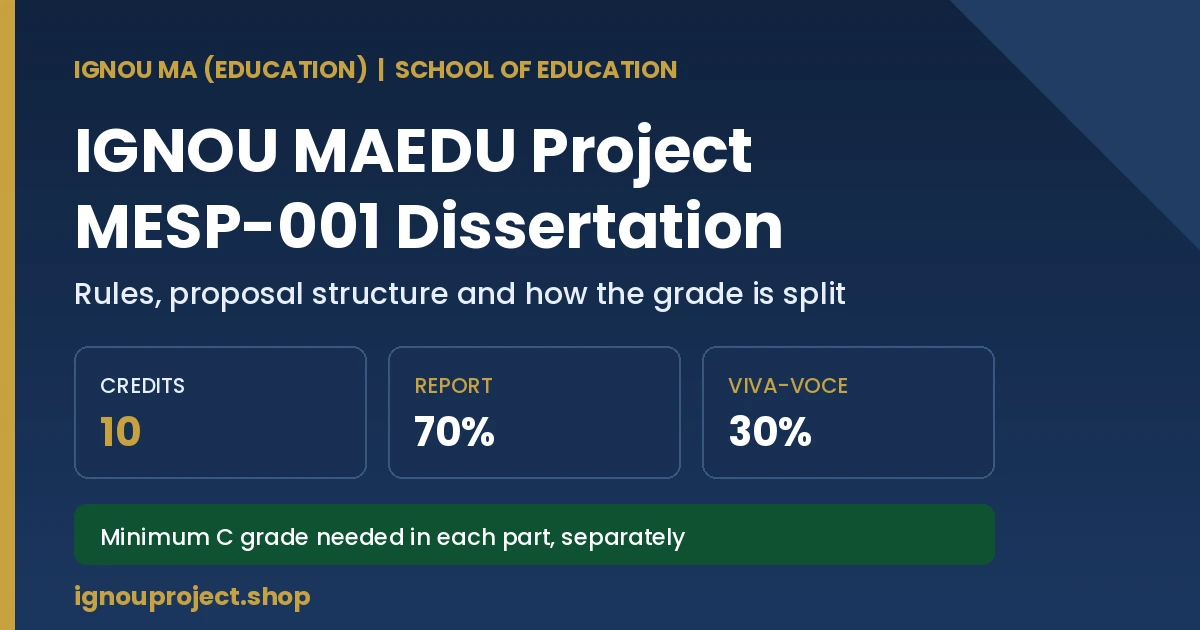
The IGNOU MAEDU project is MESP-001 Dissertation, a compulsory 10 credit course in the MA (Education) programme of IGNOU’s School of Education. It is graded in two separate parts: the dissertation report at 70 per cent and the viva-voce at 30 per cent, with at least a C grade required in each.
Why MESP-001 is graded twice, and what that means for you
MESP-001: Dissertation is the compulsory project course of the Master of Arts (Education) programme, known as MAEDU, offered by the School of Education at Indira Gandhi National Open University. IGNOU lists it as a Project course carrying 10 credits, the largest single credit block in the programme. It sits alongside MES-016: Educational Research, which supplies the theory; MESP-001 supplies the practice. A learner prepares a research proposal, gets it approved, conducts the study, submits a dissertation report, and then faces a viva-voce at the Regional Centre. The report and the viva-voce are weighted 70 per cent and 30 per cent, and a learner must obtain at least a C grade in each of them separately for the course to be treated as complete.
That last sentence is the part most MAEDU learners discover too late. A strong report does not carry a weak viva. The two components are scored independently, so a learner who writes well but cannot defend the sampling choice in person can still be held back on a 10 credit course. Planning the dissertation with the oral defence in mind from day one is not extra effort; it is the design of the assessment.
| Course code | MESP-001 (also written MESP 001, MESP-1, MESP 1) |
|---|---|
| Course title | Dissertation |
| Programme | MAEDU, Master of Arts (Education) |
| School | School of Education (SOE) |
| Course type and credits | Project, 10 credits |
| Status | Compulsory, undertaken in the second year |
| Governing document | Handbook on Dissertation Work, MESP-001, School of Education, IGNOU |
| Companion theory course | MES-016: Educational Research (6 credits) |
| Deliverables | Research proposal (synopsis), dissertation report, viva-voce |
| Assessment weightage | Dissertation report 70 per cent, viva-voce 30 per cent |
| Minimum result | At least a C grade, separately, in the report and in the viva-voce |
| Programme duration | Minimum 24 months; maximum listed as 48 months on the IGNOU programme page |
| Medium | English |
The proposal stage
The 16 questions an MESP-001 synopsis has to answer
IGNOU’s Handbook on Dissertation Work does something unusual for a project guide. Instead of handing MAEDU learners a section list to fill in, it sets out sixteen questions and pairs each one with the component of the research proposal that answers it. The Handbook also notes that a research proposal is what most students call a synopsis; the two words mean the same document here.
Working from the questions rather than the headings is the difference between a proposal that reads as a plan and one that reads as a form. A learner who can answer question eleven and question twelve in one sentence each has a defensible study. A learner who writes “Population” and “Sample” as headings without those answers has a layout.
| The question to answer | Component in the synopsis |
|---|---|
| What do you propose to study? | Title of the study |
| Why do you intend to conduct the proposed study? | Context, justification or rationale |
| How do you define the study? | Statement of the problem |
| What do earlier researches tell you? | Review of related literature |
| What do you intend to address? | Research questions |
| What do you intend to achieve? | Objectives of the study |
| What tentative solutions do you formulate? | Hypotheses |
| How do you operationally define the terms in the title? | Operational definitions of terms |
| What will be the scope of your proposal? | Delimitations of the study |
| How do you propose to conduct the study? | Methodology of the study |
| What is the total number of units studied? | Population of the study |
| What smaller number of units will be selected? | Sample |
| What means will collect the research evidence? | Tools and techniques of data collection |
| How will you collect the evidence? | Procedure of data collection |
| How will you analyse the evidence? | Method of data analysis |
| What implications would the study have for practice? | Results, findings and suggestions |
Two points the Handbook is firm about
First, hypotheses are not compulsory for every MAEDU dissertation. The Handbook states plainly that where the purpose of the research is to find facts as they exist, as in historical or some descriptive studies, a hypothesis may not be required. Learners doing a documentary or philosophical study should not invent a null hypothesis to fill the heading.
Second, the title page of the proposal carries the name of the researcher, the name of the guide and the name of the university, not just the title. A synopsis submitted with a blank guide field is an incomplete document before anyone reads the content.
The Handbook also carries two complete worked proposals as Appendix I and Appendix II, one a descriptive survey study and one an experimental study, both set in IGNOU’s own B.Ed programme. Reading those two appendices is a faster route to the expected register than any template circulating online.
The report stage
What the MESP-001 dissertation report actually contains
The Handbook organises the dissertation report into three main sections rather than a fixed chapter count, which gives MAEDU learners more room than the five chapter formula borrowed from management projects.
- Preliminary section. Title page carrying the title, the name of the institution to which the dissertation is submitted, the name of the student and the month and year of submission. Then the preface or acknowledgements, then the table of contents including the list of tables and list of figures.
- Body of the report. Four logical divisions: the introduction, which carries the problem, rationale, research questions, objectives, hypotheses if required, assumptions, operational definitions, scope and delimitations; the design or methodology of the study; the analysis and interpretation of data, described in the Handbook as the heart of the report; and the summary and conclusions.
- Reference section. The bibliography, followed by the appendices carrying the tools, questionnaires, interview schedules and raw data.
The Handbook adds one instruction that examiners notice and students often miss: any weakness or limitation in the design, tools or population that came to light during the work should be reported frankly, along with how it may have affected the findings. A limitations paragraph is not a confession. In an educational research dissertation it is evidence that the researcher understood the study.
Style rules that are specific to MESP-001
- The personal pronouns I, we, you, my, our and us are not to be used. The Handbook directs learners to write as “the researcher” or “the investigator”.
- Numbers of less than three figures, round numbers and numbers that begin a sentence are spelled out, except inside statistical discussion. Figures are used for decimals and percentages, but the words “per cent” are spelled out.
- Standard statistical formulae and the computations themselves are kept out of the report body, to preserve continuity of the text.
- Past tense for what the researcher and earlier researchers did; present tense when pointing the reader to a table or stating a well established principle.
- Abbreviations are avoided in the main text apart from universally accepted ones.
Information gain
What the Handbook does not fix: page count, word count and font
Search for the IGNOU MAEDU project and several pages will tell you the dissertation should run to about 100 pages, or 10,000 to 12,000 words, in Times New Roman 12 point with double spacing. Those figures are worth treating carefully. The Handbook on Dissertation Work for MESP-001 does not prescribe a page limit, a word limit or a typeface. What it says about length is indirect: the study selected should be one that can be completed in the second year alongside the specialised courses of the MA (Education) programme.
This matters practically. Numbers that circulate without a traceable official source often come from the M.Com or MBA project guidelines, where page bands genuinely are published, and get copied across to MAEDU pages because the programmes look similar from the outside. They are not the same document and not the same School.
What to do instead. Treat the length of an MESP-001 dissertation as an output of the design, not an input to it. A survey of 300 respondents with four objectives produces a different page count from a documentary analysis of three policy texts, and both can be correct. If your Regional Centre or your guide has issued a local instruction on length, binding or typeface, follow that, and ask for it in writing so the instruction is on record before you print.
Where the older Handbook and current practice diverge, the divergence is worth naming rather than hiding. The Handbook, produced by the School of Education in January 2009, assumes a typed and bound dissertation handed over physically. Current practice at Regional Centre level is administered cycle by cycle: Regional Centres publish their own MESP-001 schedules and notifications for each Term End Examination, and some IGNOU programmes now accept a single PDF upload on the project portal. The Handbook remains the authority on what goes into the document. Your Regional Centre’s current notification is the authority on where it goes and in what form. Check the second before you bind anything.
The supervisor
The guide, and the five dissertation limit most students never hear about
MESP-001 runs under an approved guide, and the proposal cannot move without one. The eligibility conditions for who may guide an MA (Education) dissertation are set out in Appendix III of the Handbook, and the current operating list should be confirmed with your Regional Centre rather than taken from a third party page, since Regional Centres apply it.
One constraint is rarely mentioned anywhere else. IGNOU Regional Centre guidance issued to MESP-001 supervisors records that the number of dissertations a guide is permitted to take in a single session is five. If a prospective guide has already signed four proposals for the same cycle, the sixth learner in the queue has a scheduling problem, not a content problem.
The practical consequence is about timing. Approaching a guide in the last fortnight before the proposal date, when the slots are gone, is the most avoidable way to lose a full six month cycle on a 10 credit course. BK Sahni, who has guided 5,00,000 students till date, notes that the learners who lose a cycle on MESP-001 rarely lose it on the quality of the research idea; they lose it because the supervisor’s session was already full when they asked.
Dates and cycles
Proposal and report dates, and how the two cycles work
MESP-001 runs on the same two Term End Examination cycles as the rest of IGNOU, with the proposal date falling roughly a month ahead of the report date in each cycle. Regional Centre guidance for MAEDU records the pattern below.
| Stage | June TEE cycle | December TEE cycle |
|---|---|---|
| Research proposal (synopsis) | 30 April | 30 October |
| Dissertation report | 30 May | 30 November |
| Viva-voce | Scheduled per cycle by the Regional Centre and announced on its notice board | |
Treat those as the historical pattern, not as this session’s dates. IGNOU fixes submission dates by notification each session and has extended them in the past. The dates that bind you are the ones in the current notification from your own Regional Centre. Viva-voce scheduling in particular is local: Regional Centres publish MESP-001 viva schedules cycle by cycle, sometimes clubbed with other School of Education project courses, and the date is announced with limited notice.
The month between the two dates is the trap. Reading the pattern above as “proposal in April, report in May” suggests the whole study fits into four weeks. It does not. The proposal date is the last date to have the plan approved; the research itself has to have been running well before that. Learners who treat 30 April as a starting line rather than a checkpoint are the ones who miss 30 May.
Where proposals stall
Why MESP-001 proposals get held up, by IGNOU’s own account
Most pages on this topic offer a generic list of project mistakes. IGNOU Regional Centre material prepared specifically for MESP-001 is more useful, because it records what supervisors and evaluators were actually seeing in MA (Education) dissertations. The recurring issues named there are:
- Repetition of topic. The same problem resubmitted across sessions with the sample, district or title barely altered.
- Replication passed off as new work. Sections carried over from an earlier dissertation without changing the sample or setting.
- Need and significance written as review. The section that should justify the study filled instead with a summary of what others have written.
- Operational definitions that are not operational. A definition that explains a term rather than specifying how it will be measured.
- No theoretical background. Methodology arriving without the conceptual frame that should have produced it.
- Broken chain from title to findings. Title, objectives, hypotheses, methodology, analysis and findings that do not connect to each other.
- Bibliography imported from elsewhere. References that do not correspond to what the dissertation actually used.
- Tools chosen without understanding. A questionnaire or scale named in the proposal that the learner cannot justify at the viva.
Two of the items on that list, the broken chain and the tools problem, are also the two most common places a viva-voce goes wrong, which is not a coincidence. An examiner who cannot trace objective two through to finding two will ask about it, and a learner who cannot answer has the 30 per cent component at risk.
The oral defence
The viva-voce: what the other 30 per cent is decided on
The viva-voce for MESP-001 is conducted at the Regional Centre level and is scored as a separate component. Its purpose is to establish that the dissertation submitted is the learner’s own work and that the learner understands the choices inside it.
Preparation is narrower than it sounds. The questions cluster around a small number of decisions the researcher made and must now defend:
- Why this problem, and what gap in the reviewed literature does it fill?
- Why this population, and why this sample drawn from it by this method?
- Why this tool, and what is known about its validity and reliability?
- What does each objective map to in the findings chapter?
- What are the limitations of the study, and how might they have shaped the results?
- What follows from the findings for the practice of education?
A learner who can answer those six in plain language, from memory, with the dissertation closed, is prepared. Rehearsing a summary presentation is optional and depends on what the Regional Centre asks for. Knowing your own sampling justification is not.
Planning
How to schedule a 10 credit dissertation against the second year
MESP-001 is taken in the second year of MAEDU, in parallel with the specialised area courses worth 24 credits that make up the rest of that year. The Handbook says as much: the dissertation chosen should be one that can be completed in the second year alongside those courses. That is the real design constraint on topic selection, more than any page count.
A workable sequence, counting backwards from the report date in your chosen cycle:
- Five to six months out. Narrow the area to a specific problem. The Handbook points to three sources: your own professional experience, inferences drawn from educational and psychological theory, and the “suggestions for further research” sections at the end of existing dissertations and theses.
- Four to five months out. Approach a guide, while slots are still open, and test the problem against the Handbook’s own screen: is it significant, is it feasible in terms of research competence, interest, finance and time?
- Three to four months out. Draft the proposal against the sixteen questions, get it signed, and submit it by the proposal date for your cycle.
- Two to three months out. Build or select the tool. If you are constructing one, the Handbook expects the development procedure to be described, and for standardised tools it expects validity, reliability and norms to be reported.
- One to two months out. Collect and analyse. Keep the raw instruments; they belong in the appendices.
- Final weeks. Write, proof read every page personally as the Handbook instructs, assemble the preliminary and reference sections, and confirm the current submission route with your Regional Centre before binding.
If your programme is not MAEDU, the project code and the governing document change even though the process rhymes; the list of IGNOU project course codes by programme is the quickest way to confirm which document applies to you. For a cross programme view of the submission process itself, the IGNOU project guide covering synopsis, format and submission sets out the steps that are common to every code, and the M.Com MCOP-001 guide shows how differently a School of Commerce project is specified.
Frequently asked questions about the IGNOU MAEDU project
What is the course code for the IGNOU MA Education project?
The code is MESP-001, titled Dissertation. Students type it in several forms, including MESP 001, MESP-1, MESP 1 and MESP001, and Regional Centre notices use more than one of these. They all refer to the same 10 credit project course in the MAEDU programme of the School of Education.
How many credits is MESP-001 worth?
Ten credits. IGNOU lists MESP-001 as a Project course carrying 10 credits, which makes it the single largest course in the MAEDU programme; the theory courses in the first year carry four or six credits each.
Is a synopsis the same thing as a research proposal for MESP-001?
Yes. The Handbook on Dissertation Work states directly that the research proposal is also called the synopsis of the research work to be undertaken. If a notice asks for a synopsis and the Handbook describes a research proposal, the same document satisfies both.
Do I need a hypothesis in my MAEDU dissertation?
Not always. The Handbook states that a hypothesis may not be required when the purpose of the research is to find facts as they exist, which covers historical and some descriptive studies. Hypotheses matter most in experimental work. Ask your guide to confirm for your specific design rather than adding one to fill a heading.
How many pages should the MESP-001 dissertation be?
The Handbook on Dissertation Work does not state a page or word limit for MESP-001. Figures such as 100 pages or 10,000 to 12,000 words circulate widely but are not traceable to that document, and some appear to be carried over from other IGNOU programmes. Length should follow from the design. If your Regional Centre has issued a local instruction, follow it and keep a copy.
What happens if I pass the report but not the viva-voce?
The course is not complete. The report and the viva-voce are graded separately at 70 per cent and 30 per cent, and Regional Centre guidance for MESP-001 records that at least a C grade is required in each of them separately. Confirm the re-appearance procedure with your Regional Centre, since it is handled locally.
Can my guide take my dissertation if they are already guiding others?
Possibly not in the same session. Regional Centre guidance issued to MESP-001 supervisors records a limit of five dissertations per guide per session. Confirm availability before you finalise a supervisor, ideally several months before the proposal date rather than in the final weeks.
Verify before you act. Course codes, credits and programme structure for MAEDU are published on the IGNOU programme page for Master of Arts (Education), and the full Handbook on Dissertation Work for MESP-001 is hosted on eGyanKosh under the School of Education collection. Submission dates, the viva-voce schedule and the current submission route are fixed by notification each session, so confirm those with your own Regional Centre before you submit.
IGNOUProject.shop is an independent study help publication run by Shri Chakradhar Publication Pvt. Ltd. It is not affiliated with, endorsed by or operated by Indira Gandhi National Open University. Programme requirements, dates and formats are set by IGNOU and can change without notice; the official IGNOU website, your programme guide and your Regional Centre remain the authority in every case. Guidance published here is intended to help learners understand and complete their own work.
Leave a Reply