
MBAHM (MMPP-001) · Research Methodology
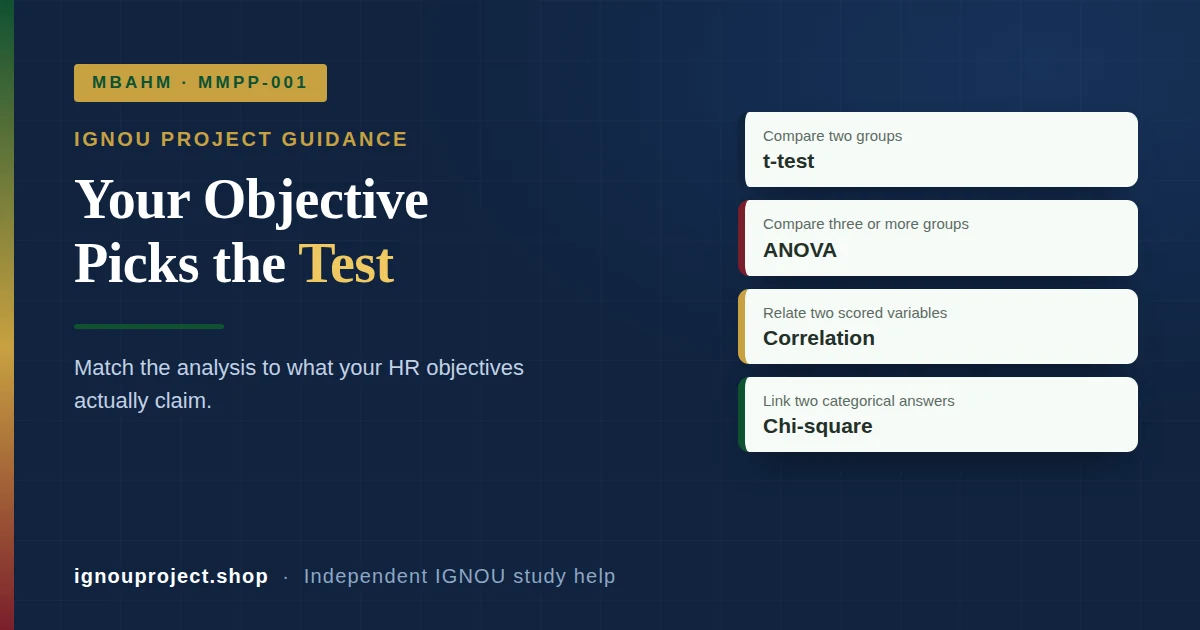
The statistical test for an IGNOU MBAHM project is decided by the wording of your objectives, not by preference. Comparing two groups points to a t-test, three or more to ANOVA, a relationship between two scored variables to correlation, and an association between two categorical answers to chi-square.
The short answer
How is the statistical test for an IGNOU MBAHM project chosen?
Choosing the statistical test for an IGNOU MBAHM project is a matter of matching the analysis to the claim your objective makes. MBAHM refers to the MBA in Human Resource Management, whose project course is MMPP-001, an eight-credit course treated as equivalent to two courses and listed under Semester III of the MBA (New) programme by the School of Management Studies. The synopsis has to state the research methodology, including the data collection tool and the analytic technique, and the finished report is assessed against that approved proposal. An objective that says compare commits you to a comparison test; one that says examine the relationship between commits you to a correlation. Where the two disagree, the analysis chapter cannot answer the objectives it was written to serve, and the mismatch is visible to the evaluator.
Most MBAHM projects fail on analysis not because the mathematics is wrong but because the test answers a different question from the one the objective asked. Fix the objective wording first, then the test follows.
Matching the analysis
Which test fits which MBAHM objective?
HR research produces two kinds of data, and the distinction decides everything downstream. Scored data comes from rating scales, where a respondent’s answers are added into an engagement, satisfaction or motivation score. Categorical data comes from questions with fixed options, such as department, shift, or whether the respondent intends to stay. Comparison and correlation tests work on scored data; chi-square works on categorical data.
| If the objective says | An HR example | Analysis that answers it | What the data must look like |
|---|---|---|---|
| Compare two groups | Engagement scores of permanent versus contract staff | Independent-samples t-test | One score per respondent, and both groups reasonably filled |
| Compare three or more groups | Job satisfaction across four departments | One-way ANOVA | One score per respondent, with each group holding enough cases to stand alone |
| Examine the relationship between two variables | Training satisfaction against intention to stay | Correlation | Two scores for every respondent, paired |
| Test the association between two characteristics | Department against willingness to relocate, answered yes or no | Chi-square | Counts in each cell, none of them very small |
| Assess the effect of one factor on another | Effect of perceived appraisal fairness on retention intention | Regression | Comfortably more respondents than the number of factors modelled |
Sample size
How many respondents does an IGNOU MBAHM project need?
IGNOU does not publish a prescribed minimum for MMPP-001, which is why the figures circulating online contradict one another — some sources suggest keeping the sample under a hundred, others set thirty to fifty as a floor, others quote a hundred as standard. None of these is an official rule. The number that matters is the number your chosen analysis can carry. A t-test across two groups needs both groups populated; an ANOVA across four departments needs four populated groups, so the same total sample stretched across more groups leaves fewer cases in each.
An HR-specific point makes this easier rather than harder. Employee populations are often small and fully known, so if the department under study has sixty people, surveying all sixty is a census, not a sample, and it removes the sampling justification entirely. BK Sahni, who has guided 5,00,000 students till date, notes that MBAHM learners routinely apologise for a small organisation when a complete count of that organisation is the stronger design.
Why it is locked early
Why does the test have to be decided before the synopsis?
The methodology section of the proposal names the data collection tool and the analytic technique, and the report is evaluated against the approved proposal. That makes the test a proposal-stage commitment rather than something to settle once the responses arrive. Changing it later means the analysis chapter no longer matches the document that was approved.
The practical consequence lands on the questionnaire. A test needs the data the questionnaire produces: a correlation needs two scored variables, so the questionnaire must carry two complete scales; a chi-square needs categorical items with usable option counts. Designing the questionnaire before deciding the test is how MBAHM learners end up with responses that cannot answer their own objectives. The full chapter structure and submission route are covered in the MMPP-001 format and topics guide, and the course record sits on eGyanKosh.
Writing it down
What should the MBAHM methodology section state?
- Research design — whether the study is a case study, a comparative study or a field survey.
- Population and sampling — who the respondents are, how they were selected, and whether the study is a sample or a complete count.
- Instrument — the questionnaire or interview schedule, with the scale used and the number of items.
- Analytic technique named explicitly — the test, and the objective it answers, stated together so the link is visible.
- Tools — the software used for the analysis, such as a spreadsheet or a statistics package.
- Ethics — consent from respondents, anonymisation of individual answers, and organisational permission where workplace records are used.
Frequently asked questions
Does an IGNOU MBAHM project have to use statistical tests at all?
Not necessarily. A study built on interviews or on published organisational material can be analysed qualitatively. What matters is that the analysis stated in the approved methodology is the one the report actually performs, and that it answers the objectives.
Can Excel be used instead of SPSS for an MBAHM project?
Yes. A spreadsheet handles descriptive statistics, t-tests, correlation and chi-square without difficulty. Name whichever tool you will use in the methodology section, and use the same one throughout the analysis chapter.
Is there a minimum sample size for the IGNOU MBAHM project?
No official minimum is published for MMPP-001, so the figures quoted on various websites should not be treated as a rule. Justify the number against the analysis you have promised and, where the population is small and fully known, consider surveying everyone rather than sampling.
Can workplace HR data be used in an MBAHM project?
It can, with formal permission from the organisation. Individual records should be anonymised, responses kept confidential, and the data used only for the academic study. Where an organisation is named in the title, confirm that it is willing to be identified before the synopsis is submitted.
If the objectives are drafted but the analysis plan is not settled, that gap is worth closing before the questionnaire goes out rather than after. Details are on the ignouproject.shop pages.

BK Sahni iD 0009-0005-8092-459X
Founder, Shri Chakradhar Publication Pvt. Ltd. & its IGNOU Project study-help brand — helping IGNOU distance-learning students since 2010 (5,00,000+ students supported across MBA, MCom, MA & more). Author of IGNOU exam guides, solved assignments & project reference books.
Disclosure: Shri Chakradhar Publication Pvt. Ltd. and ignouproject.shop are independent third-party study-help services — not the official IGNOU website. Always verify final dates and rules on ignou.ac.in.
Leave a Reply