
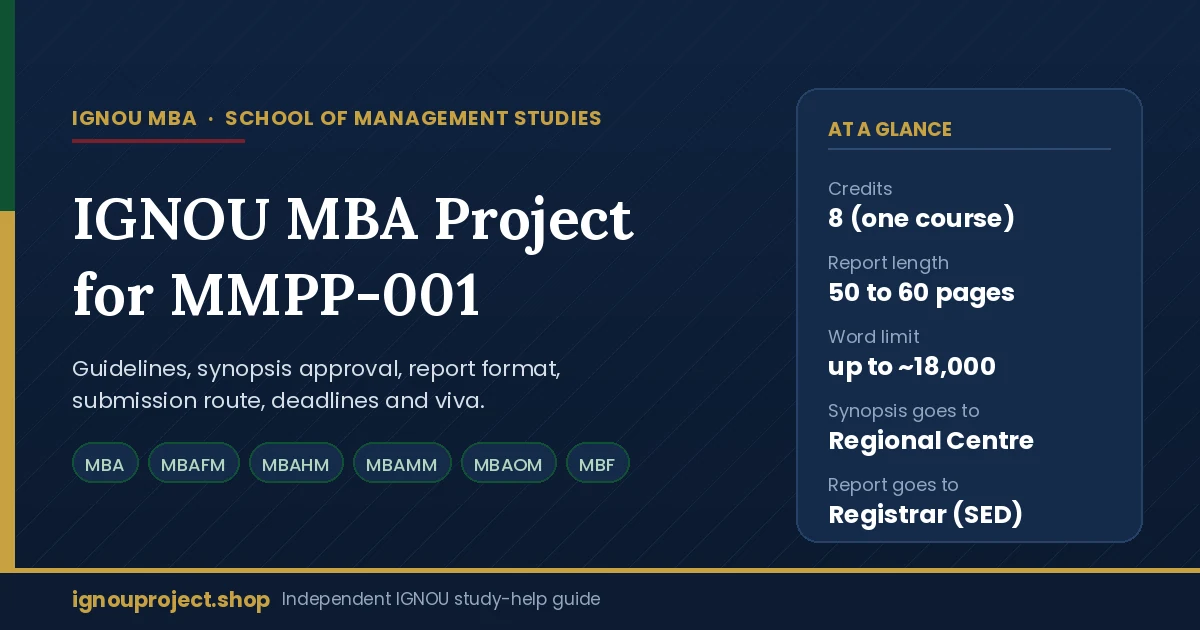
IGNOU MBA · School of Management Studies
MMPP-001 Project Course: what IGNOU actually requires, stage by stage
The IGNOU MBA project for MMPP-001 is an eight-credit project course, treated as one course for registration but equivalent to two. The synopsis is approved by the Regional Centre first, and only then may the project work begin. The report runs about 50 to 60 double-spaced pages and goes to the Student Evaluation Division.
The short answer
What is the IGNOU MBA project for MMPP-001?
MMPP-001 is the compulsory Project Course of the IGNOU MBA, offered by the School of Management Studies. The official guidelines describe it as equivalent to two courses, although for registration purposes it is treated as one course carrying eight credits, and no additional study material is supplied for it. The same course code applies to MBA, MBAFM, MBAHM, MBAMM, MBAOM and MBF learners in the Open and Distance Learning mode, and to MBA (Online) learners. Its stated purpose is to help learners apply multidisciplinary concepts, tools and techniques to analyse organisational problems, on a topic preferably drawn from the learner’s own area of specialisation. The work moves in two approved stages: a synopsis cleared by the Regional Centre, then a project report submitted for evaluation. The synopsis goes to the Regional Director of the learner’s own Regional Centre, and the finished report to the Registrar (Student Evaluation Division) at IGNOU, Maidan Garhi, New Delhi 110068.
Two facts settle most of the confusion around this course. First, MMPP-001 has no examination paper and no study material, so nothing arrives in the post to tell a learner what to do. Second, nothing can be written until the proposal is approved, because the official guidelines state that only on approval of the synopsis may the project work actually be taken up. Everything below follows that sequence.
Quick facts
MMPP-001 credits, programmes and submission routes at a glance
| Particular | Detail |
|---|---|
| Course code | MMPP-001, also written informally as MMPP 1, MMPP-1 or MMPP001. It replaced the earlier MS-100 project course. |
| Course title | Project Course |
| School | School of Management Studies (SOMS) |
| Credits | Eight credits. Equivalent to two courses in workload, but treated as one course for registration. |
| Study material | None. No additional study material is provided for this course. |
| Programmes covered | MBA, MBAFM, MBAHM, MBAMM, MBAOM and MBF in ODL mode, plus MBA (Online) |
| Deliverables | Synopsis (project proposal) first, then the project report |
| Synopsis goes to | The Regional Director of the learner’s Regional Centre. MBA (Online) learners submit through the LMS Portal. |
| Report goes to | The Registrar (Student Evaluation Division), IGNOU, Maidan Garhi, New Delhi 110068. MBA (Online) learners submit through the LMS Portal. See the submission section below for the current online-upload practice. |
| Report length | About 50 to 60 double-spaced typed pages, not exceeding approximately 18,000 words, excluding appendices and exhibits. Rational variation either side is permitted. |
| Evaluation fee | Charged by credit band: Rs. 300 per course up to four credits, Rs. 500 per course above four credits. MMPP-001 carries eight credits and falls in the higher band. |
| Viva-voce | Held only if the evaluator recommends it. The learner is then intimated. |
| Project queries | Assistant Registrar (SED), projects@ignou.ac.in |
Stage one
How do you choose an MMPP-001 topic and an eligible guide?
The official guidelines do not hand out a topic list. They define three acceptable shapes of study, and any workable MMPP-001 topic has to fit one of them.
- Comprehensive case study. A single organisation, covering multifunctional problem formulation, analysis and recommendations.
- Inter-organisational study. Aimed at comparison across organisations, validation of theory, or a survey of management practices.
- Field study. An empirical study built on data the learner collects.
The subject area is recorded separately on the proposal form, and the guidelines list the usual options as HRM and Organisational Behaviour, Accounting and Finance, Operations Management and Information Systems, Marketing, Corporate Management, or another area the learner specifies. The document works this through with an example: a project on the financial performance of a named company is entered with Finance as the subject area. Matching the subject area to the MBA specialisation is the safest route, because the same expectation runs through the guide-selection rule as well.
Guide eligibility is where a large share of proposals fail before the topic is even read. A supervisor for MMPP-001 must be one of the following: management faculty in the School of Management Studies at Headquarters; an approved Academic Counsellor of the Management Programme at a Study Centre with relevant experience; management faculty with five years of postgraduate teaching experience; or a professional holding a Master’s degree in management or an allied discipline with at least five years of experience in the relevant area after that Master’s degree. The relevance test is specific, not general: a marketing topic needs a supervisor with five years in marketing, and the guidelines also ask guides to restrict their supervision to their own core specialisation.
A guide may not supervise more than five MMPP-001 learners at any one time, and the proposal form asks the supervisor to declare how many they are currently guiding. Separately, the University pays the project guide a token honorarium of Rs. 500 for guiding a learner, so a supervisor who asks for a private fee is operating outside the stated arrangement.
The document most proposals fail on
What must the MMPP-001 guide bio-data contain?
The bio-data of a proposed MMPP-001 guide must be detailed, signed in original by the guide and dated, and the guidelines specify exactly which fields it has to carry. Where the supervisor is an approved Academic Counsellor of the Management Programme, no bio-data is required at all. In every other case the guidelines are blunt about the consequence of getting it wrong: if the duly signed bio-data and proforma are not submitted, the synopsis will not be entertained.
| Field | What has to be stated |
|---|---|
| Identity | Name and date of birth of the guide |
| Contact | Full address and contact numbers for both the residence and the current workplace |
| Qualifications | Each degree with its specialisation, the name and address of the awarding university or institution, the year of award, and the percentage of marks obtained |
| Work experience | Chronological order, with designation, period, and the name and contactable address of every organisation |
| Anything else relevant | Any further information bearing on eligibility. A current business card of the proposed guide may also be attached |
Two fields come back incomplete more often than the rest: the percentage of marks against each qualification, which professionals routinely leave out of a working CV, and a contactable address for each past employer rather than a city name. The evaluator assesses eligibility from this sheet alone, so a general-purpose resume is a slower route than a purpose-written one.
Stage two
What must the MMPP-001 synopsis contain?
The project proposal is prepared in consultation with the guide after the topic is settled. The official structure has five parts, and each one is checked.
- Introduction. A brief background to the subject chosen for study.
- Rationale. Why this particular topic has been chosen for the project work.
- Objectives. Described in the guidelines as the most important aspect of any project. They must state clearly and precisely what the learner hopes to know or achieve, may be stated in behavioural terms, and must be expressed neutrally, without implicit assumptions about what the findings will be.
- Research methodology. Research design; the nature and source of data to be collected; the sample and sampling technique with a rationale for the chosen organisation and sample; the tools and questionnaire to be used and their relevance to the objectives; the method of data collection; and the organisation, analysis and statistical tools to be applied, again tied back to the objectives.
- Limitations of the proposed project, if any.
On objectives the guidelines go one step beyond instruction and print a sample block, built on four opening stems: to study, to explore, to analyse and to investigate. Each of those verbs describes an enquiry rather than a result, which is exactly the neutrality the same paragraph asks for. An objective that begins with a verb of proof, such as to prove or to establish, has already assumed its own finding, and that is the reformulation evaluators send back most often.
The synopsis package that travels to the Regional Centre is the proposal itself, the completed Proforma for Approval of Project Proposal (MMPP-001) signed and dated by both the learner and the supervisor, and the supervisor’s signed bio-data. The envelope should carry MMPP-001 written prominently on it, and the learner should keep a copy of everything sent.
This is the detail most MMPP-001 pages leave out entirely. If the maximum programme duration of four years has expired, re-admission must be taken before the synopsis is sent. More importantly, if a synopsis was already approved under an earlier enrolment number, approval has to be sought afresh under the new enrolment number. If that is not done, the guidelines warn that the project report may not be accepted, even though an approval letter exists. Learners who take re-admission after a lapse are exactly the group who miss this and lose an entire evaluation cycle.
The proposal may be sent throughout the year, but it should go to the Regional Centre after registration for MMPP-001, so that at least eight to nine months remain to complete the work before the fourth semester expires. There is a second timing rule with real consequences: if a proposal reaches the Regional Centre more than six months after registration for MMPP-001, the Regional Centre states it will not be responsible for the timely disposal of that proposal.
Stage three
What happens after the MMPP-001 synopsis is submitted?
A proposal complete in all respects is accepted at the Regional Centre and given a Project Proposal Number, unique to the learner, which is then used for all further correspondence about the project. Written communication about approval or non-approval is sent to the learner within two to three months of the proposal reaching the Regional Centre. Work may begin only after that written approval is received.
At the foot of the Proforma for Approval of Project Proposal (MMPP-001) there are two separate decisions for the evaluator to record, side by side. One marks the Synopsis as Approved or Not Approved. The other marks the Supervisor as Approved or Not Approved. The Regional Director or Assistant Regional Director then counter-signs, and the evaluator’s comments are written in the box alongside.
The two outcomes are independent and they have completely different routes back, so the first thing to do with a returned proforma is to read which box was ticked. A synopsis marked Not Approved is revised and resubmitted against the same Project Proposal Number. A supervisor marked Not Approved cannot be revised at all: the learner has to find a new guide and file the whole proposal again as a new proposal.
A resubmitted synopsis travels with four things: a fresh Project Proposal Proforma, a copy of the rejected proposal, the proforma carrying the evaluator’s comments, and the Project Proposal Number already allotted. A change of guide, whether forced by the evaluator or chosen by the learner, carries none of that history and starts again on a new proforma.
BK Sahni, who has guided 5,00,000 students till date, notes that the single most avoidable delay in MMPP-001 is a title changed quietly between approval and submission. The guidelines state that the final project report must necessarily be on the title approved by the evaluator, and that no changes can be made while submitting the final report. A learner who narrows or rewords the title during the research, however sensibly, is submitting a report that no longer matches the approval on file.
Stage four
What is the MMPP-001 project report format?
The report is a write-up of the study exactly as envisaged in the approved synopsis. Length is about 50 to 60 double-spaced typed pages and should not exceed roughly 18,000 words, leaving out appendices and exhibits, with reasonable variation permitted on either side. It is typed on A4, double spaced, and presented as a bound volume.
| Section | What it carries |
|---|---|
| Introduction | Introduction to the project and review of literature, with brief details of the organisation under study, plus rationale, statement of the problem, objectives and scope |
| Research Methodology | Research design, nature and source of data, sample and sampling method with rationale, the questionnaire and other tools used and their purpose, reliability and validity of those tools, data collection and the statistical tools used for analysis |
| Results and Discussion | Results presented in tabular or graphical form, with elaborate interpretation of the data and findings |
| Summary and Conclusion | Consolidated findings drawn against the stated objectives |
| Recommendations | Practical suggestions arising from the findings |
| Limitations | Limitations of the project and directions for further research, marked optional in the guidelines |
| References | Reference list or bibliography |
| Annexures | Appendices including the questionnaire used |
Four items must be present in the final bound report, and their absence is treated as a compliance failure rather than a formatting preference. The cover page must carry the learner’s name and enrolment number, the guide’s name and the project title. A detailed table of contents with page numbers must be included, and every page of the report must be numbered as reflected in that table of contents. The approved proposal package, meaning the project proposal, the approved proforma and the guide’s bio-data, must be properly bound into the report: the guidelines state plainly that a project with a stapled proposal will not be accepted. Finally, a Certificate of Originality, signed and dated by both the learner and the guide, must be included, and the guidelines supply the exact wording, which they say may be reproduced in the same format.
The MMPP-001 guidelines set A4 size, double spacing and a bound volume. They do not name a font, a point size, a margin measurement or a binding colour. Pages that present Times New Roman at 12 point as an IGNOU requirement for MMPP-001 are adding a specification the document does not contain. A plain, readable typeface at a normal body size is consistent with what is actually written, and where a Regional Centre or a guide asks for something more specific, that instruction is the one to follow.
A report received without any of the four compulsory items is returned to the learner for compliance, which in practice costs a full evaluation cycle. The report submitted to the University is not returned after evaluation, so a personal copy should be retained.
Stage five
How and when is the MMPP-001 project report submitted?
Here the official course booklet and current University practice need to be read together, because they say different things and both are still quoted online.
The MMPP-001 project guidelines, as published by the School of Management Studies, direct ODL learners of MBA, MBAFM, MBAHM, MBAMM, MBAOM and MBF to send one typed copy of the report in a bound volume to the Registrar (SED), IGNOU, Maidan Garhi, New Delhi 110068, by registered post, speed post or by hand, with PROJECT REPORT-MMPP-001 written on top of the envelope. A Project Report Number is allotted on receipt and is quoted in all later correspondence. MBA (Online) learners submit through the LMS Portal.
Current practice for each Term-End Examination session is set by a separate Student Evaluation Division notification. For recent sessions the University has opened a dedicated online project submission portal and required the complete report to be uploaded as a single PDF, with reports sent by email not considered for evaluation and incomplete uploads removed from the portal once the last date passes. The practical position, therefore, is that the booklet describes the postal route while the session notification usually opens an online upload window, and the session notification is what governs the current cycle. Learners should confirm the route for their own session on ignou.ac.in before preparing the report for despatch or upload.
The report may be submitted at any time in the year, but the result attaches to a cycle. A report submitted between 1 December and 31 May has its result declared with the June Term-End Examinations. A report submitted between 1 June and 30 November has its result declared with the December Term-End Examinations. Session last dates within those windows are fixed by notification each cycle and have been extended in some sessions, so the current date should always be confirmed rather than assumed.
A viva-voce is not automatic: it is held where the evaluator recommends one, and the learner is intimated in that case. The report must be the learner’s own original work, and the guidelines state that action will be taken as per University policy if a report is found to be plagiarised.
The second deadline
What is the MMPP-001 project evaluation fee and where is it paid?
The MMPP-001 project evaluation fee is Rs. 500. IGNOU charges project evaluation fees by credit band rather than at one flat rate: Rs. 300 per course for project work up to four credits, and Rs. 500 per course above four credits. MMPP-001 carries eight credits, so it sits in the higher band. The same band captures the six-credit M.Com project course MCOP-001, which is why two projects of very different size carry the same fee.
These bands come from University policy applied from the January 2023 admission cycle onwards, notified by the Student Evaluation Division in March 2023. The part that matters for a learner is not the amount but where it is paid. SED runs its own online form for project evaluation and practical examination fees, opened session by session with its own closing date, and in some sessions the fee has instead been collected alongside the Term-End Examination form. Either way, the fee window and the report upload window are set separately.
Two consequences follow. A report uploaded on time against an unpaid fee is not a completed submission, and a fee paid against a report that never reaches the portal is not recoverable, because the University states that fees once paid are neither adjusted nor refunded. Print the acknowledgement, keep it with the submission record, and check the fee schedule for the current session rather than assuming the two dates match.
What goes wrong
Why do MMPP-001 proposals and reports get sent back?
Most rejections trace to a small set of avoidable failures rather than to weak research.
- An incomplete proposal package. A missing signature, an unsigned bio-data or an incomplete proforma means the proposal is not entertained at all, and the guidelines say proposals incomplete in any respect will not be accepted.
- A guide who does not meet the eligibility criteria. This restarts the proposal as a new one, costing months rather than weeks.
- Objectives written as conclusions. An objective that assumes what the study will find breaches the neutrality requirement and forces reformulation.
- A methodology that cannot answer the objectives. Perception-based objectives paired with a purely documentary method, or a sample size stated with no population behind it.
- A title that drifted after approval. The report must carry the approved title exactly.
- A stapled rather than bound proposal inside the report, or a missing Certificate of Originality.
- A proposal sent too late. Beyond six months after registration, timely disposal is no longer assured.
Learners working across other IGNOU programmes will recognise the same architecture at work, since the proposal, approval and originality-certificate sequence repeats across codes; the IGNOU project synopsis, format and submission guide sets out how that common structure varies by programme.
Topic direction
What are workable IGNOU MBA project topics for MMPP-001?
Topic selection is left to the learner, preferably within the area of specialisation. The examples below are directions rather than a list to copy, because a topic repeated verbatim from any published list is a weak starting point for an original study.
| Specialisation | Direction that fits the guidelines |
|---|---|
| Human Resource Management (MBAHM) | Training effectiveness, employee engagement or performance appraisal practice inside one organisation, framed as a comprehensive case study with a survey instrument |
| Financial Management (MBAFM) | Financial performance, working capital or capital structure of a named company across defined financial years, using published statements as the data source |
| Marketing Management (MBAMM) | Consumer buying behaviour, brand preference or channel effectiveness in a defined market, structured as a field study |
| Operations Management (MBAOM) | Inventory control, quality management or supply chain practice, suited to an inter-organisational comparison |
| Banking and Finance (MBF) | Credit appraisal, asset quality or service quality in selected banks, comparing practice across institutions |
Whichever direction is chosen, the objectives should be written first and the data method chosen afterwards, because the methodology section has to demonstrate that the stated tools can actually answer the stated objectives.
The full MMPP-001 project guidelines, including the Proforma for Approval of Project Proposal and the Certificate of Originality wording, are published by the School of Management Studies on ignou.ac.in and mirrored in the official repository at eGyanKosh. Session-specific last dates, the submission route and the evaluation fee should be confirmed against the current notification and with the Regional Centre before anything is sent.
Frequently asked
IGNOU MBA project MMPP-001: common questions
How many credits is MMPP-001 and which semester is it taken in?
MMPP-001 carries eight credits. The official guidelines describe it as equivalent to two courses while treating it as a single course for registration purposes. The timing guidance is tied to completion rather than a fixed semester: the proposal should reach the Regional Centre after registration for MMPP-001 so that eight to nine months remain to finish the work before the fourth semester expires.
Is MMPP-001 the same as MMPP 1, MMPP-1, MMPP001 or MS-100?
MMPP 1, MMPP-1 and MMPP001 are informal ways of writing the same code, and MMPP-001 is the canonical form used on the proforma and in the guidelines. MS-100 is the earlier project course code that MMPP-001 replaced; the proforma itself refers to students being guided for the project course as earlier MS-100 and revised MMPP-001.
How many pages should the MMPP-001 project report be?
About 50 to 60 double-spaced typed pages, not exceeding approximately 18,000 words, excluding appendices and exhibits. The guidelines allow rational variation on either side, so a report slightly outside that band is acceptable if the content justifies it.
Where is the MMPP-001 synopsis submitted?
ODL learners of MBA, MBAFM, MBAHM, MBAMM, MBAOM and MBF send it to the Regional Director of their own Regional Centre, with MMPP-001 written prominently on the envelope. It can also be forwarded to the concerned Regional Centre email address listed in the regional network section of ignou.ac.in. MBA (Online) learners submit it to the Regional Director of their designated Regional Centre through the LMS Portal.
How long does MMPP-001 synopsis approval take?
Written communication about approval or non-approval is sent within two to three months of the proposal being received at the Regional Centre. If the proposal arrives more than six months after registration for MMPP-001, the Regional Centre states it is not responsible for timely disposal, which is why sending the proposal early matters more than sending a perfect one late.
What is the MMPP-001 project fee?
Rs. 500. IGNOU sets project evaluation fees by credit band from the January 2023 admission cycle onwards, at Rs. 300 per course up to four credits and Rs. 500 per course above four credits, and MMPP-001 carries eight credits. The fee is paid through the Student Evaluation Division fee form for the session, which has its own last date, and it is neither adjusted nor refunded once paid.
Is there an official MMPP-001 sample project or synopsis PDF to download?
IGNOU publishes the MMPP-001 project guidelines, the Proforma for Approval of Project Proposal and the wording of the Certificate of Originality. It does not publish a model completed project report, a sample synopsis or a bank of approved topics for download. A file circulating as an official MMPP-001 sample PDF is normally another learner’s submitted work or a private compilation, and copying from one risks the plagiarism rule. Download the guidelines and the proforma from ignou.ac.in or eGyanKosh and use those as the format reference.
What is asked in the MMPP-001 viva-voce?
The guidelines do not publish a question list, because the viva is held only where the evaluator recommends it and its purpose is to confirm that the work is the learner’s own. In practice the ground covered is the report itself: why the topic was chosen, what the objectives were, how the sample was drawn, why those statistical tools were used, what the findings show and which limitations the learner accepts. Being able to defend the methodology chapter without reading from the document is the useful preparation.
Is a viva-voce compulsory for the IGNOU MBA project?
No. A learner may be asked to appear for a viva-voce if the evaluator recommends it, and is duly intimated in that case. It is not held for every MMPP-001 submission.
This page is independent study-help guidance and is not the official IGNOU website. Requirements, submission routes, last dates and fees are set by Indira Gandhi National Open University and can change between sessions; verify every procedural detail against the current MMPP-001 project guidelines, the live session notification and your Regional Centre before you submit.

Leave a Reply