
MTTM · MTTMP-119 · SOTHSM
IGNOU MTTM Project (MTTMP-119): Dissertation Guide for 2026
The IGNOU MTTM project is MTTMP-119 Dissertation Work, an 8-credit Semester 4 course of the Master of Tourism and Travel Management. The learner picks a tourism topic and a recognised supervisor, gets the proposal approved by the MTTM Programme Coordinator, completes the research, and submits the dissertation for evaluation.
The course in one view
What is the IGNOU MTTM project?
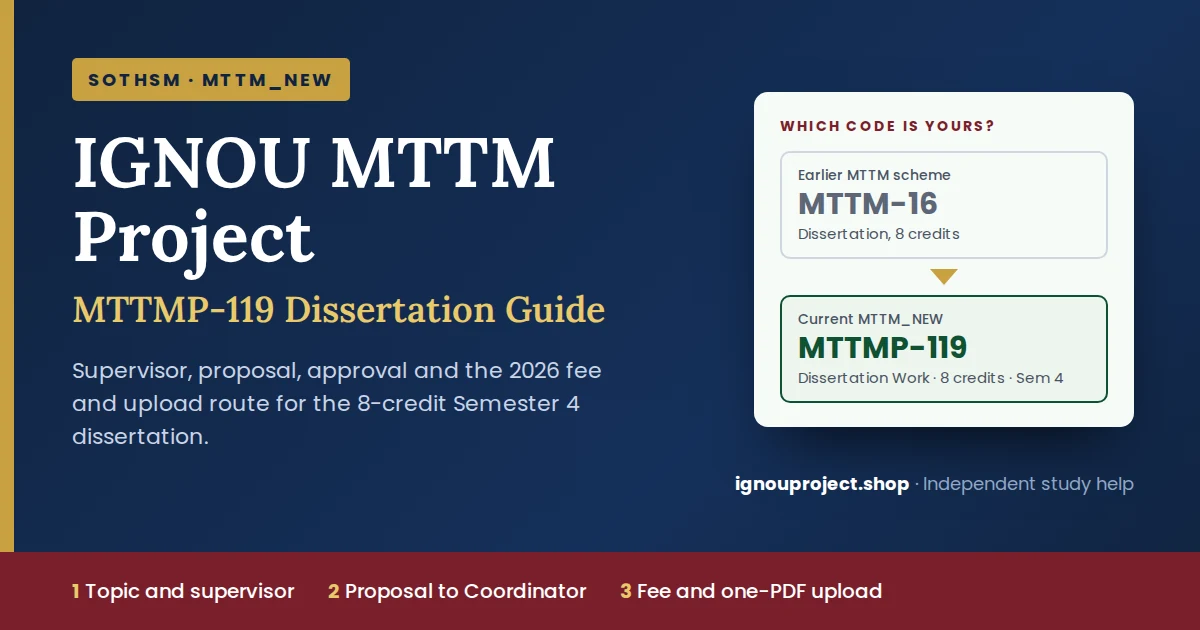
The IGNOU MTTM project refers to MTTMP-119 Dissertation Work, the 8-credit project course of the Master of Tourism and Travel Management (MTTM) offered by the School of Tourism and Hospitality Service Management (SOTHSM) at Indira Gandhi National Open University. In the current programme listing, MTTM_NEW, MTTMP-119 sits in Semester 4 alongside MTTM-116, MTTM-117 and MTTM-118. IGNOU states that the dissertation builds research competence through independent research on real tourism and hospitality issues, applying theory, research methods and analytical skills. Learners from the earlier MTTM scheme know the same component as MTTM-16 Dissertation, also 8 credits. The working sequence is the same in both: choose a topic and a recognised supervisor, get the dissertation proposal approved by the Programme Coordinator (MTTM), carry out the study, then submit the report to the Student Evaluation Division with the project fee paid for that Term-End Examination session.
Most MTTM project pages online still describe only MTTM-16. The table below uses the current official listing first and marks where the older dissertation guide still fills a gap.
| Programme | Master of Tourism and Travel Management (MTTM), ODL mode, listed as MTTM_NEW |
|---|---|
| School | School of Tourism and Hospitality Service Management (SOTHSM) |
| Project course | MTTMP-119 Dissertation Work (earlier scheme: MTTM-16 Dissertation) |
| Credits and semester | 8 credits, Semester 4 |
| Same semester | MTTM-116 Cultural Production and Heritage Management, MTTM-117 Innovation, Entrepreneurship and Incubation in Tourism, MTTM-118 Tourism Destination Management |
| Research preparation | MTTM-113 Research Methodology for Tourism and Hospitality, Semester 3 |
| Programme eligibility | Any graduate from a recognised institution or university |
| Programme duration | Minimum 24 months, maximum 48 months |
| Proposal approval | Programme Coordinator (MTTM), School of Tourism at IGNOU, Maidan Garhi, New Delhi |
| Final report | Student Evaluation Division (SED), single-PDF upload on the online project portal |
| Project evaluation fee | Above-4-credit band (Rs. 500 on the portal for the January 2023 admission cycle onwards) |
| December 2026 fee deadline | 30 November 2026, paid through the IGNOU Samarth login (SED notice dated 18 September 2026) |
Old scheme or new
MTTMP-119 or MTTM-16: which dissertation rules apply to you?
The rules on your registration apply, and the course code on your identity card and fee receipt tells you which scheme that is. IGNOU’s current programme page for MTTM_NEW lists MTTMP-119 Dissertation Work at 8 credits in Semester 4. The older MTTM scheme, still described on most help sites, placed the 8-credit dissertation under MTTM-16 within a 68-credit programme that had separate admission categories for tourism and non-tourism graduates.
The two schemes differ in structure, but the dissertation itself has kept its shape. The only full dissertation guide published by the School of Tourism on eGyanKosh is still the MTTM-16 Dissertation Guide, and no separate MTTMP-119 handbook appears on the programme page at the time of writing. Until one is issued, that guide remains the working reference for the proposal, the supervisor and the report, with the current SED notices governing fee and submission.
| Point | Earlier MTTM scheme | Current MTTM_NEW |
|---|---|---|
| Dissertation code | MTTM-16 Dissertation | MTTMP-119 Dissertation Work |
| Credits | 8 | 8 |
| Programme total | 68 credits, as widely reported | 18 theory courses of 4 credits plus the dissertation, which adds up to 80 credits on the official list |
| Admission | Category 1 for tourism graduates; Category 2 for other graduates, with four extra courses | Any graduate, one route |
| Research methods course | Part of the earlier course set | MTTM-113, Semester 3 |
| Written dissertation guide | MTTM-16 Dissertation Guide on eGyanKosh | No separate guide listed yet; the MTTM-16 guide is the reference |
| Code to write on documents | MTTM-16 | MTTMP-119 |
BK Sahni, who has guided 5,00,000 students till date, notes that the most common MTTM error in the current cycle is a MTTMP-119 learner copying a MTTM-16 cover page word for word, course code included. The guide’s layout is still useful; the code on it is not. Replace MTTM-16 with MTTMP-119 on the proforma, the first page and the declaration, and quote the enrolment number exactly as it appears on the identity card.
Planning across semesters
When should the MTTMP-119 dissertation start?
Start in Semester 3, not Semester 4. MTTMP-119 is registered in the final semester, but the proposal has to clear the Programme Coordinator before any data is collected, and one round of comments can take weeks by post. MTTM-113 Research Methodology for Tourism and Hospitality, taught in Semester 3, covers research design, literature review, sampling, data collection, analysis, research ethics and thesis writing, which is almost exactly what a dissertation proposal asks for.
- Semester 3, first half: study MTTM-113 and shortlist two or three topic areas from courses already completed.
- Semester 3, second half: fix one topic, confirm a supervisor, and draft the proposal with the supervisor’s comments.
- Start of Semester 4: send the signed proposal and wait for the approval letter. Revise on comments if it comes back.
- Semester 4, middle: collect and analyse data on the approved title only.
- Semester 4, end: write the report, pay the project fee by the notified date and upload the single PDF before the portal closes.
This plan assumes the minimum duration. The programme allows up to 48 months, so a learner who falls behind can submit in a later Term-End Examination session, provided the registration is valid.
Guidance
Who can supervise an IGNOU MTTM dissertation?
A supervisor recognised by IGNOU guides the IGNOU MTTM project, and the MTTM-16 Dissertation Guide treats every academic counsellor of the MTTM programme at the study centres as a recognised supervisor. The list of counsellors is held by the coordinator of the learner’s study centre. The guide also advises choosing someone the learner can reach easily, because supervision runs from topic selection to the final signature.
Academic counsellors at the study centre
This is the default route and needs no separate clearance. Ask the study centre coordinator for the current counsellor list before approaching anyone.
A supervisor from the tourism industry or a college
Reproductions of the MTTM-16 guide on several study-help sites describe an outside supervisor as acceptable if the person is at manager level or above in the tourism industry, or has at least three years of teaching experience in an academic post, with a short bio-data sent alongside the proposal for clearance. Those conditions could not be checked against the original PDF for this article, so confirm them with the Programme Coordinator (MTTM) before relying on an outside supervisor.
IGNOU tourism faculty for Delhi-based learners
The guide notes that learners based in Delhi may approach the School’s own tourism faculty as supervisors, while still advising a supervisor who is easy to access. For MTTMP-119, IGNOU’s programme page lists Dr. Tangjakhombi Akoijam as the course coordinator; that is the contact point for questions about the course, not an automatic supervisor.
The first submission
What goes into the MTTM dissertation proposal pack?
The proposal pack is the dissertation proposal, signed by the supervisor, sent to the Programme Coordinator (MTTM) at the School of Tourism, IGNOU, Maidan Garhi, New Delhi. The MTTM-16 Dissertation Guide gives the office as Block 15 and asks learners to prepare the proposal in consultation with the supervisor. Addresses and block numbers change between prints, so check the School’s page on ignou.ac.in before posting.
Before the envelope is sealed, the pack should contain:
- The dissertation proposal proforma as the cover page, filled in completely, with the supervisor’s signature. Guide reproductions place it at Annexure A.
- The synopsis: title, background, objectives, research questions or hypotheses, methodology, sample and data sources, and a working chapter plan.
- A short bio-data of the supervisor if that person is not an MTTM counsellor at a study centre.
- A full postal address with PIN code, since the acknowledgement and comments are reported to return by post.
- A copy of everything kept by the learner, because the university does not return the original.
The School’s name appears in two forms in official material. The programme page uses School of Tourism and Hospitality Service Management (SOTHSM), while the dissertation guide and some university notices use the longer School of Tourism and Hospitality Service Sectoral Management (SOTHSSM). Both refer to the same School, and either form on an envelope reaches it.
If it comes back
What happens if the MTTM proposal is not approved?
The proposal comes back with the Programme Coordinator’s comments, and the learner resubmits a revised version. The MTTM-16 Dissertation Guide asks that the resubmission carry a copy of the rejection letter bearing those comments, so the reviewer can see what was asked and what changed. A fresh proposal sent without that letter is treated as a new submission, and the earlier comments are lost from view.
The reasons proposals come back are predictable:
- A topic outside tourism and hospitality management, for example a general marketing or HR study with no tourism setting.
- Objectives that cannot be met in one semester, such as a national survey by a single learner.
- No reachable data source, for instance a hotel chain study with no access to its staff or guests.
- An unsigned or incomplete proforma, or an outside supervisor sent without bio-data.
- The wrong course code, MTTM-16 written by a MTTMP-119 learner.
- Methodology copied from another programme, with no link to tourism variables.
Fee and upload
How is the MTTMP-119 report submitted and the fee paid in 2026?
The finished IGNOU MTTM project report under MTTMP-119 is uploaded as one PDF on IGNOU’s online project portal, and the project evaluation fee is paid separately before the notified last date. For the December 2026 Term-End Examination, a Student Evaluation Division notification dated 18 September 2026 states that project, internship and practical course fees are to be paid through the learner’s own IGNOU Samarth portal login, with 30 November 2026 as the last date and no fee accepted after it.
This is a change in route worth noticing. The project portal’s June 2025 guidelines said the fee was paid along with the Term-End Examination form, and that a report without the fee would not be evaluated. The September 2026 notice moves the payment to the Samarth login. For December 2026 the newer notice is the one to follow; the June 2025 text shows how it used to work.
The portal guidelines set the rest of the submission:
- The first page of the PDF carries the dissertation title, learner’s name, programme code, enrolment number as printed on the identity card, Regional Centre code, course code, mobile number and email address.
- The approved proposal proforma, the synopsis, the supervisor’s bio-data where applicable and the originality certificate signed by learner and supervisor go inside the same file.
- Scans must be clear, correctly ordered and in one orientation.
- Reports sent by email are not evaluated, and incomplete uploads are removed after the last date.
- The fee receipt is attached with the report.
- Any viva-voce is arranged under the concerned Regional Centre, so that is where to ask.
The portal is only for final reports. The synopsis still goes to the Programme Coordinator for approval and must not be uploaded there.
Choosing the question
Which topics fit the new MTTM syllabus?
Topics hold up well when they grow out of a course already studied, because the evaluator can see the link and the learner already knows the literature. The MTTM-16 guide suggests themes such as architectural styles and their relation to tourism, archaeological sites and tourist flow, and events, and it says learners are free to add their own. The directions below map to MTTM_NEW courses and are examples, not an approved list.
| Course it draws on | Example topic direction |
|---|---|
| MTTM-109 Special Interest Tourism Products | Visitor expectations on a rural or wellness tourism package in one district |
| MTTM-111 Tourism Content Creation and Dissemination | How travel reels shape destination choice among first-time visitors to a hill town |
| MTTM-112 Technological Environment and Tourism | Use of online check-in and digital keys in mid-range hotels of one city |
| MTTM-114 Digital Marketing for Tourism | Response to online reviews by homestay owners and its link with repeat bookings |
| MTTM-115 MICE Management | Venue selection factors for corporate conferences in a state capital |
| MTTM-116 Cultural Production and Heritage Management | Tourist flow and site management at a protected monument |
| MTTM-117 Innovation, Entrepreneurship and Incubation in Tourism | Start-up barriers faced by small tour operators after registration |
| MTTM-118 Tourism Destination Management | Stakeholder roles in managing peak-season crowding at a pilgrimage town |
Pick a setting within reach. One monument, one hotel cluster or one town studied properly gives a stronger dissertation than a nationwide claim with thin data.
Length and format
Is there an official word limit for the MTTM dissertation?
No official word or page limit for the IGNOU MTTM project under MTTMP-119 was found in the IGNOU documents reviewed for this article. Figures such as 8,000 to 15,000 words for the report, or 8 to 12 pages for the synopsis and 70 to 100 pages for the report, circulate on help sites, but none of them traces back to a current IGNOU notice. Agree the length with the supervisor, follow the MTTM-16 guide’s structure, and keep the approved title unchanged on the final report.
What is published and what is not: the 8 credits, the Semester 4 placement, the Programme Coordinator route, the single-PDF upload rule, the fee band and the December 2026 fee date all come from IGNOU sources. Word counts, page counts and mark splits quoted elsewhere do not.
How the MTTM route compares with management and humanities programmes is set out in the IGNOU project guide covering every programme, which also explains the portal steps common to all courses.
Quick answers
IGNOU MTTM project: frequently asked questions
What is the course code for the IGNOU MTTM project?
The current code is MTTMP-119 (Dissertation Work). Students also search for it as MTTMP 119, MTTMP119, MTTM 119 or MTTMP-19, and learners of the earlier scheme use MTTM-16 or MTTM 16. Write the code shown on your own registration.
How many credits is MTTMP-119, and in which semester is it done?
MTTMP-119 carries 8 credits and is listed in Semester 4 of the Master of Tourism and Travel Management (MTTM_NEW), next to MTTM-116, MTTM-117 and MTTM-118.
Where should the MTTM dissertation proposal be sent?
To the Programme Coordinator (MTTM) at the School of Tourism, IGNOU, Maidan Garhi, New Delhi, signed by the supervisor. The MTTM-16 guide names Block 15; confirm the current address on ignou.ac.in before posting.
Can an academic counsellor at my study centre be my supervisor?
Yes. The MTTM-16 Dissertation Guide recognises all academic counsellors of the MTTM programme at study centres as supervisors. The study centre coordinator keeps the list.
What is the project fee for MTTMP-119, and when is it due for December 2026?
The project portal lists Rs. 500 for project work above 4 credits for the January 2023 admission cycle onwards, which covers the 8-credit MTTMP-119. For the December 2026 Term-End Examination, the fee is paid through the Samarth login by 30 November 2026.
Can the dissertation title change after approval?
Reproductions of the MTTM-16 guide say the final report must carry the title from the approved proposal. If the study has to change direction, write to the Programme Coordinator before submitting rather than altering the title on the report.
Verify before you act: the course list and credits are on the official IGNOU MTTM programme page, and the dissertation guide is on eGyanKosh. Fee dates and portal rules change by session, so the newest SED notice takes precedence over this page.
If the proposal is where the work has stalled, a review of the topic, objectives and method before it goes to the Programme Coordinator can save a round of comments. Details are on the ignouproject.shop project pages.
Independent study-help disclosure: ignouproject.shop is run by Shri Chakradhar Publication Pvt. Ltd. and is not the official website of IGNOU or its School of Tourism. This article summarises published university documents for guidance only; official notifications on ignou.ac.in prevail over anything written here.

BK Sahni iD 0009-0005-8092-459X
Founder, Shri Chakradhar Publication Pvt. Ltd. & its IGNOU Project study-help brand, helping IGNOU distance-learning students since 2010 and having guided 5,00,000 students till date across MBA, MCom, MA & more. Author of IGNOU exam guides, solved assignments & project reference books.
Disclosure: Shri Chakradhar Publication Pvt. Ltd. and ignouproject.shop are independent third-party study-help services, not the official IGNOU website. Always verify final dates and rules on ignou.ac.in.
Leave a Reply