
IGNOU Project Guides
IGNOU MSCHSC Project: MHCP-001 and MHCP-002 Explained
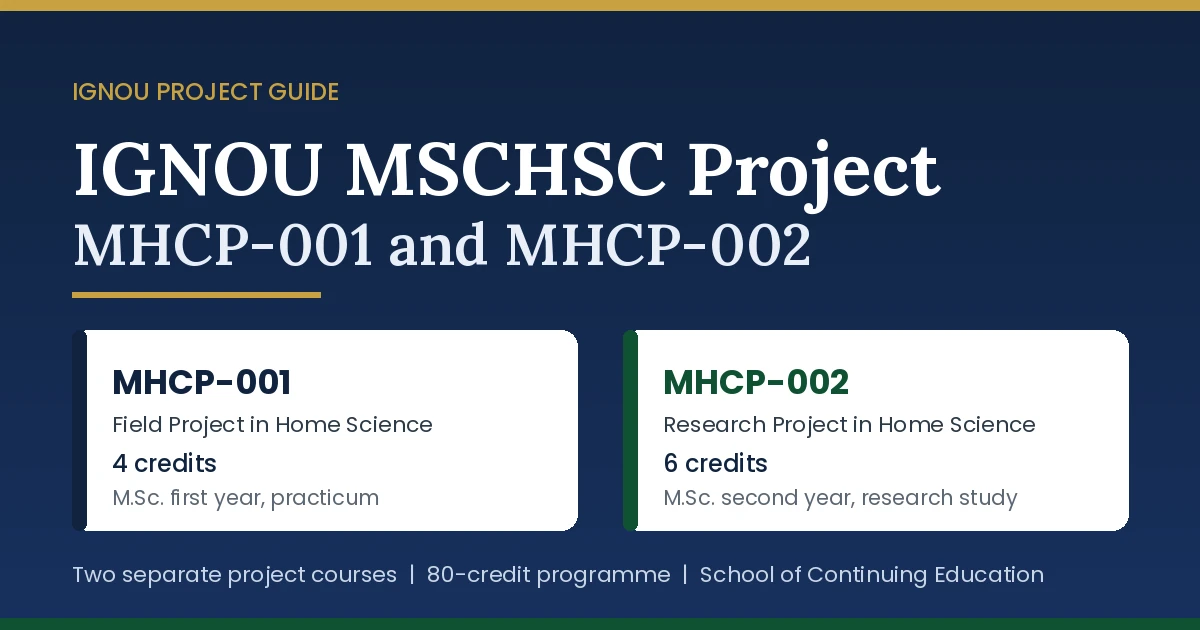
The IGNOU MSCHSC project is not one piece of work. M.Sc. (Home Science – Community Development and Extension Management) carries two separate project courses: MHCP-001, a 4-credit field project in the first year, and MHCP-002, a 6-credit research project in the second year. Each is registered, done and assessed on its own.
What is the IGNOU MSCHSC project?
The IGNOU MSCHSC project refers to the two project courses inside M.Sc. (Home Science – Community Development and Extension Management), programme code MSCHSC, offered by the School of Continuing Education (SOCE) at Indira Gandhi National Open University. The first is MHCP-001, Field Project in Home Science, a 4-credit practicum placed in the first year. The second is MHCP-002, Research Project in Home Science, a 6-credit research study placed in the second year. Together they account for 10 of the 80 credits required for the degree. MHCP-001 is built around practical activities listed in the Project Handbook. MHCP-002 is an independent quantitative or qualitative study, normally tied to a voluntary organisation, an NGO or a government agency, and it is the piece that finishes the Master’s degree.
That distinction matters more than it sounds. A large share of the pages ranking for this keyword describe MHCP-001 as the synopsis and MHCP-002 as the final report, as if they were two halves of one submission. IGNOU’s own course structure does not say that. It lists them as two courses, in two different years, carrying different credit weights, with different course titles and different kinds of work behind them.
| Detail | MHCP-001 | MHCP-002 |
|---|---|---|
| Course title | Field Project in Home Science | Research Project in Home Science |
| Course type | Project | Project |
| Credits | 4 | 6 |
| Year | M.Sc. first year | M.Sc. second year |
| Nature of work | Practicum, experiential, driven by the activities listed in the Project Handbook | Independent research study, quantitative or qualitative, with a defined methodology |
| Typical setting | Chosen alongside first-year courses, on a topic of the learner’s interest | Undertaken with a selected voluntary organisation, NGO or government agency |
| Programme | MSCHSC, School of Continuing Education, 80 credits, English medium, annual examination mode | |
The correction most pages get wrong
Why MHCP-001 and MHCP-002 are two projects, not two halves of one
MHCP-001 and MHCP-002 are separate credit-bearing courses. The IGNOU course structure for MSCHSC lists MHCP-001 as Field Project in Home Science, type Project, 4 credits, in the first year, and MHCP-002 as Research Project in Home Science, type Project, 6 credits, in the second year. Nothing in that structure describes MHCP-001 as a proposal for MHCP-002.
The two course descriptions published by IGNOU point in different directions as well. MHCP-001 is described as a practicum based form of experiential learning, with practical activities listed in the Project Handbook, and with the learner free to choose a topic of interest while studying the first-year courses. MHCP-002 is described as a study that can be undertaken with selected voluntary organisations or government agencies, that may be quantitative or qualitative, and that must carry research significance and follow a proper research methodology.
BK Sahni, who has guided 5,00,000 students till date, notes that this is the single most expensive misreading in MSCHSC project work: a learner who treats MHCP-001 as a synopsis often postpones it to the second year, and then finds that a first-year project credit is still sitting incomplete on the grade card while the second-year research study is already due.
One more consequence worth knowing. MSCHSC has an exit option. Launch Notification No. 146 records PGDCDEM, the P.G. Diploma in Community Development and Extension Management, as an exit after completion of the first year. MHCP-001 sits inside that first year. A learner who plans to exit with the diploma still has the field project to complete, because it is part of the 40 first-year credits.
Programme map
Where each project sits in the 80-credit MSCHSC structure
MSCHSC totals 80 credits over two years, 40 in each year, with an annual examination mode rather than a semester pattern. It is offered by the School of Continuing Education in English only, and eligibility is a Bachelor’s degree in any discipline. The semester labels shown against each course on the IGNOU website confuse learners; the launch notification is the document that records the examination mode as annual.
| Year | Courses | Credits |
|---|---|---|
| First year, theory | MHC-001 Fundamentals of Development and Extension (6), MHC-002 Community Organisation and Community Development (4), MDC-003 Media in Development Communication (6), MDC-005 Development: Information and Communication Technologies (6), MHC-003 Programme Planning and Evaluation (4), MHC-004 Participatory Community Development (4) | 30 |
| First year, elective | Any one of MGS-001 Gender and Development: Concept, Approaches and Strategies, or MRD-202 Rural Development Programmes | 6 |
| First year, project | MHCP-001 Field Project in Home Science | 4 |
| Second year, theory | MHC-005 Community Sciences and Community Development: Emerging Issues (8), MDV-110 Training and Development (6), MHC-006 Management of Maternal and Child Health (4), MHC-007 Social and Behaviour Change (6), MHC-008 Research Methods in Community Development and Extension Management (4) | 28 |
| Second year, elective | Any one of MEDS-051 Fundamentals of CSR, or MHC-009 Rural Development: Issues and Concerns | 6 |
| Second year, project | MHCP-002 Research Project in Home Science | 6 |
Two details in that table matter. First, MHC-008 sits in the same year as MHCP-002 and covers research designs, sampling, field research, tools for data collection and data analysis. It is the toolkit course for the research project, and reading it before finalising a design saves rework later.
Second, the first-year assignment count confirms the split. IGNOU’s MSCHSC assignment booklets state that seven assignments in total, covering six compulsory courses and one elective course, are to be completed in the first year. Six compulsory theory courses plus one elective is exactly seven. MHCP-001 is not in that count, because a project course is not assessed through an assignment. If a learner is looking for an MHCP-001 assignment question paper, there is not one to find.
First-year track
MHCP-001 Field Project in Home Science: what the first-year practicum asks for
MHCP-001 asks the learner to do practical work, not to write a proposal. IGNOU describes it as a practicum based form of experiential learning course, and states that the practical activities the learner must carry out are listed in the Project Handbook, which is supplied as self learning material for the course. The Handbook, not a blog template, is the specification for this course.
Where to get the MHCP-001 Project Handbook
The MHCP-001 material is catalogued on eGyanKosh under IGNOU Self Learning Material, School of Continuing Education, Master’s Degree Programmes, MSCHSC First Year. Search the repository at egyankosh.ac.in for the course code MHCP-001 and open the Field Project in Home Science collection. If the print copy has reached the learner through the study material dispatch, that is the same document.
How to choose the field project topic
IGNOU’s own wording is that learners can choose a topic of their interest while doing the first-year courses. In practice that means the field project runs alongside MHC-001 to MHC-004, rather than after them. The topic should be something the learner can reach physically and repeatedly: a self-help group in the same block, an anganwadi centre, a school kitchen garden, a mahila mandal, a skill training batch, a village water committee. Reach beats ambition here, because the practical activities in the Handbook need data the learner actually gathers.
What the field project tends to require in practice
- Fixing a community and a theme early, while the first-year theory courses are still being studied.
- Working through the practical activities set out in the Project Handbook rather than inventing a chapter plan.
- Using the tools and methods the Handbook orients the learner towards for gathering data.
- Recording observations as they happen, because a field project rewritten from memory at the end shows.
- Confirming the MHCP-001 submission route with the Regional Centre, since practicum records and research reports are not always routed identically.
Second-year track
MHCP-002 Research Project in Home Science: what the second-year study asks for
MHCP-002 is the research study that completes the degree. IGNOU’s course description sets three conditions on it, and all three are worth reading literally. The project can be undertaken with selected voluntary organisations or government agencies, using scientific knowledge in community development and extension management. It may be quantitative or qualitative. The learner must ensure that the topic has research significance and follows a proper research methodology.
The organisational tie-up is the part learners skip most often. IGNOU explicitly frames it as a benefit: linking the project to a local community, NGO, related institution or organisation builds insight into how development projects are actually run after the Master’s is finished. A study designed around a real organisation also solves the practical problem of access to respondents, which is where most stalled projects stall.
Quantitative or qualitative, and how to decide
Both are allowed, so the choice should follow the question rather than convenience. A question about coverage, uptake, prevalence or difference between two groups points to a quantitative design with a structured tool and a defined sample. A question about how a programme is experienced, why an intervention is resisted, or how a community negotiates a change points to a qualitative design with interviews, focus groups or case studies. Mixing the two is possible, but it doubles the fieldwork and the analysis, and it is rarely necessary at this level.
A workable chapter shape
IGNOU has not published a chapter-by-chapter template specific to MHCP-002 on its public pages. What it has published is the requirement that the study follow a proper research methodology, and MHC-008 is the course that defines what that means. A structure that satisfies a methodology reader usually runs: introduction and statement of the problem, review of literature, objectives, methodology covering design, sampling, tools and data collection, results and analysis, discussion, conclusion, references, and annexures holding the tool used. Confirm the shape with the assigned guide before writing, because the guide signs off on the work.
Accuracy check
Which MSCHSC project figures are official, and which are only circulating
Search results for this course code carry a lot of confident numbers. Very few of them trace back to an IGNOU document. The table below separates what is published from what is repeated.
| Point | Status |
|---|---|
| MHCP-001 is 4 credits, MHCP-002 is 6 credits | Published. Both appear with these credit values on the IGNOU MSCHSC programme page and in Launch Notification No. 146. |
| MSCHSC totals 80 credits, 40 per year | Published in Launch Notification No. 146, and the course-wise credits on the programme page add up to the same total. |
| MHCP-001 is a proposal and MHCP-002 is the report | Not supported by any IGNOU document found. The official course titles and credit values describe two distinct projects. |
| Proposal must be 8 to 15 pages; report must be 60 to 100 pages | Circulating without a traceable official source. No page range for MHCP-001 or MHCP-002 appears on the IGNOU programme page or in the launch notification. Confirm with the Project Handbook, the programme guide or your Regional Centre. |
| MSCHSC stands for Human Science, or for Counselling and Family Therapy | Incorrect. IGNOU lists MSCHSC as M.Sc. (Home Science – Community Development and Extension Management). |
| Guides are allotted by the University and cannot be chosen | Circulating without a traceable official source for this programme. Guide eligibility and allotment for MSCHSC should be confirmed with the Regional Centre or the Programme Coordinators at the School of Continuing Education. |
| Programme fee | Changed over time. Launch Notification No. 146, dated 13 June 2024, records Rs. 14,000 for the full programme. The current IGNOU MSCHSC programme page records Rs. 15,000 for the full programme at Rs. 7,500 per year. The programme page is the current figure. |
| Maximum duration | Changed over time. The launch notification records a maximum of 5 years. The current programme page records a minimum of 24 months and a maximum of 48 months. The programme page is the current figure, and it is worth confirming in writing before planning a long completion timeline. |
| Separate project evaluation fee for MHCP-001 or MHCP-002 | No separate evaluation fee for these two course codes is published on the MSCHSC programme page. Confirm with your Regional Centre before paying anything. |
Topic selection
How to choose an MSCHSC project topic that survives approval
A topic clears review when it is anchored to the programme’s own subject matter, small enough to finish, and reachable in the field. The MSCHSC programme description names the areas the degree is built on: extension and institutional management, development communication, social and behaviour change, advocacy, resource mobilisation, participatory media, gender mainstreaming, maternal and child health, researching in communities, and interdisciplinary areas of Home Science. A topic that maps cleanly onto one of those areas already answers the first question a reviewer asks.
Four directions that fit the programme and stay finishable:
- Maternal and child health delivery. Awareness, utilisation or drop-off in one defined service, in one block (MHC-006).
- Extension and skilling. Uptake of a training programme by a named group, and what changed after it (MDV-110, MHC-003).
- Development communication. How a nutrition, sanitation or scheme message actually travels through a community (MDC-003, MDC-005, MHC-007).
- Participatory community development. How a self-help group or village institution decides, and who is left out (MHC-004).
Narrow the title before writing it down. “Women’s empowerment in India” is not a study. “Participation of self-help group members in decision making on household expenditure in two gram panchayats of a named district” is. The second version tells a reviewer the population, the place, the variable and the boundary, and it tells the learner exactly how much fieldwork to plan.
Submission
What the submission pack contains and where it is uploaded
IGNOU’s project submission portal sets out what a complete upload looks like, and it applies across programmes that submit final project reports online. The instructions on the portal state that learners should prepare the project report based on the approved project proposal wherever applicable, and that while submitting final project reports through online mode, the proposal proforma should be duly approved in original, along with the synopsis and the bio-data of the project guide, and the originality certificate duly signed by both the student and the project guide.
| Rule | What it means for an MSCHSC learner |
|---|---|
| One complete PDF | The whole report, including the approved proforma, synopsis, guide bio-data and signed originality certificate, is scanned and uploaded as a single file. |
| Incomplete submissions are not evaluated | A missing signature or a missing annexure means the upload is treated as incomplete rather than late. |
| Incomplete uploads are removed after the last date | The learner has to upload again in the next session, which pushes the result to the next cycle. |
| Email submissions are not considered | Sending the report to a coordinator’s inbox does not count as submission. |
| No correspondence after the last date | The University states it will not entertain correspondence about incomplete submissions once the window closes. |
Confirm the route for MHCP-001 separately. The portal wording says “based on the approved project proposal wherever applicable”, which is a signal that not every project course runs through proposal approval in the same way. MHCP-001 is a Handbook-driven practicum, not a proposal-and-report course. Before uploading anything, check with the Regional Centre whether MHCP-001 goes through the online project portal, through the Study Centre, or through the School of Continuing Education, and get that answer in writing or by email.
Timing
When is the last date to submit the MSCHSC project?
IGNOU fixes the project submission window by notification each session, so the date to work to is the one in the current Student Evaluation Division notification, not a date carried over from last year. The pattern has been stable: a window tied to the June Term-End Examination and another tied to the December Term-End Examination, with the last date frequently extended after the original deadline is announced.
Recent cycles show the pattern. For the June 2025 Term-End Examination, the Student Evaluation Division issued an extension covering assignments, project reports, field work journals, practicum, dissertation and internship reports for ODL and Online programmes. The June 2026 window was likewise fixed by notification. Both are illustrations, not dates to reuse.
Planning backwards is more useful than memorising a date. For a June cycle, the research design and tool for MHCP-002 should be settled by the previous winter, fieldwork done by early spring, and analysis and writing finished with a clear month in hand for signatures, scanning and upload. Signatures are the step that quietly eats a week, because the guide and the learner both have to sign the originality certificate.
Common failures
Why MSCHSC project work gets sent back
- Treating MHCP-001 as paperwork for MHCP-002. The field project is a course with its own credits. Leaving it unfinished leaves a gap in the first-year credit count.
- A topic with no defined population or place. A title that could describe a national policy review gives a reviewer nothing to assess and gives the learner no sampling frame.
- Methodology written as a list of words. Naming a design, a sample size, a sampling method and a tool is what MHC-008 trains for, and a methodology section without those four is the most common resubmission trigger.
- No organisational anchor for MHCP-002. IGNOU’s description points to voluntary organisations and government agencies for a reason. Without one, access to respondents usually collapses mid-study.
- Unsigned or missing annexures. An originality certificate signed by only one party, or a guide bio-data left out of the PDF, makes the upload incomplete.
- Recycled sample reports. A downloaded report fails on the originality declaration the learner has personally signed.
Verify before you submit. Course codes, credits, fees and the current course structure for this programme are published on the official IGNOU page for M.Sc. (Home Science – Community Development and Extension Management), and the course material including the MHCP-001 Project Handbook is catalogued on eGyanKosh. Session-specific dates come from the Student Evaluation Division notifications. For a wider walk-through of how IGNOU project work is structured across programmes, see the IGNOU project guide on this site.
Questions learners ask
Frequently asked questions about the IGNOU MSCHSC project
What is the IGNOU MSCHSC project?
It is the project component of M.Sc. (Home Science – Community Development and Extension Management), and it consists of two separate courses: MHCP-001, Field Project in Home Science, worth 4 credits in the first year, and MHCP-002, Research Project in Home Science, worth 6 credits in the second year. Both are compulsory parts of the 80-credit programme.
Is MHCP-001 the synopsis and MHCP-002 the final report?
No. IGNOU lists them as two project courses with different titles, different credit values and different years. MHCP-001 is a practicum built on the activities in the Project Handbook. MHCP-002 is an independent research study. Any page describing MHCP-001 as a proposal document for MHCP-002 is not following the published course structure.
How many credits are MHCP-001 and MHCP-002, and is MHCP 1 the same course?
MHCP-001 carries 4 credits and MHCP-002 carries 6 credits. Learners type these codes in several ways, including MHCP 001, MHCP-01, MHCP 1, MHCP1 and MHCP 002 or MHCP 2. They all refer to the same two courses. The canonical forms used by IGNOU are MHCP-001 and MHCP-002.
How many pages should the IGNOU MSCHSC project report be?
No page count or word limit for MHCP-001 or MHCP-002 appears on the IGNOU MSCHSC programme page or in the launch notification. Page ranges quoted on other sites, such as 8 to 15 pages for a proposal or 60 to 100 pages for a report, circulate without a traceable official source for this programme. Check the Project Handbook supplied for MHCP-001, the programme guide, and your assigned guide, and confirm with your Regional Centre.
Can a free MSCHSC project sample PDF be downloaded and submitted?
A sample can be read to understand structure. It cannot be submitted. The submission pack includes an originality certificate signed by the learner and the guide, so a downloaded report submitted as original work fails on a declaration the learner has personally signed. Use samples to see how a methodology section is built, then write the study from the learner’s own fieldwork.
Where is the MSCHSC project submitted and what is the last date?
Final project reports for IGNOU programmes are uploaded as one complete PDF on the University’s online project submission portal, with the approved proforma, synopsis, guide bio-data and signed originality certificate inside the same file. Reports sent by email are not considered. The last date is fixed by Student Evaluation Division notification for each session and is often extended, so check the current notification. Confirm the exact route for MHCP-001 with your Regional Centre, since practicum records are not always handled the same way as research reports.
Is there a viva-voce for the MSCHSC project, and where does the result show?
Viva-voce practice varies by programme and by Regional Centre, and no viva requirement specific to MHCP-001 or MHCP-002 is published on the MSCHSC programme page. Ask the Regional Centre whether a viva applies to your session. Project results, once declared, appear against the course code on the grade card alongside the theory courses.
Disclosure: ignouproject.shop is an independent study-help publication operated by Shri Chakradhar Publication Pvt. Ltd. It is not affiliated with, endorsed by, or an official website of Indira Gandhi National Open University. Course codes, credits, fees and dates change by notification; always verify current requirements on ignou.ac.in and with your Regional Centre before acting on them.

Independent study-help publication. Not affiliated with or endorsed by Indira Gandhi National Open University. No approval, grade or outcome is promised.
Leave a Reply