
MSCENV · MEVP-11 · SOITS
IGNOU MSCENV Project (MEVP-11 Dissertation): What the Handbook Actually Requires
The IGNOU MSCENV project is MEVP-11 Dissertation/Project, an 8-credit, fourth-semester course of the Master of Science (Environmental Science). The learner chooses a topic and an eligible supervisor, gets the proposal approved through the Programme Study Centre or Study Centre coordinator, carries out the study, and submits the report for evaluation and a viva-voce.
Start here
What is the IGNOU MSCENV project (MEVP-11)?
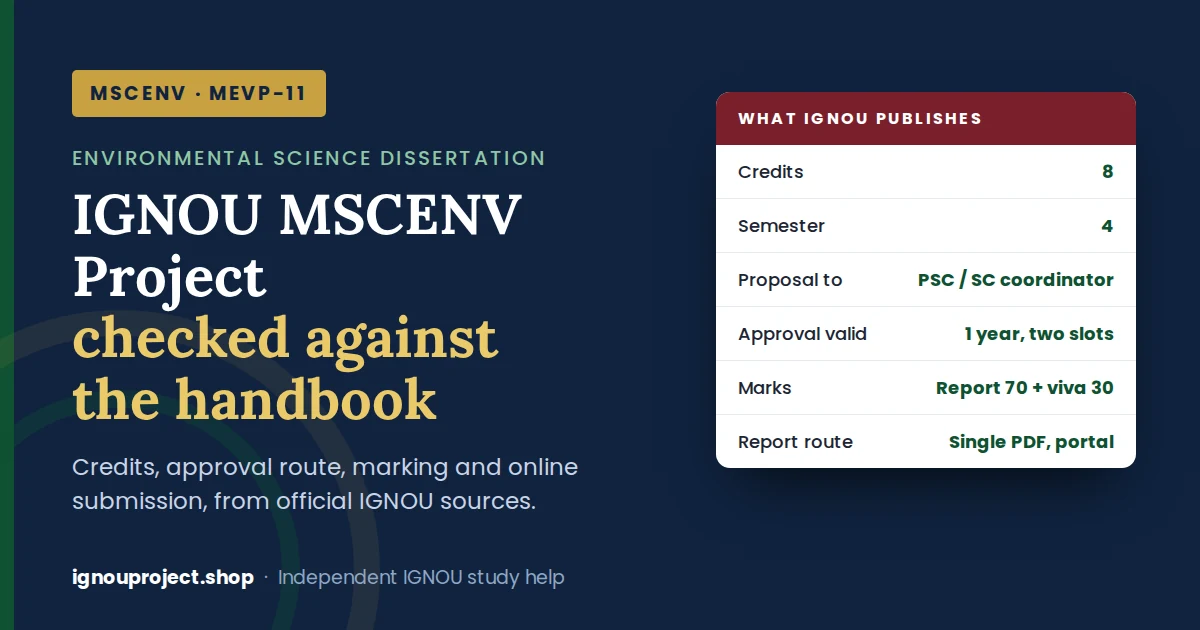
The IGNOU MSCENV project refers to MEVP-11 Dissertation/Project, the research component of the Master of Science (Environmental Science) programme run by the School of Inter-Disciplinary and Trans-Disciplinary Studies (SOITS) at Indira Gandhi National Open University. The official programme page lists MEVP-11 at 8 credits in Semester 4, the same semester as the elective courses MEVE-011 to MEVE-019. The MEVP-011 Handbook on Project Work, published on eGyanKosh, sets out the sequence: select a topic and a suitable supervisor, prepare the proposal in consultation with that supervisor, send it to the coordinator of the Programme Study Centre or Study Centre for approval, and begin the work only once it is approved. An approved proposal stays valid for one year, which the handbook describes as two submission slots. Evaluation combines the written dissertation and a viva-voce.
The code is printed three ways (MEVP-11 on the programme page, MEVP-011 on the handbook, MEVP 11 in most searches), and many pages ranking for it repeat figures that no IGNOU document supports. The table below uses only what the university publishes.
| Programme | Master of Science (Environmental Science), programme code MSCENV, ODL mode |
|---|---|
| School | School of Inter-Disciplinary and Trans-Disciplinary Studies (SOITS) |
| Project course | MEVP-11 Dissertation/Project (handbook title: MEVP-011 Handbook on Project Work) |
| Credits and semester | 8 credits, Semester 4 |
| Programme duration | Minimum 24 months, maximum 48 months |
| Programme eligibility | Bachelor’s degree in Science, Engineering, Agricultural Science, Forestry or Veterinary Science from a recognised university |
| Supervisor | An eligible supervisor as listed in the handbook; complete, signed bio-data is required even when the supervisor is an MSCENV academic counsellor |
| Proposal approval | Coordinator of your Programme Study Centre or Study Centre |
| Proposal validity | One year (two slots); after that, a fresh proposal |
| Evaluation | Dissertation plus viva-voce (70 and 30 marks, as reproduced from the handbook) |
| Final report route | Single PDF on the IGNOU online project portal, as notified each session |
| Evaluation fee | Rs. 500 (above-4-credit band, January 2023 admission cycle onwards), paid with the Term-End Examination form |
| Last date | Fixed by notification each session; confirm on ignou.ac.in |
Before you trust any figure
Why do guides disagree about MEVP-11 credits, route and length?
Because many of them copy one another, and some of the copied text does not belong to this programme. The official IGNOU programme page for the Master of Science (Environmental Science) lists MEVP-11 at 8 credits. Several widely read guides still call it a four-credit project framed around “environmental and occupational health”, wording that fits a different environment programme of the same School better than this M.Sc.
The same guides send proposals to a coordinator at Maidan Garhi by fixed dates, while the MEVP-011 handbook directs them to the coordinator of the learner’s Programme Study Centre or Study Centre. When a help page and the handbook disagree, the handbook decides; where it is silent, ask the Study Centre in writing.
| Claim you will meet | What the official source says | Status |
|---|---|---|
| MEVP-11 is a 4-credit project | Programme page on ignou.ac.in: 8 credits, Semester 4 | Incorrect |
| Send the proposal to the MSCENV Coordinator at headquarters by 30 April or 31 October | Handbook: to the coordinator of your Programme Study Centre or Study Centre | Not the handbook route |
| Post one bound copy with a CD to the Registrar, SED | Handbook’s older instruction; recent portal guidelines ask for one PDF per course | Superseded |
| Report of about 10,000 words or 40 to 50 pages (other pages say 7,000 to 8,000) | No length figure found in the IGNOU documents reviewed | Unverified |
| Proposal of about 1,500 words | No word count found in the documents reviewed | Unverified |
| Report 70 marks, viva-voce 30 marks | Reproduced from the handbook’s evaluation section | Matches handbook |
| Re-submission fee of Rs. 1,200 by demand draft for failed learners | An older handbook provision; current fee notices govern | Check current notice |
BK Sahni, who has guided 5,00,000 students till date, notes that the costliest mistake on this course is usually a routing one rather than a research one: a proposal posted to the office a help page named, followed by weeks of waiting for a reply that office was never going to send. Reading the approval page of the handbook first avoids it.
Labs versus dissertation
Is the MSCENV dissertation the same as the lab practicals?
No. MEVP-11 is a separate course from the three laboratory courses. The programme page lists MEVL-011 in Semester 1 (ecological studies), MEVL-012 in Semester 2 (water quality analysis) and MEVL-013 in Semester 3 (microbiological analysis of soil, air and water samples), each at 4 credits. Practicals are scheduled by the Study Centre and assessed on their own terms; the dissertation has its own proposal, report and viva-voce.
One Study Centre’s published notice splits lab evaluation into guided experiments (70 per cent) and unguided experiments (30 per cent). That split belongs to the practicals, not to the dissertation, even though the numbers look alike.
The labs still matter to the project: the water and microbiological methods rehearsed in MEVL-012 and MEVL-013 are the ones a small field-and-lab dissertation can use, if a laboratory or testing kit stays within reach after the sessions end.
Timing
When should an MSCENV learner start the MEVP-11 dissertation?
Start in Semester 3, even though the course sits in Semester 4. The programme page places MEV-019 Research Methodology for Environmental Science in Semester 3, covering research formulation, design, data collection, statistical analysis and research paper writing: the toolkit the proposal needs.
- Semester 3, early: shortlist two or three topics that can be measured, and identify a supervisor who meets the handbook’s criteria.
- Semester 3, late: draft the proposal with the supervisor, complete the proforma and collect the signed bio-data.
- Approval: submit to the Programme Study Centre or Study Centre coordinator and wait; the handbook allows the work to begin only after approval.
- Semester 4: collect and analyse the data, then write the dissertation.
- Submission: upload within the proposal’s validity. The handbook states that an approved proposal covers one year, or two slots, and that a learner who misses both must submit a fresh proposal. It also states there are no separate slots for failed learners.
Environmental data also has a calendar. Pre-monsoon and post-monsoon water samples differ, winter air quality in north India differs sharply from summer, and field surveys of birds or trees depend on the season. Fix the data window before fixing the title, so the approved proposal describes a study that fits inside the validity period.
Supervision
Who can supervise an IGNOU MSCENV project?
A supervisor who falls within the eligible categories listed in the MEVP-011 handbook, which include academic counsellors of the M.Sc. Environmental Science programme with relevant experience. Read the full list in your own copy before approaching anyone.
The supervisor’s complete, signed bio-data must accompany the proposal, and the handbook says this applies even when the supervisor is an academic counsellor of IGNOU’s MSCENV programme; without it the proposal is not entertained. The supervisor’s signature on the certificate of originality should tally with the signature elsewhere in the submission.
On money, the handbook is equally direct: the learner should not pay any fee or remuneration to the supervisor, because the university pays the supervisor. Collect the bio-data at the first meeting and check that names and designations match across every form.
Approval
How is an MEVP-11 proposal approved, and what happens if it is not?
The proposal, the proforma and the supervisor’s bio-data go to the coordinator of your Programme Study Centre or Study Centre, and the dissertation work begins only after approval. The online project portal guidelines also name the Regional Centre or the concerned School (SOITS) as general channels for synopsis approval; if your Study Centre has no active MSCENV coordinator, ask the Regional Centre in writing which applies.
Reproductions of the handbook list the elements a proposal should carry:
- Title of the study.
- Introduction, explaining why the problem matters.
- Objectives, few and measurable.
- Statement of the problem.
- Research methodology: location, sample size, instruments and statistical techniques.
- Limitations, if any, and references.
If the proposal is not approved, the handbook allows a revised proposal to be resubmitted with a new proforma, together with a copy of the earlier proforma that was not approved, to the same coordinator. Every learner must do the work individually and independently; the handbook states that completely identical proposals or reports will be rejected, which rules out circulating template proposals with the location changed.
Marking
What does the evaluator mark in an MSCENV dissertation?
Each component of the dissertation is marked separately, and the handbook publishes what each is judged on. Reproductions of the handbook give the split as 70 marks for the report and 30 for the viva-voce, with a minimum of 40 per cent in each; confirm the pass rule in your programme guide.
| Component | What it is judged on | What to show in the report |
|---|---|---|
| Selection of topic | Relevance of the problem to the real world | A named site, water body, ward, block or dataset, not a textbook theme |
| Introduction and objectives | Reasons for the choice, work already done, aims and feasibility, planning, objectives | Objectives the collected data can actually answer |
| Methodology | Design, sampling, instruments and statistical techniques | Sampling points, dates, methods and the standard each result is compared against |
| Organisation of the report | Clarity and use of language | Sequential numbering of pages, tables and figures, every table and figure titled |
| Analysis and conclusions | Quality of analysis, conclusions and recommendations | Each recommendation tied to a specific finding |
| Viva-voce | 30 marks, as reproduced from the handbook | Command of your own objectives, method and results |
Feasibility is marked even after approval, so an objective the data cannot deliver still costs marks; how objectives are weighed against feasibility is explained in this guide to writing IGNOU project objectives.
Sections the dissertation should contain
Reproductions of the handbook list a title, introduction, objectives, statement of the problem, research methodology, results and discussion, summary and limitations, followed by references and appendices. The approved proforma, the approved proposal, the supervisor’s bio-data and the certificate of originality signed by both learner and supervisor go at the front.
Evidence the handbook asks you to attach
The handbook asks learners to attach any relevant data, device or object that supports the conclusions or recommendations. For an environmental dissertation that usually means raw readings, lab result sheets, dated field photographs and the questionnaire, if used. Keep a copy of the complete report for the viva-voce.
Choosing what to study
Which MSCENV project topics are realistic for one learner?
Realistic topics come out of the programme’s own courses and can be measured by one person within the proposal’s validity. The directions below are illustrations built from official course titles, not an approved list.
| Course it draws on | Example topic direction | Main data source |
|---|---|---|
| MEV-015 Environmental Pollution, Control and Management | Pre- and post-monsoon water quality of one named pond or lake | Field samples, lab analysis |
| MEVL-012 water analysis methods | Drinking water quality of hand pumps in one village, compared with the applicable BIS standard | Field samples, testing kit |
| MEV-016 Environmental Impact Assessment | Review of the baseline and mitigation chapters of published EIA reports for one project type | Secondary documents |
| MEV-017 Environmental Legislations | Awareness of plastic waste rules among shopkeepers in one market | Structured questionnaire |
| MEVE-014 Biodiversity Conservation and Management | Tree species inventory of a campus or city park | Quadrat or transect survey |
| MEVE-016 Urban Environment | Green cover and open space in two municipal wards compared | Field survey, satellite imagery |
Three questions settle feasibility faster than any topic list. Can you reach the sampling points or respondents more than once? Do you have laboratory access or a kit after the lab courses end? Does the thing you want to measure exist during your data window? A study that fails one of these is better replaced now than defended at the viva-voce.
Submission
How is the MEVP-11 report submitted now?
Through the IGNOU online project portal, as a single PDF for the course, within the dates notified for the session. The MEVP-011 handbook describes an older route: one bound original copy with a CD holding the report as a PDF, posted to the Registrar, Student Evaluation Division, IGNOU, Maidan Garhi, New Delhi-110068, with “M.Sc. Environmental Science (MSCENV) Project Report (MEVP-011)” written on the envelope.
The portal guidelines for recent sessions replace that with an upload. The original report is scanned into one PDF per course, and the first page must show the report title, the learner’s name, programme code, enrolment number as printed on the identity card, Regional Centre code, course code, mobile number and email address. Scans must be clear, correctly ordered and in one orientation; incomplete uploads are removed after the last date, emailed reports are not considered, and the synopsis does not go on this portal.
Where the handbook and the live portal notice disagree on the medium, the portal notice for your session applies.
| Evaluation fee | Rs. 300 for project work up to 4 credits, Rs. 500 above 4 credits, for the January 2023 admission cycle onwards; MEVP-11 at 8 credits falls in the Rs. 500 band |
|---|---|
| How it is paid | Along with the Term-End Examination form; the receipt is uploaded with the report, and a report without the fee paid is not evaluated |
| Viva-voce | Conducted by the concerned faculty under the Regional Centre; contact your Regional Centre for the schedule |
| Queries | Your Regional Centre email, or the SED project section at projects@ignou.ac.in |
| Last date | Set by notification each session; for the June 2024 examination, for example, the portal closed on 31 May 2024 |
The last-date row is a historical reference, not a forecast. How the same portal rules apply to other programmes is set out in the programme-by-programme IGNOU project hub.
Avoidable setbacks
What sends an MSCENV proposal or report back?
- Wrong office. The proposal goes to headquarters or to a School address because a help page said so, instead of to the Programme Study Centre or Study Centre coordinator.
- Missing bio-data. The supervisor is an MSCENV academic counsellor, so the learner assumes bio-data is unnecessary; the handbook says it is still required.
- Template proposals. Completely identical proposals or reports are rejected, and a circulated synopsis with only the location changed is easy to spot.
- Front matter left out. The upload lacks the approved proforma, the approved proposal, the supervisor’s bio-data, or an originality certificate signed and dated by both learner and supervisor.
- Poor scans. Blurred, dim, out-of-sequence or mixed-orientation pages, which the portal guidelines specifically warn against.
- Fee not paid with the TEE form. The report is then not considered for evaluation.
- Expired approval. Both slots pass without submission, and a fresh proposal becomes necessary.
Quick answers
IGNOU MSCENV project: frequently asked questions
What is the course code for the IGNOU MSCENV project?
The programme page lists it as MEVP-11 Dissertation/Project, and the handbook uses MEVP-011. Students also search for it as MEVP 11, MEVP11, MEVP 011 and MEVP011. All refer to the same 8-credit course of the Master of Science (Environmental Science).
How many credits is MEVP-11, and in which semester?
MEVP-11 carries 8 credits and sits in Semester 4 of the MSCENV programme, according to the official programme page on ignou.ac.in. Descriptions of it as a four-credit project do not match that page.
Where does the MSCENV project proposal go for approval?
To the coordinator of your Programme Study Centre or Study Centre, with the proforma and the supervisor’s signed bio-data, as the MEVP-011 handbook describes. The portal guidelines also name the Regional Centre or the School as general channels; confirm which applies to you.
How long is an approved MEVP-11 proposal valid?
One year, which the handbook describes as two submission slots. If the report is not submitted within those two slots, a fresh proposal has to be submitted.
Is there an official word limit for the MSCENV dissertation?
No word or page limit was found in the IGNOU documents reviewed for this article. Follow the handbook and your supervisor rather than figures quoted on help sites.
What is the project evaluation fee for MEVP-11?
For learners of the January 2023 admission cycle onwards, the portal lists Rs. 500 for project work above 4 credits, which covers the 8-credit MEVP-11. It is paid with the Term-End Examination form and the receipt is uploaded with the report.
Should the learner pay the project supervisor?
No. The MEVP-011 handbook tells learners not to pay the supervisor; the university pays the supervisor’s remuneration.
Verify before you act: the course structure is published on the official MSCENV programme page, and the MEVP-011 Handbook on Project Work is available on eGyanKosh. Portal rules, fees and dates are notified each session, and the newest notice always takes precedence over this page.
If the proposal is where the work has stalled, a review of the topic, objectives and sampling plan against the MEVP-11 assessment components before it reaches the Study Centre can save a round of revision. Details are on the ignouproject.shop project pages.
Independent study-help disclosure: ignouproject.shop is run by Shri Chakradhar Publication Pvt. Ltd. and is not the official website of IGNOU or SOITS. This article summarises published university documents for guidance only; official notifications on ignou.ac.in prevail over anything written here.

BK Sahni iD 0009-0005-8092-459X
Founder, Shri Chakradhar Publication Pvt. Ltd. & its IGNOU Project study-help brand, helping IGNOU distance-learning students since 2010 and having guided 5,00,000 students till date across MBA, MCom, MA & more. Author of IGNOU exam guides, solved assignments & project reference books.
Disclosure: Shri Chakradhar Publication Pvt. Ltd. and ignouproject.shop are independent third-party study-help services, not the official IGNOU website. Always verify final dates and rules on ignou.ac.in.
Leave a Reply