
MSCCC · MEVP-033 · SOITS
IGNOU MSCCC Project (MEVP-033): What Is Confirmed and How to Prepare
The IGNOU MSCCC Project is MEVP-033 Project Work, an 8-credit course of the Master of Science in Climate Change run by IGNOU’s School of Inter-Disciplinary and Trans-Disciplinary Studies. The course and its credits are listed, but no MEVP-033 handbook had been published when this page was checked, so preparation starts with research methods and the School’s sister project rules.
Start here
What is the IGNOU MSCCC project (MEVP-033)?
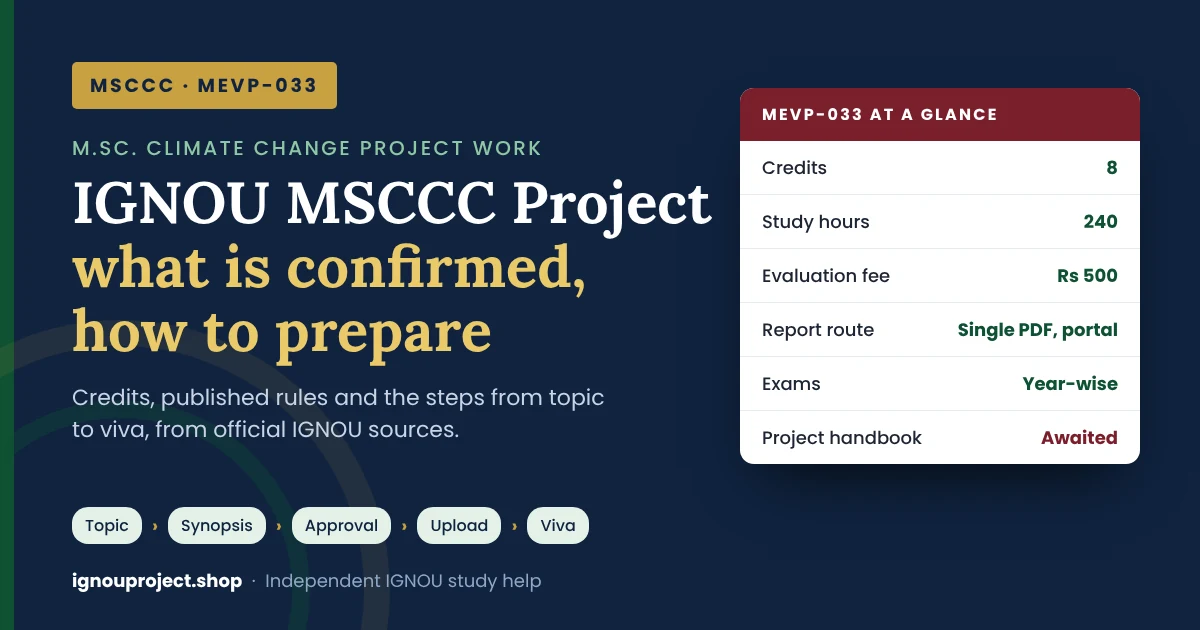
The IGNOU MSCCC project refers to MEVP-033 Project Work, the research component of the Master of Science in Climate Change (MSCCC), a two-year Open and Distance Learning programme of the School of Inter-Disciplinary and Trans-Disciplinary Studies (SOITS) at Indira Gandhi National Open University. IGNOU’s programme listing names MEVP-033 as Project Work of the type Project, carrying 8 of the programme’s 80 credits. The Common Prospectus for July 2026 lists MSCCC as open to graduates of any discipline, taught in English, examined year-wise, with a minimum duration of two years and a maximum of four. Learners who leave after the first-year courses (40 credits) may opt for a Post Graduate Diploma in Climate Change. Admissions to the M.Sc. opened in the July 2026 cycle, so no learner has yet reached the end of a full two-year MSCCC cycle, and the course’s own project handbook had not appeared on eGyanKosh or ignou.ac.in by 16 October 2026.
That last point shapes everything below. Most learners searching for this course are in their first months of the programme, and the useful question is not how to format a finished report but how to arrive at the project year with a topic, a data source and a method already tested. The code also appears in several spellings (MEVP-033 on IGNOU’s pages, MEVP 033 and MEVP 33 in searches); all of them mean the same course.
| Programme | Master of Science in Climate Change, programme code MSCCC, Open and Distance Learning |
|---|---|
| School | School of Inter-Disciplinary and Trans-Disciplinary Studies (SOITS) |
| Project course | MEVP-033 Project Work, course type Project |
| Credits | 8 of the programme’s 80 credits; one IGNOU credit equals 30 hours of study, so 240 hours |
| Separate lab course | MEVL-032 Climate Change Lab Course, listed separately from the project |
| Eligibility and medium | Graduate in any discipline; English |
| Duration and exams | Minimum 2 years, maximum 4 years; year-wise examination |
| Programme fee | Rs. 8,000 per year (Rs. 16,000 in all), plus registration and development fees as applicable |
| Exit option | Post Graduate Diploma in Climate Change after the first-year courses (40 credits) |
| Project evaluation fee | Rs. 500 for project work above 4 credits, paid with the Term-End Examination form |
| Project handbook | Not found on eGyanKosh or ignou.ac.in as of 16 October 2026 |
| Report route | IGNOU’s current practice is a single-PDF upload on the online project portal; confirm the MSCCC notice when issued |
| Last date | Fixed by notification each session |
Workload
How big is the IGNOU MSc Climate Change project?
For the IGNOU MSCCC project, the credit value is the most useful planning number IGNOU has published so far. MEVP-033 carries 8 credits, and the Common Prospectus defines one credit as 30 hours of learner study, so the course stands for about 240 hours of work: reading, fieldwork or data handling, analysis, writing and revision. At twelve hours a week, that is roughly twenty weeks, which is why a project left to the final months of the programme tends to be rushed.
The MSCCC project credits also place the course alongside the larger projects of the same School. Within SOITS, two older environment programmes already run projects, and they make a fair yardstick until MEVP-033 has its own rules:
| Programme | Project course | Credits | Study hours (30 per credit) | Status |
|---|---|---|---|---|
| M.Sc. Climate Change (MSCCC) | MEVP-033 Project Work | 8 | 240 | Handbook not yet issued |
| M.Sc. Environmental Science (MSCENV) | MEVP-011 Dissertation/Project | 8 | 240 | Handbook on eGyanKosh |
| M.A. Environmental Studies (MAEVS) | MEVP-012 Project/Dissertation | 6 | 180 | Listed in the MAEVS assignment booklet |
Two practical points follow. The project is a separate course from MEVL-032 Climate Change Lab Course, which IGNOU lists as a separate course, so lab sessions do not count towards the project. And because the MSCENV dissertation carries the same 8 credits, its handbook is the closest published picture of what IGNOU expects from a project of this size, provided it is read as a guide and not as the MSCCC rulebook.
Published so far
What has IGNOU published about MEVP-033, and what is still missing?
On the IGNOU MSCCC project, IGNOU has so far published the course identity, the credits and the general fee and portal rules, but not the project-specific rules. The table separates the two, so a learner can see which statements are safe to plan around and which still need the official handbook.
| Item | Where it stands | Source |
|---|---|---|
| Course code, title, type and credits | Published | MSCCC programme page on ignou.ac.in; Samarth admission portal |
| Eligibility, fee, duration, exam mode | Published | Common Prospectus, July 2026 |
| Project evaluation fee (Rs. 500 above 4 credits) | Published | Common Prospectus and online project portal, general rule |
| Single-PDF upload, first-page details, viva through the Regional Centre | Published | Online project portal guidelines, June 2026 cycle, general rule |
| Project guide booklet | Promised in general terms | The Prospectus says a project guide booklet accompanies the study material for programmes with project work |
| Supervisor eligibility, proposal proforma, marks split | Not published for MSCCC | Only the sister MEVP-011 handbook covers these |
| Word or page limit | Not published | No figure in any IGNOU document reviewed |
The booklet row is the detail most pages skip. The Common Prospectus describes a comprehensive project guide, in booklet form, as part of the study material for programmes with project work. For MEVP-033 that booklet had not surfaced on eGyanKosh or ignou.ac.in when this page was checked. Until it does, any file circulating as the MSCCC project guidelines should be checked against those two sites before it is relied on.
BK Sahni, who has guided 5,00,000 students till date, advises treating any document labelled as the official MEVP-033 guidelines with caution until the same file appears on ignou.ac.in or eGyanKosh. On a newly launched programme, the first rulebooks passed between learners are often an older programme’s handbook with the course code changed, and an approval route copied from the wrong programme costs more time than a late start.
Year one
How should the first year be used to prepare the IGNOU MSCCC project?
The IGNOU MSCCC project rewards learners who use their theory courses as rehearsal. The MSCCC syllabus on ignou.ac.in lists MEV-019 Research Methodology for Environmental Science and MEV-024 Climate Change Assessment Tools among the programme’s courses, and between them they cover most of what a proposal needs: research design, data collection, statistical analysis, and the assessment methods a climate study is built on. The course list reviewed does not mark which year each course belongs to, so check the order in the programme guide or with the Regional Centre.
| Course | What it gives the project |
|---|---|
| MEV-019 Research Methodology for Environmental Science | Objectives, research design, sampling, statistics; the backbone of the synopsis |
| MEV-024 Climate Change Assessment Tools | Vulnerability, emissions and impact methods that turn a topic into something measurable |
| MEV-021 Introduction to Climate Change | The scientific and policy framing for the introduction chapter |
| MEV-017 Environmental Legislations and MEV-031 Climate Change and Governance | A base for policy-review projects that rely on published documents |
| MEV-026 to MEV-030 (water, energy, agriculture, disaster risk reduction, waste and circular economy) | The sector a field or data project can sit in |
| MEVL-032 Climate Change Lab Course | Measurement practice, kept separate from the project’s own credits |
- While studying research methods: write down two or three questions that could be answered with numbers or interviews collected by one person.
- Before the first-year examinations: name the data source for each question and confirm it can actually be reached, whether a public record, a survey site or a set of documents.
- On re-registration for the project year: check eGyanKosh and the SOITS pages on ignou.ac.in for the MEVP-033 handbook and read it before approaching a supervisor.
- Once the handbook is out: match the shortlisted topic to its proforma, supervisor rules and approval route, then draft the synopsis.
Choosing what to study
Which MSCCC project topics can one learner finish with real data?
Workable MSCCC project topics are narrow, local and tied to evidence that exists before the study starts. “Impact of climate change on India” is a textbook chapter, not a 240-hour IGNOU MSCCC project; “rainfall change in one district over three decades, set against what farmers there report” is a study one person can finish. The directions below are illustrations built from MSCCC course titles, not an approved list, and the supervisor and the approving authority decide what is acceptable.
| Course it draws on | Example topic direction | Main evidence |
|---|---|---|
| MEV-026 Climate Change and Water | Rainfall trend in one district compared with residents’ perception of change | Published IMD rainfall records, short interviews |
| MEV-028 Climate Change and Agriculture | Shifts in sowing dates reported by farmers in one block | Structured questionnaire |
| MEV-029 Climate Change and Disaster Risk Reduction | Heatwave preparedness of one urban ward against its city’s heat action plan | Plan documents, field observation |
| MEV-027 Climate Change and Energy | Rooftop solar adoption and its barriers in one housing society | Household survey |
| MEV-030 Climate Change, Waste Management and Circular Economy | Household waste segregation in one colony and the emissions it avoids | Survey plus a standard emission factor |
| MEV-031 Climate Change and Governance | Adaptation priorities in two State Action Plans on Climate Change compared | Published plan documents |
| MEV-024 Climate Change Assessment Tools | Carbon footprint of one school or office | Electricity bills, travel logs, a published calculator |
Three questions settle feasibility faster than any topic list. Can the data or the respondents be reached more than once? Does the record cover enough years to show a trend rather than a single bad season? Can the result be compared with a published standard, plan or baseline? A topic that fails any of these is better replaced in the first year than defended at the viva-voce. No official MSCCC project sample has been published either, so a sample report from another programme shows layout, not what an MSCCC evaluator will expect.
Proposal stage
How is an IGNOU MSCCC synopsis likely to be approved?
No approval route has been published for an IGNOU MSCCC synopsis yet, so the closest guide is the published handbook of the same School. Under the MEVP-011 handbook of the M.Sc. Environmental Science, a learner prepares the proposal with an eligible supervisor, sends it with the proposal proforma and the supervisor’s signed bio-data to the coordinator of the Programme Study Centre or Study Centre, and begins the study only after approval. IGNOU’s online project portal guidelines add that synopsis approval can be sought through the Regional Centre or the concerned School, which for this programme is SOITS. The practical step is to ask the Regional Centre in writing which of these channels applies to the IGNOU MSCCC project, and to keep the reply.
The sister handbook lists the parts a proposal should carry, and they translate directly to a climate study:
- Title of the study, naming the place, sector and period.
- Introduction, explaining why the problem matters locally.
- Objectives, few in number and measurable with the chosen data.
- Statement of the problem.
- Methodology: study area, sample size or record length, tools and statistical techniques.
- Limitations, if any, and references.
Choosing an MSCCC project supervisor
The MSCCC project supervisor rules are not yet published. In the MEVP-011 handbook, eligible supervisors include academic counsellors of that programme with relevant experience, the supervisor’s complete signed bio-data must accompany the proposal even when the supervisor is an IGNOU counsellor, and the learner is told not to pay the supervisor, because the university pays the remuneration. Those are MSCENV rules; treat them as the likely pattern, then check the MEVP-033 handbook before collecting signatures.
If the synopsis is not approved
The sister handbook allows a revised proposal to be resubmitted with a new proforma and a copy of the earlier one that was not approved. It also states that an approved proposal stays valid for one year, described as two submission slots, and that identical proposals or reports are rejected, which rules out a shared template with only the district name changed. How to write objectives an approver can test is set out in this guide to writing project objectives.
Submission and marks
How will the IGNOU MSCCC project report be submitted and evaluated?
The IGNOU MSCCC project report will follow whatever notice SOITS and the Student Evaluation Division issue for MEVP-033, but IGNOU’s current practice for every programme gives a clear default. For MSCCC project submission online, the June 2026 portal guidelines ask for the original report scanned into a single PDF for each course, with pages clear, in order and in one orientation. The first page must show the report title, the learner’s name, programme code, enrolment number as printed on the identity card, Regional Centre code, course code, mobile number and email address.
The same guidelines list what travels with the report: the guide’s approval in the prescribed proforma, the approved project proposal proforma, the synopsis and the guide’s bio-data, and a certificate of originality signed and dated by both learner and guide. Reports sent by email are not considered, incomplete uploads are removed after the last date, and the synopsis itself is not uploaded on this portal.
Older SOITS rules differ on the medium. The MEVP-011 handbook asks for one bound copy and a CD posted to the Registrar, Student Evaluation Division; the portal notices of recent sessions replace that with the upload. Where the two disagree, the portal notice for the session is the current rule.
| MSCCC project evaluation fee | Rs. 500, the band for project work above 4 credits (January 2023 admission cycle onwards); MEVP-033 at 8 credits falls in it |
|---|---|
| How it is paid | With the Term-End Examination form; the receipt goes with the report, and a report without the fee paid is not evaluated |
| Viva-voce | Conducted for project reports by the concerned faculty under the Regional Centre; contact the Regional Centre for the schedule |
| Last date | Set by notification each session; for the June 2026 cycle the portal closed on 15 June 2026 |
| Queries | The Regional Centre, or the SED project section at projects@ignou.ac.in |
The marks split has not been published for MEVP-033. Until it is, the MSCCC project report format can be drafted on the sister handbook’s structure: title, introduction, objectives, statement of the problem, methodology, results and discussion, summary and limitations, then references and appendices, with the approved proforma, the approved proposal, the supervisor’s bio-data and the originality certificate at the front. Raw data, dated field photographs and the questionnaire belong in the appendices. The programme-wide picture of how these portal rules work is kept on the ignouproject.shop project hub.
Avoidable setbacks
What gets an MSCCC proposal or report sent back?
Most reasons an MSCCC project is rejected or returned can be seen coming at the planning stage:
- Following unofficial rules. A circulated “MEVP-033 guidelines” file that is really another programme’s handbook sends the proposal to the wrong office.
- A topic without a boundary. National or global themes give the evaluator nothing a single learner could have measured.
- No baseline. A finding with nothing to compare it against, whether a standard, a plan target or an earlier record, cannot support a conclusion.
- Fieldwork before approval. The sister handbook allows the work to begin only after the proposal is approved.
- Lab work counted as project work. MEVL-032 and MEVP-033 are separate courses with separate credits.
- Missing front matter. No guide approval, approved proforma, bio-data or signed originality certificate in the upload.
- Fee not paid with the TEE form, or a report sent by email instead of the portal.
Quick answers
IGNOU MSCCC project: frequently asked questions
Is MEVP 033 the same as MEVP 33 and MEVP-033?
Yes. IGNOU writes the code as MEVP-033, and learners also search for it as MEVP 033, MEVP 33, MEVP033 and MEVP-33. All of them refer to the same 8-credit Project Work course of the Master of Science in Climate Change.
Is there an official handbook for the IGNOU MSCCC project yet?
Not as of 16 October 2026. The course is listed with its credits, but no MEVP-033 handbook or set of MSCCC project guidelines had been published on eGyanKosh or ignou.ac.in. Check both sites at re-registration for the project year.
How many hours does the 8-credit project take?
About 240 hours. The Common Prospectus defines one credit as 30 hours of learner study, and MEVP-033 carries 8 credits.
What is the MSCCC project evaluation fee?
Rs. 500, the band IGNOU sets for project work above 4 credits from the January 2023 admission cycle onwards. It is paid with the Term-End Examination form.
Is there an MSCCC project last date yet?
No MEVP-033 date has been notified. Project report dates are fixed by notification each session; for the June 2026 cycle, for example, the online portal closed on 15 June 2026.
Will there be an MSCCC project viva?
The portal guidelines describe a viva-voce conducted by the concerned faculty under the Regional Centre for project reports, and the sister MEVP-011 dissertation includes one. Its weight in the MSCCC result has not been published.
Is there an official MSCCC project word limit?
No word or page limit was found in any IGNOU document reviewed. Follow the MEVP-033 handbook once it is issued, and the supervisor until then.
Verify before acting: the IGNOU MSCCC project is governed by IGNOU’s own notices, not by this page. Programme rules and fees are in the Common Prospectus for July 2026 on ignou.ac.in, and the nearest published project rules are in the MEVP-011 Handbook on Project Work on eGyanKosh. The newest notice always takes precedence.
If the topic or the data plan is where the work has stalled, a review of the shortlisted question, its evidence and its objectives against the published SOITS rules can save a round of revision. Details are on the ignouproject.shop project pages.
Independent study-help disclosure: ignouproject.shop is run by Shri Chakradhar Publication Pvt. Ltd. and is not the official website of IGNOU or SOITS. This article summarises published university documents for guidance only; official notifications on ignou.ac.in prevail over anything written here.

BK Sahni iD 0009-0005-8092-459X
Founder, Shri Chakradhar Publication Pvt. Ltd. & its IGNOU Project study-help brand, helping IGNOU distance-learning students since 2010 and having guided 5,00,000 students till date across MBA, MCom, MA & more. Author of IGNOU exam guides, solved assignments & project reference books.
Disclosure: Shri Chakradhar Publication Pvt. Ltd. and ignouproject.shop are independent third-party study-help services, not the official IGNOU website. Always verify final dates and rules on ignou.ac.in.
Leave a Reply