
MBA (MMPP-001) · Choosing Your Study Type
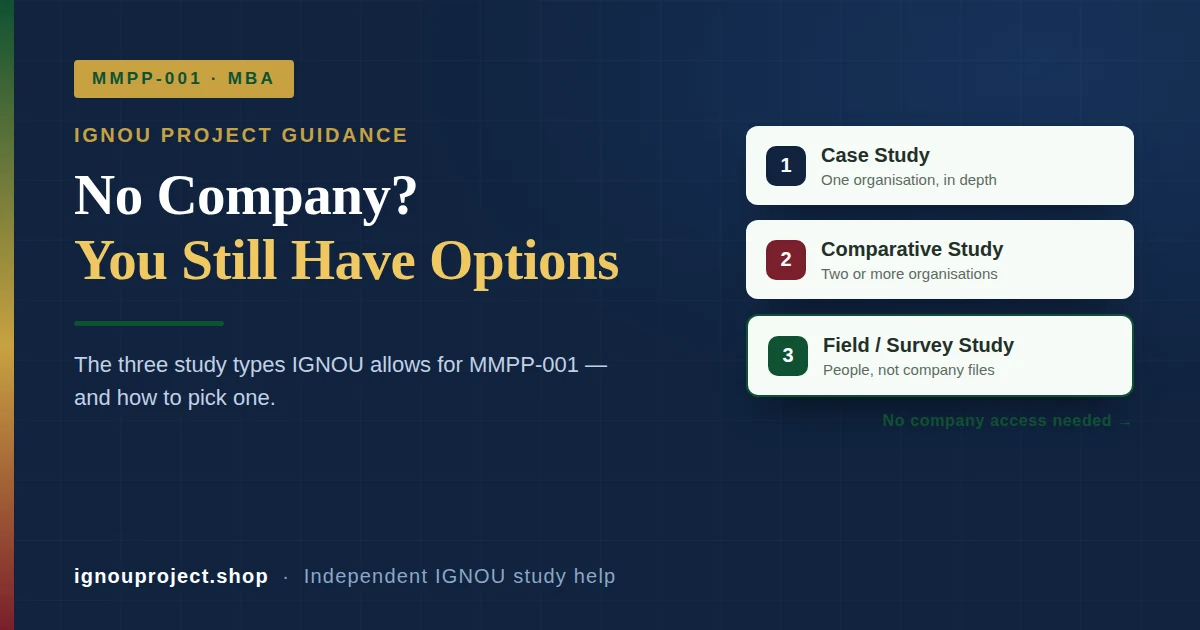
An IGNOU MMPP-001 project without a company is permitted. The guidelines allow three kinds of study: a case study of one organisation, a comparative study of two or more, or a field survey that collects data directly from people. Only the first two require organisational access.
The short answer
Can you do the IGNOU MMPP-001 project without a company?
Doing an IGNOU MMPP-001 project without a company is not only possible, it is one of the three study designs the project course explicitly recognises. MMPP-001 refers to the eight-credit project course of the IGNOU MBA, registered in Semester III and treated as equivalent to two courses. The guidelines allow a case study, which examines one organisation in depth; a comparative study, which sets two or more organisations against each other; and a field or survey study, which gathers data directly from people such as employees, customers or consumers. A field study needs respondents, not a company file room or a permission letter from an HR department. Learners who are not currently employed, or who cannot get an organisation to release internal data, are therefore not blocked from MMPP-001 — they are simply pointed towards the third design rather than the first.
The mistake is choosing the topic first and discovering the data problem later. A title like “Financial Performance of XYZ Ltd.” commits you to internal figures you may never be given. Decide what data you can actually reach, then write the title around it.
The three designs
What are the three study types allowed for MMPP-001?
Each design answers a different kind of research question, and each carries a different access cost. The table sets out what you are committing to before you write a single line of the synopsis.
| Design | What it examines | What you must be able to get | Typical risk |
|---|---|---|---|
| Case study | One organisation, in depth | Internal data or staff access, usually because you work there or hold written permission | Permission withdrawn part-way, leaving no data |
| Comparative study | Two or more organisations set against each other | Published material for every firm compared — annual reports, filings, disclosures | One firm publishes less than the other, breaking the comparison |
| Field or survey study | People: employees, customers, consumers | Respondents willing to answer a questionnaire or sit for an interview | Too few responses to support the analysis you promised |
Choosing
Which MMPP-001 design fits the data you can actually reach?
Work backwards from access. If you are employed and your organisation will let you use internal records, a case study is the natural fit and gives you material no other learner has. If you are not employed but your specialisation deals with publicly reported information — financial ratios, disclosure practice, published sustainability claims — a comparative study lets you build the whole project from material anyone can download. If neither applies, a field survey is the design that removes the dependency altogether, because your data source is people rather than an institution.
BK Sahni, who has guided 5,00,000 students till date, notes that the MBA learners who stall for months are almost always the ones who fixed on a company name before checking whether that company would actually hand over anything. Reversing the order — access first, title second — removes the most common cause of a stalled MMPP-001.
A common worry
Does a survey-based MMPP-001 project score lower?
There is no rule that ranks the designs against each other, and the evaluator assesses whether the method answers the objectives, not whether a company letterhead appears in the annexure. A survey study fails when the sample is too small for the statistical test claimed, when the questionnaire does not map onto the stated objectives, or when the sampling method goes undescribed. A case study fails just as readily when the internal data turns out to be thin. The design is not the risk; the mismatch between design and objectives is.
The practical implication is that a field study has to state its sampling plan precisely: who the population is, how respondents were selected, how many were approached, and which test the responses will support. Once that is written into the synopsis, the design defends itself.
Timing
When can the MMPP-001 synopsis be submitted?
Two timing rules matter, and the first surprises people. The proposal may be sent only after MMPP-001 has been registered — a synopsis submitted before registration has no course record to attach to. The guidelines then indicate that the proposal should reach the Regional Centre within about six months of registering for MMPP-001, so confirm the current window with your own Regional Centre before you plan around it. A synopsis may otherwise be sent throughout the year, and approval or non-approval is normally communicated in roughly two to three months.
The route depends on your admission mode. ODL learners send the proposal to the Regional Director of their Regional Centre; MBA (Online) learners upload it through the LMS portal. One detail specific to MMPP-001 is worth knowing: the guide’s signed bio-data must accompany the proposal, except where the guide is an approved IGNOU Academic Counsellor, in which case it is not required. Choosing an approved counsellor therefore removes a document from the packet. The full chapter structure and stream-wise topic ideas are set out in the MMPP-001 format and topics guide, and the course record sits on eGyanKosh.
Before you draft
What should be settled before writing the MMPP-001 synopsis?
- Confirm MMPP-001 is registered for the current session, since the proposal cannot go in before that.
- Test your data access in writing. Ask the organisation, or run a pilot of ten questionnaire responses, before the title is fixed.
- Pick the design that survives that test — case, comparative, or field — and only then draft the title around it.
- Match the analysis to the sample. A test that needs a hundred responses should not appear in a synopsis promising thirty.
- Check guide eligibility against your topic area, and note whether the bio-data requirement applies to your guide.
- Confirm your route — Regional Centre for ODL, LMS portal for MBA (Online) — and verify the current submission window with your Regional Centre.
Frequently asked questions
Can I do the IGNOU MMPP-001 project if I am not working anywhere?
Yes. A field or survey study collects data directly from individual respondents rather than from an organisation, so employment is not a requirement. A comparative study built on publicly published company material is also open to learners with no organisational access.
Do I need a permission letter from a company for MMPP-001?
Only if your design depends on that organisation’s internal data. A case study normally does. A field survey does not, because the respondents consent individually. Where an organisation is involved, keep the data confidential and state that it was used for academic purposes only.
Can I change the study design after my synopsis is approved?
Changing the design usually changes the objectives and often the title, and the report is assessed against what was approved. Treat the design as a decision to settle before submission rather than one to revisit later, and speak to your guide and Regional Centre before altering an approved proposal.
Is the guide’s bio-data always needed for the MMPP-001 proposal?
The signed bio-data must be enclosed with the Proforma for Approval of Project Proposal, except where the guide is an approved IGNOU Academic Counsellor. Confirm your guide’s status before assembling the packet, as a missing bio-data can hold up the proposal.
If the data access question is what is holding your MMPP-001 up, working out which design your situation supports is the step worth getting right first. Details are on the ignouproject.shop pages.

BK Sahni iD 0009-0005-8092-459X
Founder, Shri Chakradhar Publication Pvt. Ltd. & its IGNOU Project study-help brand — helping IGNOU distance-learning students since 2010 (5,00,000+ students supported across MBA, MCom, MA & more). Author of IGNOU exam guides, solved assignments & project reference books.
Disclosure: Shri Chakradhar Publication Pvt. Ltd. and ignouproject.shop are independent third-party study-help services — not the official IGNOU website. Always verify final dates and rules on ignou.ac.in.
Leave a Reply