
MCA_NEW · MCSP-232 · SOCIS
IGNOU MCA Project (MCSP-232): Edition, Timeline, Approval Rules and Evaluation
The IGNOU MCA project is MCSP-232, a 12-credit software development project in Semester 4 of the MCA_NEW programme. Proposals open once the learner enters Semester 3, in two slots a year, and the finished work is assessed on a 150-mark report and a 50-mark viva-voce, with 40 percent needed in each.
The course in one view
What is the IGNOU MCA project (MCSP-232)?
The IGNOU MCA project refers to MCSP-232 Project, the 12-credit final component of the Master of Computer Applications programme (MCA_NEW) offered by the School of Computer and Information Sciences (SOCIS) at Indira Gandhi National Open University. The MCA_NEW programme guide places MCSP-232 in Semester 4, beside MCS-230 and MCS-231, within an 80-credit programme. The MCSP-232 project guidelines for July 2026 and January 2027 require the work to include software development; LAN or WAN configuration, physical installations and theoretical studies are not accepted. A learner becomes eligible to submit a project proposal after entering Semester 3, sends it with the guide’s bio-data to the Regional Director of the Regional Centre, and starts development only after approval. The project report is marked out of 150 and the viva-voce out of 50, and a pass needs 40 percent in each component separately.
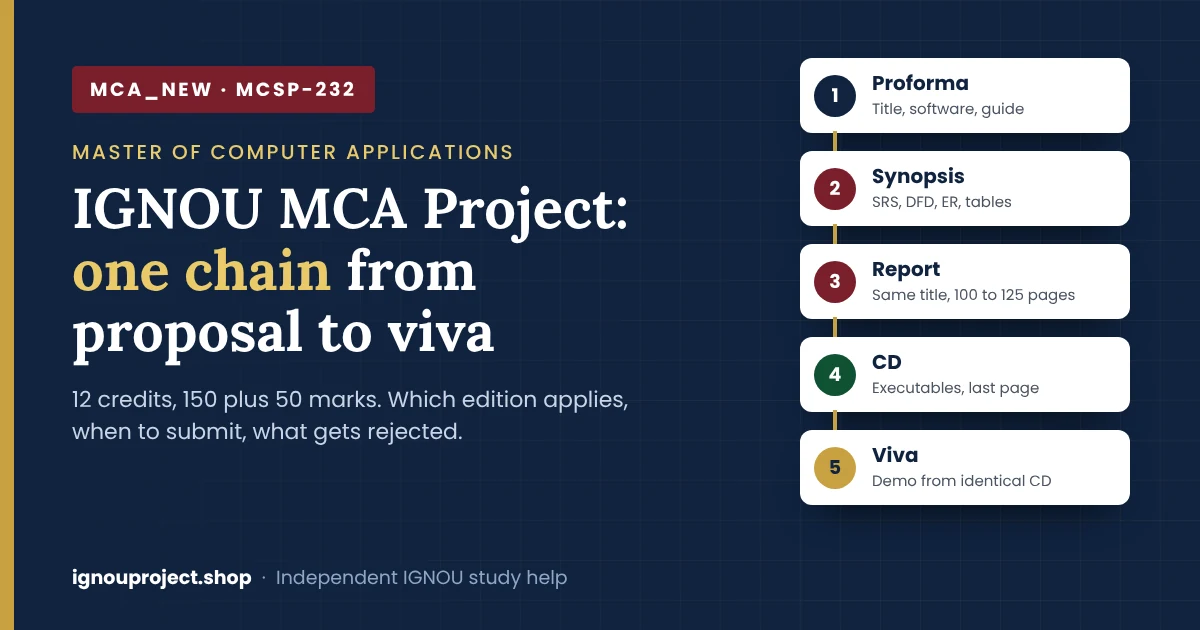
Almost every rule in the guidelines follows from one idea: each document has to agree with the one before it. The proforma fixes the title and the software. The synopsis fixes the design. The report keeps that title and carries the guide’s matching signature, and the viva runs from the identical CD that went in with the report. A learner who treats these as one continuous record, rather than four separate submissions, avoids most of the returns described later on this page.
| Programme | Master of Computer Applications, programme code MCA_NEW, School of Computer and Information Sciences (SOCIS) |
|---|---|
| Project course | MCSP-232 Project |
| Credits and semester | 12 credits, Semester 4; proposal allowed after entering Semester 3 |
| Counselling | 4 project discussion sessions of 2 hours each in Semester 4, as listed in the programme guide |
| Proposal slots | 1 April to 30 June, or 1 October to 31 December |
| Report slots | 1 July to 30 September, or 1 January to 31 March, matched to the slot in which the proposal was approved |
| Proposal goes to | The Regional Director of the learner’s Regional Centre; never to SOCIS, New Delhi |
| Synopsis length | 14 to 18 pages in the enclosure checklist, 15 to 20 pages in Section V (reconciled below) |
| Report length | About 100 to 125 pages of documentation, excluding code, plus a CD of the executable files |
| Marks | Project report 150, viva-voce 50; 40 percent in each component separately |
| Viva-voce | Face-to-face at the Regional Centre, with a demonstration of the project |
| Approval validity | One year, which means two report slots |
| Guide load | No more than 5 IGNOU MCA students at any given time |
Which document applies
Which MCSP-232 guidelines edition should you follow?
Follow the MCSP-232 edition dated July 2026 and January 2027 if your proposal or report falls in either of those sessions. Search results for the course code still surface several older PDFs hosted on webservices.ignou.ac.in, and they rank above the current file, so many learners open the wrong one without noticing the date on the cover.
The editions agree on most rules, including the two proposal slots, the 150 plus 50 marks split and the 100 to 125 page documentation. They differ on details that matter at the margin, and the online MCA follows a separate document altogether.
| Edition on the cover | Who it is for | Point worth noting |
|---|---|---|
| January 2023 file | Earlier MCA_NEW sessions | Superseded by later editions; useful only as history |
| July 2024 and January 2025 | MCA_NEW learners of those sessions | Prints a pro-rata fee of Rs. 2,500 for failed learners resubmitting a report |
| July 2026 and January 2027 | Current MCA_NEW (distance) learners | Prints no pro-rata amount and tells failed learners to ask the Regional Centre |
| MCAOL edition | Learners of the online MCA | Proposal and report go on the Learning Management System, the report as one PDF, and the viva-voce is held online |
In practice: check the cover label before relying on any figure, and keep the current edition open while writing. An MCA_NEW learner who follows the MCAOL upload route, or an MCAOL learner who posts a bound copy, has used the right course code with the wrong rulebook.
Timing
When can you submit your IGNOU MCA project proposal?
In the first proposal slot that opens after you enter Semester 3. The MCSP-232 guidelines allow proposals only from the third semester, and the MCA_NEW programme guide runs semesters from July to December and from January to June. Because the two proposal slots sit inside those semesters, the semester in which Semester 3 begins decides the whole calendar.
| Semester 3 begins | First proposal slot | Report slot after approval | Viva-voce window |
|---|---|---|---|
| July | 1 October to 31 December | 1 January to 31 March | May or July |
| January | 1 April to 30 June | 1 July to 30 September | November or January |
A worked case shows how this lines up. A learner who entered Semester 3 in July 2026 can send the proposal between 1 October and 31 December 2026, post the report between 1 January and 31 March 2027 while in Semester 4, and expect the viva-voce in May or July 2027. Those months are read directly off the published calendar; the exact viva date comes by letter from the Regional Director.
How long does proposal approval take?
The guidelines give three figures in three places: 30 days after receipt in the calendar, four to six weeks in the section on communication of approval, and six to eight weeks in the points on proposal preparation. Plan around the longest of the three. The guidelines also say that a learner who hears nothing within four to six weeks after the last date of the proposal slot should contact the Regional Centre, so note that date when posting.
What if the report misses its slot?
An approved proposal stays valid for one year, which the guidelines define as two slots. A proposal approved in the April to June slot normally leads to a report between July and September; if that is missed, the January to March slot is the second chance. After both, a fresh synopsis approval is needed.
Approvability
Will your MCA project topic and software be accepted?
Most proposal problems are visible before anything is posted. Sections III, IV and VIII of the MCSP-232 guidelines name the project types and software combinations that will not pass, and the coordinator’s message adds two more. The table collects them in one place.
| Situation | Position in the guidelines | What it means for the proposal |
|---|---|---|
| Web, mobile or desktop application with a database | Accepted | Use the latest versions and name them in the software field of the proforma |
| AI, machine learning, data science, image processing or mobile computing | Accepted as project categories | Software development must still be the deliverable, not a study of a model |
| Tools not listed in Section VIII | Accepted if part of latest technologies | The Section VIII list is suggestive, not a closed list |
| LAN or WAN configuration, physical installation | Not allowed | No software is developed, so the project fails the basic test |
| Theoretical project or study of an existing system | Not allowed | Same reason: the work must compulsorily include software development |
| Topic already done at BCA level | Not allowed | The coordinator’s message asks learners not to repeat it |
| dBase III Plus, FoxPro, Visual FoxPro or MS-Access | Not allowed | Old packages are barred outright |
| Visual Basic front end with MS-Access back end | Not allowed | The combination is named and barred |
| C or C++ for a hospital, reservation, library, school or college management system | Not allowed | The bar covers information management systems; the suggested list offers Java, Python, C# and the .NET platform |
| Copied or reproduced project | Unfair means | Forwarded to the Exam Discipline Committee of the University |
The coordinator’s message adds a size test as well: the topic should be complex and large enough to justify an MCA project. A single-table record keeper rarely meets it, however neatly coded.
Is a company or industry project compulsory?
No. Section IV says most learners are expected to work on a real-life project, preferably in industry, a research laboratory, an educational institution or a software company, and then states that it is not mandatory. A learner can frame the problem with the guide instead. Those who need a letter to approach an organisation can use the Project Trainee Letter in the guidelines, attested by the Project Coordinator, the Regional Director or an Assistant Regional Director.
Can two students work on one MCA project?
Only by exception. The guidelines prefer one student per project, and allow at most two when the work needs one human-year or more, counted at six human-months per student. Prior recommendation from the MCA Project Coordinator at SOCIS is mandatory, sought with the complete synopsis from both students and a handwritten application. Each student then submits a separate proposal and report covering individually built modules; only introductory and concluding remarks may be common.
Supervision
Who can guide an IGNOU MCA project?
A person with a Ph.D. or M.Tech. in Computer Science and at least one year of experience, or a person with a B.E. or B.Tech. (Computer Science), MCA or M.Sc. (Computer Science) and at least two years of experience, preferably in software development. That is the eligibility set out in Section IV of the MCSP-232 guidelines, and the proforma on page 5 repeats that the qualification must be in Computer Science or IT.
Two further conditions catch learners out. A guide may not supervise more than 5 IGNOU MCA students at any given time, and the proposal must carry the guide’s bio-data, signed and dated, with a certified copy of the guide’s proof of identity. Later, the guide’s signature on the Certificate of Originality has to match the signature on the proforma.
In practice: ask a prospective guide how many IGNOU MCA learners they are currently supervising before the proforma is signed, and keep a photocopy of the complete proposal as the guidelines direct. The guide’s role is guidance; the guidelines say the complete project work should be done by the student, and Section VI warns that a learner found uninvolved in a phase such as coding risks rejection at any stage.
Synopsis
What does the evaluator look for in an MCA project synopsis?
The same things Section VII uses to grade the final report. The assessment guidelines describe how analysis, design, coding and testing are judged, and the synopsis contents listed in Section V map onto those criteria almost item for item. Writing the synopsis to the assessment criteria, rather than to a generic template, is the most direct way to get it approved and to carry it forward into the report without rework.
| Synopsis item | What the assessment guidelines look for | A version likely to draw objections |
|---|---|---|
| Title, introduction and objectives | A real problem, complex and large enough for MCA level | A bare title such as “Library Management System” with no scope boundary |
| Project category, tools, hardware and software specifications | Latest versions; a stack permitted by Section VIII | Tool names without versions, or a barred combination |
| Problem definition and requirement specifications | An SRS structured to a standard such as IEEE, not running text | Requirements written as one long paragraph |
| Project planning and scheduling | PERT chart with proper decomposition of stages, Gantt chart with a valid timeline, and cost and effort estimated by function point analysis or a similar method | A Gantt chart alone, with no effort estimate |
| Analysis models | DFDs levelled from context to Level 1 and Level 2 with proper inputs and outputs; an ER diagram with proper symbols and cardinality, tied to the SRS; a data dictionary covering both; UML diagrams for object-oriented work | A context diagram only, or an ER diagram without cardinality |
| Database and tables | Primary and foreign keys, constraints, tables normalised to at least 3NF | A list of table names with no keys or constraints |
| Modules, data structures, process logic, reports | Proper modularisation, a specification for each module, the list of reports to be generated | Module names with no process logic |
| Security mechanisms | Confidentiality, integrity and authorisation, with database-level security such as views, grant and revoke, and user access rights | A login screen offered as the whole security design |
| Future scope and bibliography | Realistic enhancements and sources actually used | Generic future scope copied across projects |
The effort estimate is the item most often left out, even though the assessment guidelines name function point analysis explicitly. A worked function point and effort estimator for MCSP-232 shows how the count turns into person-months for the planning section.
14 to 18 pages or 15 to 20 pages?
The current edition states both. The enclosure checklist on page 6 says 14 to 18 pages, and Section V on page 10 says 15 to 20. A synopsis of 15 to 18 pages sits inside both ranges, which removes the question without needing a ruling.
BK Sahni, who has guided 5,00,000 students till date, notes that the two page ranges cause more worry than they deserve. Evaluators read the MCA synopsis for internal consistency: whether the ER diagram, the DFD levels and the table design describe the same system the SRS promised. A 16-page synopsis where those four agree is in a far stronger position than a 20-page one where they do not.
Assessment
How is the 200-mark IGNOU MCA project evaluated?
The project report carries 150 marks and the viva-voce 50, and a learner must secure 40 percent in each component separately, which works out to at least 60 of 150 and 20 of 50. A strong report does not rescue a failed viva, and the reverse also holds. These figures come from the Project Evaluation paragraph in Section VII of the MCSP-232 guidelines.
Section VII describes three lenses for the report: the quality of the report itself, the technical merit of the project, meaning the depth of intellectual effort, and project execution, meaning how much work was actually put in. Beneath those sit specific checks on coding and testing. Code should carry comments that describe inputs, outputs, function calls, parameters and main variables; follow naming conventions; and show error handling, parameter passing and security measures. Testing should not be a list of definitions. The guidelines ask for test case designs, reports and results at unit, integration and system level, and an account of how the code was debugged and improved.
The practical meaning is that the report has to describe this system rather than the subject. Section VI says the documentation should be in respect of the learner’s project only, and that theory available in reference books should be avoided as far as possible. Screen layouts, sample reports and the SQL used to create tables and assign access rights all count as evidence of execution.
What happens in the MCA project viva-voce?
The viva-voce is held face-to-face at the Regional Centre, never at an examiner’s workplace or residence, after an intimation letter from the Regional Director. The examiner may ask questions on the project and on the courses concerned, ask for a demonstration, and ask the learner to write portions of code for a problem. The learner must carry the identical copy of the CD submitted with the report. The guidelines publish no list of viva questions; preparation follows from those three sources. A learner who submits the report but misses the viva has an incomplete project and should contact the Regional Centre.
Submission
How is the IGNOU MCA project report submitted?
As one original bound copy, with a CD of the executable files attached on the last page, sent by registered insured post to the Regional Director of the Regional Centre in the report slot that matches the approval. A photocopy is not acceptable. That is the route in Section VI of the July 2026 and January 2027 edition, for MCA_NEW learners.
- Place the original approved proforma and the approved project proposal at the front of the report.
- Add the guide’s bio-data, signed and dated by the guide.
- Add the Certificate of Originality, signed by learner and guide. Section VI refers to its format “on Page 23”, but in the current edition the certificate appears on page 20, after the Project Trainee Letter on page 19.
- Write the project documentation, about 100 to 125 pages excluding code, with the title exactly as in the approved synopsis.
- Print on A4 paper, one side only, normally in single line spacing, with every page, table and figure numbered and every table and figure titled.
- Attach the CD carrying the executables of the complete project to the last page; it must not be sent separately.
- Make two print-outs. Submit one; keep the other with an identical CD for the viva-voce.
- Post it by registered insured post with “MCA PROJECT REPORT (MCSP-232)” written on top of the envelope.
One question comes up every session because two official sources describe different routes. The University’s online project portal, onlineproject.ignou.ac.in, publishes a general procedure for each Term-End Examination. Its June 2026 page asks for one scanned PDF per course and names a single exclusion, DECE04, without mentioning MCA. The MCSP-232 edition for July 2026 and January 2027, which is both course-specific and later, still prescribes a bound copy with a CD by post, and a scanned PDF cannot carry the executable files the evaluator and the viva examiner need. Follow the MCSP-232 edition, and ask the Regional Centre in writing whether an upload is also expected in your session.
The MCSP-232 guidelines do not mention an evaluation fee for first submissions. The portal’s fee table, applicable from the January 2023 admission cycle, sets Rs. 300 for projects up to 4 credits and Rs. 500 above 4 credits, paid with the Term-End Examination form; MCSP-232 at 12 credits falls in the higher band. Learners admitted before that cycle should confirm the amount with the Regional Centre. How the portal rules apply across other programmes is set out in the programme-by-programme IGNOU project hub.
Avoidable setbacks
Why do IGNOU MCA projects get rejected or returned?
The guidelines name most of the triggers themselves. Each of these appears in Sections II, V, VI or VIII:
- Incomplete proforma. Any blank or incomplete entry gets the approval proforma summarily rejected.
- Missing enclosure in the report. A report without the original approved proforma, the synopsis, the signed guide bio-data, the Certificate of Originality or the CD is summarily rejected and returned for compliance.
- Proposal sent to the wrong office. The guidelines state that proposals must not be sent to SOCIS, New Delhi.
- Changed title or mismatched signature. The title must stay as approved, and the guide’s signatures must match.
- Reformulation suggestions ignored. Even an approved proposal can carry suggestions, and a report that does not incorporate them may be rejected at any stage of evaluation.
- A guide over the limit. More than 5 IGNOU MCA students under one guide breaches the guidelines.
- A barred stack or a non-software project, as listed in the approvability table above.
- Copied work or identical reports. Copying is treated as unfair means; two-student projects with identical synopses or reports are not allowed.
- A photocopy posted instead of the original report.
What if the proposal is not approved?
The suggestions for reformulating the project come with the evaluated proforma. The revised synopsis, with a new proforma and a copy of the earlier synopsis and the non-approved proforma, goes in the next slot: a proposal not approved in the April to June slot can be resubmitted only in the October to December slot. A learner who wants a different topic, software or guide can submit a fresh proposal instead.
What if the project fails?
The whole cycle restarts from a new proposal, preferably on a new topic, within the normal calendar; there are no separate slots for failed learners. A pro-rata fee by demand draft in favour of IGNOU, payable at the city of the Regional Centre, goes with the resubmitted report. The July 2024 and January 2025 edition printed this fee as Rs. 2,500; the current edition prints no amount and directs learners to the Regional Centre, which is the figure to rely on.
Quick answers
IGNOU MCA project: frequently asked questions
What is the course code for the IGNOU MCA project?
The course code is MCSP-232, also searched as MCSP 232, MCSP232 and MCSP-232 project. It belongs to the MCA_NEW programme of SOCIS. An older SOCIS MCA project file for 2017 to 2018 carries the code MCSP-060, which is not the code for MCA_NEW learners.
How many pages should the IGNOU MCA project report be?
About 100 to 125 pages of documentation, excluding code, according to Section VI of the MCSP-232 guidelines. It is printed on A4 paper, one side only, normally in single line spacing.
How many pages should the MCA project synopsis be?
The current edition gives 14 to 18 pages in one place and 15 to 20 pages in another. A synopsis of 15 to 18 pages satisfies both statements.
When can an MCA_NEW learner submit the project proposal?
After entering Semester 3, in the 1 April to 30 June slot or the 1 October to 31 December slot, whichever opens first. The report follows in the matching slot during Semester 4.
Is a CD compulsory for the MCSP-232 project report?
Yes, for MCA_NEW. The CD with the executable files is attached on the last page of the report, and an identical copy goes with the learner to the viva-voce. MCAOL learners follow their own edition, which uses LMS uploads.
Is there an official list of approved MCA project topics?
No. Section VIII lists suggested software and broad application areas, such as e-commerce, ERP, financial systems and networking software, and says learners may work in any area of interest or emerging technology, subject to the stack rules.
What are the passing marks for the IGNOU MCA project?
40 percent in each component separately: at least 60 of the 150 report marks and at least 20 of the 50 viva-voce marks.
Verify before you act: the MCSP-232 guidelines, proforma and forms for the current session are linked from the MCA_NEW assignments and project page on IGNOU webservices, and the programme structure appears in the MCA_NEW programme guide on ignou.ac.in. Slots, fees and submission routes are revised by notification, and the newest notice always takes precedence over this page.
If the synopsis is where the work has stalled, a check of the SRS, DFD levels, ER diagram, table design and stack choice against the current MCSP-232 edition before posting can save a full slot. Details are on the ignouproject.shop project pages.
Independent study-help disclosure: ignouproject.shop is run by Shri Chakradhar Publication Pvt. Ltd. and is not the official website of IGNOU or SOCIS. This article summarises published university documents for guidance only; official notifications on ignou.ac.in prevail over anything written here.

BK Sahni iD 0009-0005-8092-459X
Founder, Shri Chakradhar Publication Pvt. Ltd. & its IGNOU Project study-help brand, helping IGNOU distance-learning students since 2010 and having guided 5,00,000 students till date across MBA, MCom, MA & more. Author of IGNOU exam guides, solved assignments & project reference books.
Disclosure: Shri Chakradhar Publication Pvt. Ltd. and ignouproject.shop are independent third-party study-help services, not the official IGNOU website. Always verify final dates and rules on ignou.ac.in.
Leave a Reply