
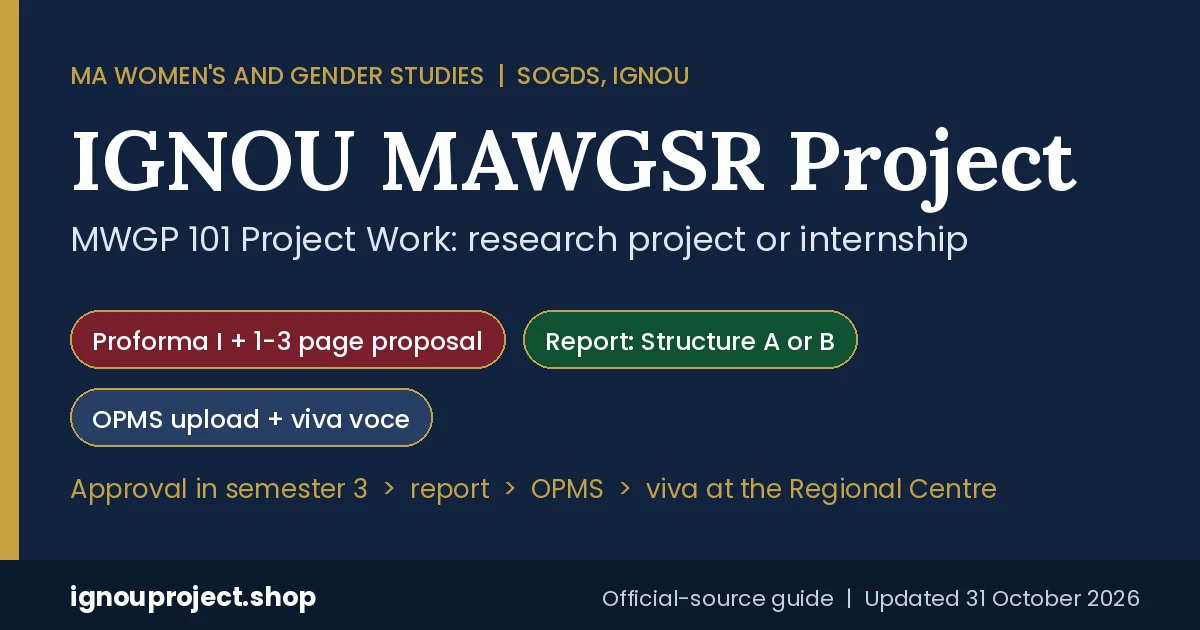
MA Women’s and Gender Studies · MWGP-101 Project Work
IGNOU MAWGSR Project (MWGP 101): Research Project or Internship, Proposal, Report and OPMS Upload
The IGNOU MAWGSR Project is MWGP-101 Project Work, a compulsory 8-credit course in the second year of the MA in Women’s and Gender Studies. Learners choose a research project or an internship, take approval in the third semester, upload the final report through OPMS, and then face a viva voce at the Regional Centre.
The course in one place
What is the IGNOU MAWGSR Project (MWGP-101)?
The IGNOU MAWGSR Project refers to MWGP-101 Project Work, the 8-credit project course of the M.A. (Women’s and Gender Studies), programme code MAWGSR, offered in distance mode by the School of Gender and Development Studies (SOGDS) at Indira Gandhi National Open University. MWGP-101 sits in the second year and, according to the revised MAWGSR Programme Guide, is a compulsory course common to both second-year specialisations, Gender, Literature and Culture, and Women’s Studies. A learner completes it in one of two ways: a research project on a women’s and gender studies question, or an internship with an approved organisation. The Common Prospectus states that the process begins at the start of the third semester, ends by the close of the fourth, and has two components, the research study or internship itself and a viva voce. The programme guide adds that MWGP-101 carries no term-end examination paper and no separate assignment.
The quick-facts table below collects the published details in one place. Where a figure changes from one document to another, the row says so rather than picking one silently.
| Course code and title | MWGP-101, Project Work (also written MWGP 101) |
|---|---|
| Programme | M.A. (Women’s and Gender Studies), MAWGSR, 80 credits, ODL, English medium |
| School | School of Gender and Development Studies (SOGDS), IGNOU, Maidan Garhi, New Delhi |
| Credits and year | 8 credits, second year; compulsory in both specialisations |
| Routes | Research project, or internship with an approved organisation or institution |
| Internship length | “One month” in the Programme Guide; “one to three month” in the Common Prospectus (see the section on conflicting documents) |
| When approval is taken | Third semester, before work begins |
| Proposal paperwork | Proforma I with a brief project proposal of 1 to 3 pages, sent to the Course Coordinator (MWGP-101) |
| Components assessed | Research study or internship report, plus viva voce |
| Submission route | Online through OPMS on the Samarth login; no hard copy to SED or the Regional Centre |
| Programme duration | Minimum 24 months, maximum 36 months |
Picking the route
Research project or internship: which MWGP-101 route fits you?
For the IGNOU MAWGSR Project, the choice between a research project and an internship is made by the learner, and the Common Prospectus ties it to the learner’s own interest, preparation and employment situation. Neither route is graded as the lighter one. Both earn the same 8 credits, both end in a written report, and both go to a viva voce.
The real difference lies in who approves what. A research project needs the topic and proposal approved by the Course Coordinator (MWGP-101) at SOGDS. An internship needs the Programme Coordinators to approve the host organisation and the field supervisor before any work starts, and the field supervisor later signs off on what was done.
| Point of comparison | Research project | Internship |
|---|---|---|
| First approval | Proforma I plus a 1 to 3 page proposal, approved by the Course Coordinator (MWGP-101) | Programme Coordinators approve the organisation and the field supervisor through the internship proforma |
| Who supervises the work | The supervisor named on the approved proposal | A field supervisor at the NGO or approved organisation |
| What the supervisor records | Signs the proposal; OPMS also asks for the supervisor’s signed bio-data | Academic qualifications, total field experience and field experience in the last 5 years |
| What is submitted | Research report with the approved proposal and declaration | Report of the work done, with Proforma V and the completion certificate |
| Best suited to | Learners who want a text, film, media or field study of their own | Learners already working with, or able to join, a gender-focused organisation |
A practical way to decide: if a host organisation and a willing field supervisor are not lined up by the start of the third semester, the research project route is usually the safer plan, because its approval depends on a document the learner controls. Either way, a women’s and gender studies project at IGNOU is judged on how well it applies the MWG course readings to one clearly bounded question.
Topic and structure
MWGP 101 project topics that match the two official report structures
An IGNOU MAWGSR Project topic has to fit one of two report structures printed in the MAWGSR Programme Guide, so it pays to pick the structure and the topic together. The guide allows a critical analysis of a textbook, newspaper reports or articles, a case study, or a study in the learner’s own area of interest, built either on theory studied in the courses or on empirical work.
Structure A: literature and other humanities-related areas
Title, Introduction, Purpose of Study, Discussion and Critical Analysis, Conclusion, and References. The guide notes that in humanities work the Discussion and Critical Analysis forms the main body of the report, and it expects that discussion to read as the learner’s own argument rather than a summary of other critics.
Topics that sit naturally here, all original examples:
- A feminist reading of women’s work and domestic space in a contemporary Hindi or regional-language novel.
- How a single newspaper reported dowry deaths across one calendar year: framing, sources quoted, and silences.
- Representation of girls in one state board’s class 8 social science textbook.
Structure B: social science-related areas
Title, Introduction and Statement of the Problem, Objectives, Methodology, Analysis, Conclusion, and References. The guide stresses that a social science project must describe its methodology in detail, including whether the study takes a quantitative or a qualitative perspective. Learners should match their headings to the exact list in the current guide’s annexure before writing.
- Decision-making within self-help groups of women in one block or ward.
- Awareness of the internal committee under the workplace sexual harassment law among women staff of private schools in one district.
- Time use of women home-based workers in one urban settlement, using a short interview schedule.
The test for any of these MWGP 101 project topics is size. A title that names one place, one group and one question can be finished inside the third and fourth semesters; a title that names “India” or “society” usually cannot.
Approval paperwork
How to write the MWGP 101 synopsis for approval
What students call the MWGP 101 synopsis is, in the programme guide’s own words, a brief project proposal of one to three pages submitted with Proforma I. That length matters. Many pages online describe an 8 to 12 page synopsis for this course, but the MAWGSR guide asks for something much shorter, and a padded proposal is harder for the Course Coordinator to approve quickly.
The guide sets the timing too: “Approval for project work should be taken in the third semester”, and the proposal goes to the Course Coordinator (MWGP-101) before the research project begins. A sensible 1 to 3 page MAWGSR project proposal covers:
- Working title that names the text, group or place being studied.
- Background and the question, in one tight paragraph.
- Purpose or objectives, two to four of them, written neutrally.
- Chosen structure, A or B, and the method: texts to be read, or sample, tools and setting.
- Key readings, a short list drawing on the MWG courses already studied.
- Supervisor details, with the signatures the proforma asks for.
Learners opting for the internship write no such proposal. They contact the Programme Coordinator instead and send the internship proforma for the organisation and field supervisor.
Reconciling sources
IGNOU MAWGSR Project rules: where the official documents disagree
The IGNOU MAWGSR Project is described in at least three official documents, and they do not say exactly the same thing. Reading them together, and knowing which one is current for each point, saves a learner from planning around a rule that has already changed.
| Point | What the documents say | Which to follow |
|---|---|---|
| Internship length | MAWGSR Programme Guide (eGyanKosh, 2023 issue): “one month internship”. Common Prospectus July 2025, section 3.49: “one to three month internship with an NGO/ other approved Organization”. | Treat one month as the minimum and agree the exact length in writing with the Programme Coordinator before joining. |
| Proposal and report dates | The older MWGP-001 guide for the earlier MAWGS programme fixed the proposal by 31 January and the research project by 31 March, as hard copy to SOGDS. | Those dates belong to the earlier programme. For MAWGSR, approval falls in the third semester and the report deadline is set by each OPMS cycle. |
| Word limit | The older MWGP-001 guide gave 4000 to 5000 words for a critical analysis and for an internship report. | No limit could be confirmed from the current MAWGSR guide; confirm with the Course Coordinator before treating it as binding. |
| Where the report goes | Older guides asked for a hard copy to the School. The OPMS guidelines for TEE December 2026 say do not send a hard copy to SED or the Regional Centre. | OPMS upload is current for the December 2026 cycle. |
BK Sahni, who has guided 5,00,000 students till date, sees the internship-length question come up again and again with gender studies learners, and the one step that settles it is an email reply from the Programme Coordinator kept with the approved proforma.
Upload and viva
Submitting the IGNOU MAWGSR project report through OPMS
An IGNOU MAWGSR project report for the December 2026 term-end cycle goes online through the Online Project Management System (OPMS), which IGNOU’s Student Evaluation Division launched in October 2026 on the Samarth platform. The steps below follow the OPMS guidelines for TEE December 2026.
- Pay the project fee on Samarth. IGNOU OPMS project submission opens only after payment. IGNOU’s earlier online project guideline set the evaluation fee at Rs. 500 for project work above 4 credits, from the January 2023 admission cycle; MWGP-101 carries 8 credits, so confirm the amount shown on Samarth.
- Prepare one PDF of the report, scanned in the right order and orientation. The first page shows the title, name, programme code MAWGSR, enrolment number, Regional Centre code and course code MWGP-101.
- Keep the three supporting files separate: the supervisor’s signed bio-data (up to 5 MB), the copy of the approval (up to 5 MB) and the proposal itself (up to 10 MB). The full report may be up to 40 MB.
- Upload before the deadline. For TEE December 2026 it is 30 November 2026, 11:59 PM, and the portal says no extension will be given.
- Do not post or email a copy. OPMS states that hard copies to SED or the Regional Centre and emailed reports will not be considered.
The MAWGSR project submission last date changes every cycle, so the date above applies to December 2026 only; learners targeting June 2027 should wait for the next OPMS notice. After upload, the MWGP 101 viva voce is arranged by the learner’s Regional Centre, and the schedule comes from the RC, not from SOGDS.
Avoidable setbacks
Mistakes that get an MWGP-101 proposal or report sent back
Most delays on the IGNOU MAWGSR Project trace back to a handful of avoidable errors. None of them needs a rewrite of the research itself, only care with the paperwork.
- Starting work before approval. Both the older guide and the current one expect approval first; a report built on an unapproved title has nothing to attach in the OPMS approval field.
- Mixing the two structures. A film analysis written under Methodology and Sample headings reads as a social science study with no data. Pick A or B and keep to it.
- Using old MAWGS forms. Proforma numbers and dates in the MWGP-001 guide differ from the MAWGSR guide; download the current MAWGSR project guidelines from eGyanKosh.
- Internship without the field supervisor’s form. The guide makes Proforma V, filled by the field supervisor, part of the submission.
- A report title that does not match the approved one. Evaluators check the two against each other.
- Copied material. SOGDS states in its MWG assignment files that plagiarised work will not be evaluated, and those files point learners to the plagiarism statement in the programme guide; read it before drafting the report.
When an MWGP 101 project is rejected at the proposal stage, the usual fix is a narrower title and a clearer method, resubmitted with a fresh Proforma I.
Quick answers
MWGP-101 questions students ask most
Is MWGP-101 compulsory or optional in MAWGSR?
Compulsory. The MAWGSR Programme Guide lists MWGP-101 Project Work as a compulsory, 8-credit course common to both the Gender, Literature and Culture and the Women’s Studies specialisations. What the learner chooses is the route, research project or internship, not whether to do the course.
Is there a viva voce for the IGNOU MAWGSR Project?
Yes. The Common Prospectus describes MWGP-101 project work as having two components, the research study or internship and a viva voce. OPMS guidelines state that, where applicable, the viva is conducted under the learner’s Regional Centre, which also publishes the schedule.
How long is the MWGP 101 internship?
The MAWGSR Programme Guide says one month with an approved organisation or institution; the Common Prospectus July 2025 says one to three months with an NGO or other approved organisation. Agree the duration with the Programme Coordinator before starting the MWGP 101 internship.
Does MWGP-101 have a term-end exam or an assignment?
No. The programme guide states that there is no term-end examination or separate assignment for MWGP-101. The MWGP 101 credits are earned through the report and the viva voce alone.
Who can be the MAWGSR project supervisor?
For a research project, the MAWGSR project supervisor is the person named and signing on the approved proposal; for an internship, it is the field supervisor whose qualifications and field experience are entered on the internship proforma. A numeric eligibility rule could not be confirmed from the current guide, so confirm it with the Course Coordinator (MWGP-101).
Is MWGP 101 the same as MWGP-001 or MWGP 1?
Related but not the same. MWGP-101 (also written MWGP 101 or MWGP101) belongs to the revised MAWGSR programme. MWGP-001 (searched as MWGP 1, MWGP-1 or MWGP 01) belonged to the earlier IGNOU MAWGS project and the PG Diploma. Use the forms and guide that match the programme code on the admission record.
Before acting on any date or form: check the current position for the IGNOU MAWGSR Project on the official M.A. (Women’s and Gender Studies) programme page on ignou.ac.in and download the revised Programme Guide from eGyanKosh. OPMS deadlines are fixed fresh for each term-end cycle.
Learners still choosing a route can start with a single-page plan: route, structure (A or B), title, and the person who will sign. For the wider picture of how IGNOU project courses work across programmes, see the IGNOU project hub on this site, which links each programme guide built so far.
Disclosure: ignouproject.shop is an independent study-help publication of Shri Chakradhar Publication Pvt. Ltd. It is not the official website of Indira Gandhi National Open University and is not affiliated with or endorsed by IGNOU. Rules, forms and dates are taken from IGNOU’s published documents as of the date above; the university’s own notices always prevail.

ignouproject.shop is an independent study-help site and is not the official IGNOU website.
Leave a Reply