
MASS · MSDP-18 · SOITS
IGNOU MASS Project for MSDP 18: From Topic Approval to Final Upload
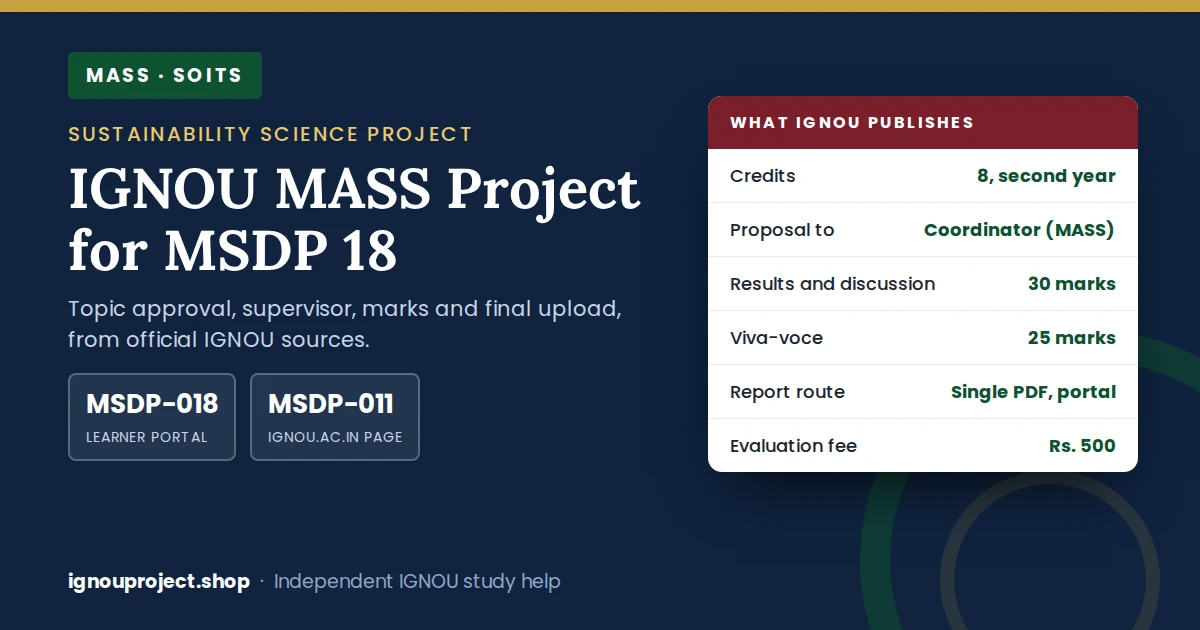
The IGNOU MASS project is the 8-credit, second-year project course of the Master of Arts (Sustainability Science). The learner picks a sustainability problem, secures an eligible supervisor, gets the proposal approved by the MASS coordinator at SOITS, completes the study and uploads the report for evaluation, which includes a viva-voce.
The short version
What is the IGNOU MASS project (MSDP-18)?
The IGNOU MASS project refers to the project course of the Master of Arts (Sustainability Science), a programme of the School of Interdisciplinary and Transdisciplinary Studies (SOITS) at Indira Gandhi National Open University. The MASS learner portal maintained by SOITS calls it MSDP-018: Project and describes the programme as 16 courses, of which 15 are theory courses and one is this project of 8 credits. The ignou.ac.in programme page lists the same 8-credit, second-year component as MSDP-011: Project Work. The work runs in a fixed order: choose a topic that suits sustainable development, find a supervisor who meets the SOITS eligibility list, send a proposal to the MASS coordinator, carry out the study only after approval, and submit the report for evaluation. Assessment covers the introduction, literature review, methodology, results and discussion, conclusions and a viva-voce.
Most learners arrive with two questions: which code to write, and what the university expects in the report. IGNOU’s own documents answer both, and the table below collects them.
| Programme | Master of Arts (Sustainability Science), code MASS, ODL mode, medium English |
|---|---|
| School | School of Interdisciplinary and Transdisciplinary Studies (SOITS) |
| Project course | MSDP-018: Project on the MASS learner portal; MSDP-011: Project Work on the ignou.ac.in programme page |
| Credits and year | 8 credits, second year (MASS is a yearly programme, so there is no project semester) |
| Programme duration | Minimum 24 months, maximum 48 months |
| Supervisor | From the eligibility list published by SOITS; SOITS can reject an unsuitable supervisor |
| Proposal goes to | Coordinator (MASS), SOITS, IGNOU, Maidan Garhi, New Delhi-110068 |
| Evaluation | Report components plus a 25-mark viva-voce, total stated as 100 |
| Final report route | Single PDF on the IGNOU online project portal, within the session’s notified dates |
| Evaluation fee | Rs. 500 for project work above 4 credits, paid with the Term-End Examination form |
| Academic queries | mass@ignou.ac.in (MASS programme coordinator, SOITS) |
The code question
Is the IGNOU MASS project code MSDP-018 or MSDP-011?
Both codes appear on official IGNOU pages, and the MASS learner’s own records decide which one to write. The official ignou.ac.in page for the Master of Arts (Sustainability Science) lists the project as MSDP-011: Project Work, 8 credits, second year. The MASS learner portal run by SOITS, which holds the project handbook, the formats and the sample reports, files the same course as MSDP-018: Project, also at 8 credits. eGyanKosh, IGNOU’s digital repository, carries an item titled MSDP-018 Project Work.
ignou.ac.in programme page
MSDP-011
Listed as “Project Work”, 8 credits, second year of MASS. The PGDSS programme page shows the same code.
MASS learner portal and eGyanKosh
MSDP-018
Listed as “Project”, 8 credits, with the handbook, proposal format, report format and FAQs underneath.
Neither page explains the difference, and no notification found during research reconciles the two. The practical rule is simple. Write the project course code exactly as it appears against your enrolment in your examination form and your Term-End Examination records, because that is the record the Student Evaluation Division matches the upload against. If your records and the report’s first page disagree, write to mass@ignou.ac.in before uploading and keep the reply.
BK Sahni, who has guided 5,00,000 students till date, notes that the code mismatch costs MASS learners more anxiety than marks: the evaluator reads the study, but the upload is matched to the enrolment record, so the first page has to agree with the examination form, whichever of the two codes that form shows.
Timing
When should a MASS learner start the project?
Start planning at the end of the first year, even though the project belongs to the second. MASS is a yearly programme, so there is no “project semester” to wait for, and the proposal has to be approved before any field work begins. The second-year courses listed on the MASS learner portal, including MEDS-044 Monitoring and Evaluation of Projects and Programmes, run alongside the project.
- End of year one: shortlist two problems you can observe at first hand, and approach a supervisor from the SOITS eligibility list.
- Early year two: read the project formulation and sampling blocks of MEDS-044, then draft the proposal with the supervisor.
- Proposal sent: post or forward the proposal packet to the Coordinator (MASS) at SOITS and wait for approval.
- After approval: collect data, using the supervisor’s or the Study Centre’s authorisation letter where an office or institution asks for one.
- Before the session’s last date: assemble the single PDF, pay the evaluation fee with the Term-End Examination form, and upload.
No IGNOU document reviewed gives a fixed approval time, so build slack into the plan. The university fixes the report deadline afresh each session; for the June 2026 Term-End Examination, the Student Evaluation Division extended the last date for final project and dissertation reports of ODL programmes to 15 June 2026.
Choosing the problem
How does SOITS judge a MASS project topic?
SOITS judges a MASS project topic against practical criteria published on the MSDP-018 page of the MASS learner portal, not against how ambitious it sounds. The list asks the learner to weigh the following before committing:
- Suitability of the topic, and its relevance to sustainable development and issues of sustainability.
- The time actually available to the learner.
- Whether data can be collected within that time, what challenges data collection involves, and how they will be met.
- The cost of data collection.
- Communication facilities and the local language of the people being studied.
Cost and local language rarely appear on generic topic lists, yet they decide whether a field study survives. A household survey where the learner cannot speak the language needs an interpreter, which is a cost and time problem before it is a research one.
A worked example: from theme to approvable title
The drafts below show how one broad theme narrows into something the criteria can accept. They are illustrations, not approved titles.
Draft 1: “Plastic pollution and sustainability in India.”
No place, no population, no method. The relevance test passes; every other criterion fails.
Draft 2: “Plastic waste management in Delhi.”
A place, but a city of millions. Time, cost and feasibility of data collection are still undefined for one learner.
Draft 3: “Segregation of household waste at source in two residential wards of one town: a questionnaire study of households.”
A defined locale, a defined respondent group, an instrument the learner can administer in the local language, and a scope one person can cover. This is the shape the proposal format expects.
Second-year courses supply themes that narrow the same way: water use around one lake for MSD-022 Aquatic Ecosystem, adaptation in one hill village for MSD-021 Mountain and Hill Ecosystem, green spaces in one ward for MEVE-016 Urban Environment, or CSR disclosures of a few companies for MEDS-051 Fundamentals of CSR. The move is always a reachable place, a group you can talk to and an instrument you can use.
Supervision
Who can supervise an IGNOU MASS project?
A supervisor for the IGNOU MASS project must fall within the eligibility list SOITS publishes for MSDP-018. According to the project page of the MASS learner portal, the eligible categories are:
- Faculty at IGNOU headquarters.
- Academic counsellors of the PG Diploma in Sustainability Science with relevant experience.
- Teachers or researchers working in the area of sustainable development.
- Holders of a Ph.D. in environmental science or studies, economics, sociology, anthropology or a related discipline.
- Holders of a Master’s or M.Phil. in those disciplines with two years of research or teaching experience.
The same page states that if SOITS does not accept the proposed supervisor, the learner is told so and must change the supervisor and resubmit the proposal. The portal also lists SOITS faculty members a learner may request as supervisor, which is a useful route for anyone with no eligible academic nearby.
The supervisor’s listed responsibilities go beyond signing forms: narrowing the topic, pointing to literature and field settings, encouraging original work, and issuing an authorisation letter for data collection. The Study Centre or Regional Centre can also issue that letter, which matters when an office, school or company asks who is sending the researcher.
Before field work
What goes into the MSDP-018 proposal, and where is it sent?
The MSDP-018 proposal must state the title, introduction, objectives, problem statement, research methodology, limitations and references, according to the MASS learner portal. The methodology part is expected to name the locale of the study, the sampling, the instruments and the statistical tools to be used. A proposal that leaves any of those four blank gives the coordinator nothing to approve.
The learner portal publishes three downloadable formats for this course (project proposal, certificate of originality and final project report), plus sample reports and a step-by-step document from formulation to submission. Use those files rather than help-site templates.
| Stage | What is sent | Where it goes | Source |
|---|---|---|---|
| Proposal | Proposal, approval proforma, supervisor’s signed bio-data | Coordinator (MASS), SOITS, Swami Vivekanand Bhawan, IGNOU, Maidan Garhi, New Delhi-110068 | MASS learner portal, MSDP-018 FAQs |
| Proposal (general channel) | Project proposal for synopsis approval | The concerned School or the Regional Centre | IGNOU online project portal guidelines |
| Supervisor not accepted | Revised proposal with a new supervisor | Back to SOITS | MASS learner portal |
| Final report (older instruction) | Project report | Registrar (Student Evaluation Division), IGNOU, Maidan Garhi | MASS learner portal, MSDP-018 FAQs |
| Final report (current practice) | One PDF with proforma, synopsis, bio-data, originality certificate, report and fee receipt | IGNOU online project portal | Portal guidelines for each session |
The table records one live inconsistency: the learner portal still names the Registrar of the Student Evaluation Division for the report, a remnant of the postal system, while the online portal requires a single PDF upload. The portal notice for your session is the current rule.
Marks
How are the marks for the MSDP-018 project divided?
The MSDP-018 evaluation scheme on the MASS learner portal places the heaviest weight on results and discussion, followed by the viva-voce. The published components are listed below exactly as SOITS presents them, with a column on what each one asks of the report.
| Component | Maximum marks | What to show |
|---|---|---|
| Introduction (with objectives and rationale) | 10 | Why this problem, in this place, matters for sustainable development |
| Review of the literature | 10 | What earlier studies found and the gap your study addresses |
| Methodology | 10 | Locale, sampling, instruments and statistical tools, as approved |
| Results and discussion | 30 | Tables and figures interpreted against each objective |
| Conclusions | 10 | Answers to the objectives and recommendations tied to findings |
| Viva-voce | 25 | Command of your own topic, method and findings |
| Total stated on the page | 100 | The six listed components add up to 95 |
The arithmetic deserves a second look. The six components on the learner portal add up to 95, while the same page gives the total as 100, and it does not say which element carries the remaining five marks. Plan the report against the components as listed, and if the gap matters to you, ask the MASS coordinator rather than guessing; the stated total of 100 is the figure IGNOU publishes.
Read as a writing budget, results and discussion alone carry as many marks as introduction, literature review and methodology together. A report that spends most of its pages on background and little on its own data is weighted the wrong way round.
Method support
Which MASS course helps most with the project methodology?
MEDS-044 Monitoring and Evaluation of Projects and Programmes, a 6-credit second-year course of MASS, is the closest thing the programme has to a research methods course. Its four blocks, as listed on the ignou.ac.in programme page, are Project Formulation and Management, Monitoring and Evaluation, Measurement and Sampling, and Data Collection and Analysis.
Those blocks map almost one to one onto the proposal format: Block 1 supports the problem statement and objectives, Block 3 the sampling section, and Block 4 the instruments and statistical tools. Study them before drafting, not after the proposal comes back.
The 2023 second-year MASS assignment set, for example, asked learners to explain project proposals and the steps in formulating one, the same skill the MSDP-018 proposal tests.
Final submission
How is the MASS project report submitted and evaluated now?
The MASS project report is now uploaded as one PDF on the IGNOU online project portal, within the dates notified for the session. The portal guidelines ask for the original report to be scanned into a single file for the course, so that the Regional Centre and the Student Evaluation Division can download it in one piece.
The first page must carry the report title, the learner’s name, programme code, enrolment number as printed on the identity card, Regional Centre code, course code, mobile number and email address. The approved proforma, synopsis, supervisor’s bio-data and an originality certificate signed and dated by learner and supervisor go inside the same file, scanned clearly, in order and in one orientation.
| Evaluation fee | Rs. 300 for project work up to 4 credits and Rs. 500 above 4 credits, for the January 2023 admission cycle onwards; the 8-credit MASS project falls in the Rs. 500 band |
|---|---|
| How it is paid | With the Term-End Examination form; the receipt goes into the upload, and a report without the fee paid is not evaluated |
| Reports received through email are not considered for evaluation | |
| Incomplete uploads | Removed from the portal after the last date; the learner uploads again in the next session |
| Viva-voce | Conducted by the concerned faculty under the Regional Centre; contact the Regional Centre for the schedule |
| Queries | Regional Centre email, or the SED project section at projects@ignou.ac.in |
| Last date | Fixed by notification each session; confirm the current one on ignou.ac.in |
Some help pages still describe emailing the report to a programme address; the portal guidelines rule that out. How the same portal rules apply across other programmes is set out in the programme-by-programme IGNOU project hub.
Avoidable setbacks
What sends a MASS project proposal or report back?
- A supervisor outside the list. SOITS can decline the supervisor, and the whole proposal then has to be resubmitted with a new one.
- A methodology with blanks. No locale, no sampling plan, no named instrument or no statistical tool, all four of which the proposal format asks for.
- Field work before approval. Data collected for a topic that is later changed has to be collected again.
- A first page that disagrees with the records. A different course code, a control number in place of the enrolment number, or a missing Regional Centre code.
- Missing front matter. The approved proforma, synopsis, supervisor’s bio-data or the jointly signed originality certificate is left out of the PDF.
- Poor scans. Blurred, dim, out-of-order or mixed-orientation pages, which the portal guidelines warn against by name.
- Fee not paid with the examination form. The report is then not taken up for evaluation, however good it is.
Quick answers
IGNOU MASS project: frequently asked questions
What is the course code for the IGNOU MASS project?
The MASS learner portal and eGyanKosh use MSDP-018, which students also search as MSDP 18, MSDP-18, MSDP18 and MSDP 018. The ignou.ac.in programme page lists the same 8-credit project as MSDP-011. Write the code shown in your own examination records.
How many credits does the MASS project carry, and in which year?
The MASS project carries 8 credits and belongs to the second year of the Master of Arts (Sustainability Science). MASS is a yearly programme, so the project is not tied to a semester.
Where is the MSDP-018 project proposal sent?
To the Coordinator (MASS), School of Interdisciplinary and Transdisciplinary Studies, IGNOU, Maidan Garhi, New Delhi, as the MASS learner portal states. The online project portal guidelines also mention the concerned School or the Regional Centre as general channels.
Can a PGDSS academic counsellor supervise the MASS project?
Yes, if the counsellor has relevant experience. Academic counsellors of the PG Diploma in Sustainability Science are one of the eligible supervisor categories published for MSDP-018.
Is there an official word limit for the MSDP-018 report?
No word or page limit was found in the IGNOU documents reviewed for this article. Follow the final project report format published on the MASS learner portal and your supervisor’s advice.
What is the evaluation fee for the MASS project?
Rs. 500, because the portal guidelines set that fee for project work above 4 credits from the January 2023 admission cycle onwards. It is paid with the Term-End Examination form, and the receipt goes into the uploaded PDF.
Can the MASS project report be sent by email?
No. The IGNOU online project portal guidelines state that reports received through email are not considered for evaluation.
Verify before you act: the course structure is on the official MASS programme page on ignou.ac.in, and the project handbook is indexed on eGyanKosh as MSDP-018 Project Work. The formats, FAQs and sample reports sit on the MASS learner portal at sites.google.com/ignou.ac.in/mass under SLM, Second Year, MSDP-018. Portal rules, fees and dates are notified each session, and the newest notice takes precedence over this page.
If the proposal is where the work has stalled, a review of the topic, objectives and sampling plan against the MSDP-018 proposal format before it goes to SOITS can save a round of revision. Details are on the ignouproject.shop project pages.
Independent study-help disclosure: ignouproject.shop is run by Shri Chakradhar Publication Pvt. Ltd. and is not the official website of IGNOU or SOITS. This article summarises published university documents for guidance only; official notifications on ignou.ac.in prevail over anything written here.

BK Sahni iD 0009-0005-8092-459X
Founder, Shri Chakradhar Publication Pvt. Ltd. & its IGNOU Project study-help brand, helping IGNOU distance-learning students since 2010 and having guided 5,00,000 students till date across MBA, MCom, MA & more. Author of IGNOU exam guides, solved assignments & project reference books.
Disclosure: Shri Chakradhar Publication Pvt. Ltd. and ignouproject.shop are independent third-party study-help services, not the official IGNOU website. Always verify final dates and rules on ignou.ac.in.
Leave a Reply