
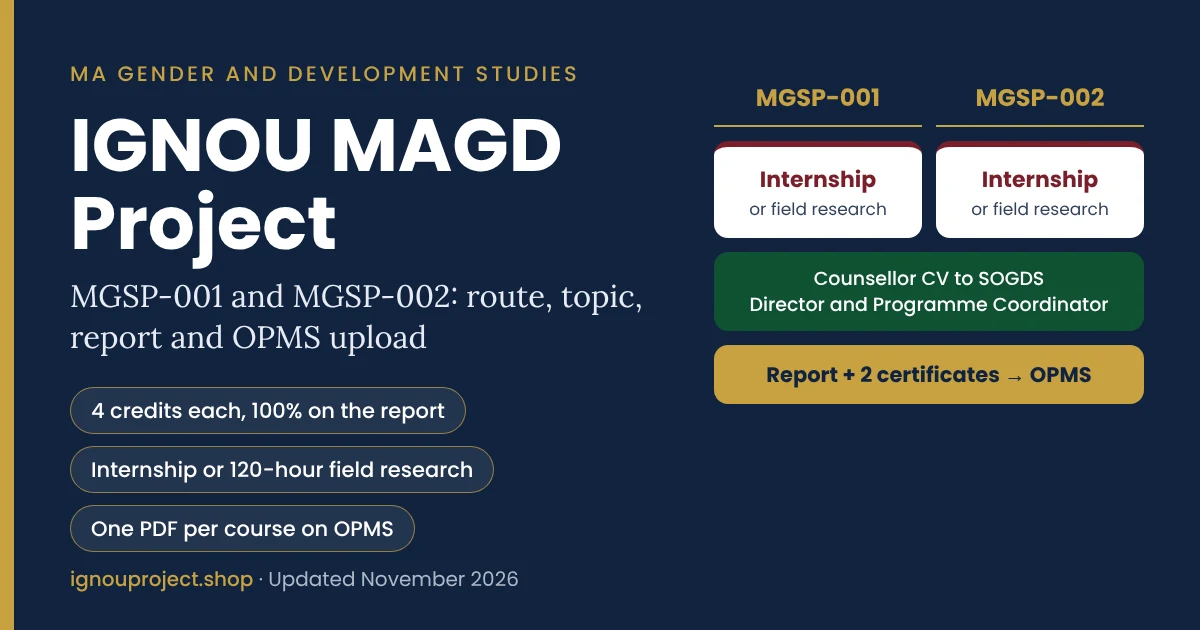
MA Gender and Development Studies · MGSP-001 and MGSP-002
IGNOU MAGD Project: MGSP-001 and MGSP-002 Routes, Topics, Report and OPMS Submission
The IGNOU MAGD project is two compulsory 4-credit courses, MGSP-001 and MGSP-002, in the MA in Gender and Development Studies. Each is done as either an internship or a field-based research project, and each is marked wholly on the report you submit: 100 per cent weightage, with no term-end paper.
Start here
What the IGNOU MAGD project actually is
The IGNOU MAGD project refers to two separate project courses of the M.A. (Gender and Development Studies) programme, offered by the School of Gender and Development Studies (SOGDS) at Indira Gandhi National Open University. MGSP-001 is Internship-I / Field based Research Project-I, and MGSP-002 is Internship-II / Field based Research Project-II. Each carries 4 credits, 8 across the two courses, and the programme page states that 100 per cent weightage goes to the internship report or research project report submitted. For each course, the learner takes one route: an internship in an organisation, logged at 100 to 120 hours, or a field-based research project of 120 hours under a Project Counsellor. The 2020 course handbooks on eGyanKosh tie each course to fixed themes, so MGSP-001 draws on first-year coursework and MGSP-002 on the second-year electives.
Two consequences follow. There is no question paper to recover marks in, so the report carries the whole grade. And because MGSP-001 and MGSP-002 are separate courses, you plan, write and upload two reports, each with its own counsellor approval and certificates. The credit values and the 100 per cent weightage are printed on the M.A. (Gender and Development Studies) programme page on ignou.ac.in.
| Programme | M.A. (Gender and Development Studies), code MAGD |
|---|---|
| School | School of Gender and Development Studies (SOGDS), Block 15 B, IGNOU, Maidan Garhi, New Delhi 110068 |
| Course codes | MGSP-001 Internship-I / Field based Research Project-I; MGSP-002 Internship-II / Field based Research Project-II |
| Credits | 4 each, 8 in total across the two courses |
| Year | MGSP-001 in the first year; MGSP-002 in the second year on eGyanKosh and the SOGDS academic support page (the programme page lists both under Year 1, so follow your own registration) |
| Routes | Internship or field-based research project, chosen per course |
| Time | 120 hours per field-based project; internship stated as 120 hours, with 25 days (100 hours) as the floor |
| Assessment | 100 per cent on the report; no term-end examination |
| Typing | A4, double spacing (MGSP-002 handbook, 2020) |
| Submission | Online Project Management System (OPMS) through the Samarth login; for the December 2026 TEE, by 30 November 2026, 11:59 PM |
| Fee | Project, internship and practical course fee through Samarth, by 30 November 2026 for the December 2026 TEE; the amount shows in your account |
| Medium | English and Hindi (programme medium) |
The choice
MGSP 1 and MGSP 2: four routes, one choice per course
Every IGNOU MAGD project decision starts from a grid of four boxes: two courses, MGSP 1 and MGSP 2 as the programme page labels them, and two routes for each. The handbooks present the internship and the field-based research project as alternatives within each course, so decide route by route, not once for the whole programme.
| Point | Internship | Field-based research project |
|---|---|---|
| Who guides you | An Internship Counsellor designated by the organisation | A Project Counsellor you identify |
| Approval of the guide | CV sent to the Director, SOGDS and the Programme Coordinator, MAGD | CV sent to the Director, SOGDS and the Programme Coordinator, MAGD |
| What you prepare first | Internship proposal: organisation name, address, head, Internship Counsellor, objectives of the organisation, and your own objectives | Research proposal discussed and finalised, including feasibility, with the Project Counsellor |
| Time | 120 hours stated; at least 25 days, counted as 100 hours | 120 hours, from proposal to write-up |
| Certificates attached | Certificate of Bonafide Work; Certificate of Satisfactory Completion of Internship | Certificate of Bonafide Work; Certificate of Satisfactory Completion of Research Project, issued by the project counsellor |
When the MAGD internship route makes sense
The MAGD internship suits a learner who already works in, or can get placed with, an organisation running gender-related work: an NGO, a women’s cell, a self-help group federation, a CSR unit or a scheme office. The handbook lets you choose the organisation with intimation to the Programme Coordinators (MAGD) at SOGDS. The person who will act as your Internship Counsellor sends no paperwork to IGNOU; you do. Their CV goes from you to the Director, SOGDS and the Programme Coordinator, MAGD for approval, so ask for it in the first week, not the last.
When field-based research is the safer route
Field-based research suits a learner with no placement, or one whose question is about a community rather than an organisation: unpaid care work in a village, girls’ school retention in a ward, women’s access to a welfare scheme. You work with a Project Counsellor, whose CV follows the same path to SOGDS. The handbook asks you to discuss and finalise the research proposal with that counsellor, feasibility included, before you go to the field.
Topics
Which MAGD project topics does the handbook point you to?
For the IGNOU MAGD project, topic choice is narrower than most students assume. Section 1.4 of the MGSP-001 handbook, headed Themes for the MGSP I and MGSP II, ties each course to the coursework behind it.
| Course | Theme listed in the handbook | Course it draws on |
|---|---|---|
| MGSP-001 | Gender, Development Goals and Praxis | MGS-002 |
| MGSP-001 | Gender Analysis | MGS-003 |
| MGSP-001 | Gender-Sensitive Planning and Policy Making | MGS-004 |
| MGSP-002 | Gender Planning and Development Policies | MGSE-001 |
| MGSP-002 | Gender Audit and Gender Budgeting | MGSE-002 |
| MGSP-002 | Gender Mainstreaming | MGSE-003 |
| MGSP-002 | Gender Issues in Agriculture, Rural Livelihoods and Natural Resource Management | MGSE-004 |
The pattern matters more than any single line. The MGSP-001 themes mirror first-year courses, and the MGSP-002 list follows the second-year electives (read the full list in the handbook, which continues beyond the rows above). Pick the MGSP-002 theme from an elective you have actually registered for, because that course material is what your report will be read against.
The handbook also sends you back to MGS-005, Research Methodologies in Gender and Development Studies. Question 6 of the 2026-27 MGS-005 assignment opens by asking you to choose a topic of interest related to gender and development studies. Treat that answer as the first draft of your MGSP-001 proposal instead of starting twice.
Sample titles that fit the themes
The handbook gives themes, not titles. The titles below were written for this page as illustrations; they are not an IGNOU list, and each needs your own district, ward or organisation filled in.
- Gender analysis: division of household and farm work in two villages of one block.
- Gender-sensitive planning: how women’s needs are recorded in a Gram Panchayat Development Plan.
- Development goals and praxis: reasons for girls leaving secondary school in one urban ward, as told by mothers and daughters.
- Gender budgeting: tracing gender-responsive allocations in three years of a municipal budget.
- Gender mainstreaming: whether a district skilling programme records and responds to women trainees’ constraints.
- Agriculture and livelihoods: women farmers’ access to institutional credit in one block.
Proposal and counsellor
Writing the proposal and getting your counsellor approved
Generic IGNOU guides describe a proforma posted to the Regional Centre. For the IGNOU MAGD project, the MGSP handbooks describe a different chain, and that chain decides whom you contact first: your counsellor, then SOGDS.
What goes into the MAGD synopsis
Students call it the MAGD synopsis; the handbook calls it the research proposal. Its headings include the title of the research project, the research questions, the purpose and objectives of the research, and the appropriate research techniques or tools. Write the research questions before the objectives, and make each objective answerable inside 120 hours with a method you can name: a semi-structured interview schedule, a household survey, a document review, a case study of one organisation.
Who can be your MAGD project guide?
Your MAGD project guide is called a Project Counsellor on the research route and an Internship Counsellor on the internship route. Under the MGSP-001 and MGSP-002 handbooks, the counsellor’s CV is sent to the Director, School of Gender and Development Studies, and the Programme Coordinator, MAGD, at IGNOU, Maidan Garhi, New Delhi 110068, for approval. The handbook sets out the qualifications a counsellor must hold; read that list in the handbook itself, and do not rely on a supervisor rule copied from an MBA or M.Com manual. In practice, ask the counsellor for a signed CV on day one, because the same signed bio-data is a separate upload on OPMS at the end.
Approval of the research proposal itself sits with the counsellor: the handbook asks you to finalise it with the Project Counsellor before the field work begins. Keep every written approval you receive, by email or on paper. The OPMS guidelines ask for an approval copy from the School, the Regional Centre or the supervisor as its own file. The MGSP-002 handbook also points back to the annexures of the MGSP-001 handbook for the forms, so download both handbooks even if you are working on only one course. How other programmes route their proposals is compared in the programme-by-programme IGNOU project hub.
Time plan
Planning the hours: 120, or 25 days of 100?
The IGNOU MAGD project handbooks measure effort in hours, not pages, and on the internship route they do not quite agree with themselves.
For the field-based route the answer is clear: 120 hours per project. Both handbooks state it, and the MGSP-001 handbook counts developing and discussing the proposal, finalising it, reviewing literature and collecting primary data inside those hours. For the internship route, the MGSP-002 handbook says learners should spend 120 hours, and then describes an internship of at least 25 days that comes to 100 hours; the MGSP-001 handbook carries the same 25-day, 100-hour line. Read 100 hours as the floor and 120 as the target. BK Sahni, who has guided 5,00,000 students till date, advises logging an internship against the 120-hour figure, because an hours record that clears the higher number cannot be read as short under either line.
| Stage | Hours | Output you keep |
|---|---|---|
| Proposal drafting and counsellor discussion | 15 | Finalised proposal, counsellor’s signed CV |
| Review of literature, starting from MGS-005 | 15 | Reading notes with full references |
| Tool design and a small pilot | 10 | Interview schedule or questionnaire, revised |
| Field work and data collection | 45 | Dated field log, consent notes, raw data |
| Analysis | 15 | Tables, coded themes, gender-disaggregated findings |
| Writing, certificates and scanning | 20 | Final report, two certificates, one PDF |
The handbook fixes the total, not the split. Shift hours toward field work if your question needs more respondents, but keep a dated log either way: it is the simplest evidence that the time was spent.
Report
IGNOU MAGD project report format, part by part
The IGNOU MAGD project report format in the 2020 handbooks is a short list, and two of its parts sit outside your own writing: the certificates. The parts the handbooks name are:
- Cover page: the title of the research project, the name of the School and your enrolment number, with the identifiers the handbook lists (Regional Centre, Study Centre and, for an internship, the Internship Counsellor’s name).
- Preface: about 100 words explaining the research project.
- Acknowledgement, crediting everyone who helped you complete the research.
- Table of contents, page-wise, starting with Introduction and Methodology.
- Body of the research report.
- Certificate of Bonafide Work.
- Certificate of Satisfactory Completion of the Research Project, or of the Internship.
The MGSP-002 handbook treats the two certificates as pre-requisites for evaluation, and for the research route says the project counsellors issue them and they are attached with the report. A report without them is incomplete before anyone reads a page. The same handbook asks for A4 paper, typed in double spacing.
What the MAGD internship report adds
The MAGD internship report follows the same order, with the Internship Counsellor named on the cover and the Certificate of Satisfactory Completion of Internship in place of the research certificate. Keep your own day-by-day record of hours and tasks in the organisation and attach it as an annexure; it supports the counsellor’s certificate.
How long should the report be?
No word limit for MAGD appears in the handbook sections checked for this guide. The figure of 4,000 to 5,000 words that circulates comes from the research project guidelines of MWGP-001, a different SOGDS course in the MA in Women’s and Gender Studies, so do not import it. Ask your counsellor or the Programme Coordinator, MAGD for the expected length, and let the 120 hours set the depth.
Students also look for a MAGD project sample before writing. The MGSP-001 collection on eGyanKosh holds the handbook and research methodology units, not a model report, so any sample in circulation is someone else’s work on someone else’s field site. Use one only to see layout, never wording.
Submission
MAGD project submission in 2026: OPMS replaces the paper route
The 2020 handbook says the IGNOU MAGD project report is submitted at the Student Evaluation Division (SED). That is no longer the route for the December 2026 Term-End Examination (TEE).
For the December 2026 TEE, IGNOU’s Online Project Management System (OPMS) takes project, dissertation and internship reports online through the learner’s Samarth login. Its guidelines say not to send a hard copy to SED or the Regional Centre after uploading, and reports sent by email are not considered. The MAGD project submission last date for that cycle is 30 November 2026, 11:59 PM, and the guidelines state there will be no further extension. Later cycles get their own date by notification, so check the current one each session.
- Check eligibility: a valid, not time-barred registration, and a component you have not already passed. Resubmission is for a component you failed.
- Pay the project or internship course fee in Samarth. The OPMS upload link opens only after the fee is recorded, and the fee deadline for the December 2026 TEE is also 30 November 2026.
- Arrange the report in the order of your course handbook. OPMS warns that a wrongly ordered report may not be considered, with no notice sent.
- Scan the original into one PDF per course, pages in order and one orientation throughout. MGSP-001 and MGSP-002 are two uploads, never one file.
- Upload as separate files: the supervisor’s signed bio-data (up to 5 MB), the approval copy (up to 5 MB), the proposal or synopsis (up to 10 MB) and the complete report with declarations (up to 40 MB).
- Type NA in any OPMS field that does not apply to the MAGD counsellor model.
- Keep the fee receipt and every submission record.
What the MAGD project front page must show
OPMS fixes the MAGD project front page: the title of the report, your name, the programme code (MAGD), your enrolment number as printed on the ID card (not the control or registration number), your Regional Centre code and the course code, MGSP-001 or MGSP-002. Put the originality certificate, signed and dated by you and your counsellor, in the report where the OPMS checklist asks for it.
Mistakes
Why an IGNOU MAGD project is not evaluated
Most problems with an IGNOU MAGD project are procedural, and almost all of them are visible before upload.
- One combined report for MGSP-001 and MGSP-002. They are separate courses with separate uploads.
- Missing the Certificate of Bonafide Work or the Certificate of Satisfactory Completion.
- An MGSP-002 theme drawn from an elective you never registered for.
- An internship hours record below 100 hours, or no record at all.
- A counsellor whose CV never reached the Director, SOGDS and the Programme Coordinator, MAGD.
- Fee unpaid, so the OPMS link never opens.
- The control number in place of the enrolment number on the front page.
- Pages out of order, or mixed page orientation in one PDF.
- Emailing the report after the portal closes.
Most cases students report as MAGD project rejected fall into two groups: a submission that was never evaluated because it was incomplete, misordered or late, or a report that was evaluated and not passed. OPMS sends a missed submission to the next session, provided the registration is still valid, and allows resubmission of a failed component.
Quick answers
IGNOU MAGD project: questions students ask
What are the course codes for the IGNOU MAGD project?
MGSP-001 (Internship-I / Field based Research Project-I) and MGSP-002 (Internship-II / Field based Research Project-II). Students also type them as MGSP 1, MGSP-1, MGSP1, MGSP 01, MGSP 001, MGSP 2, MGSP-2, MGSP2, MGSP 02 and MGSP 002; all refer to the same two courses.
Is there a viva in the MAGD project?
The programme page gives the report 100 per cent weightage, so no viva marks appear for either course. The OPMS guidelines say that where a project has a viva-voce, the Regional Centre conducts it and shares the schedule. Treat any MAGD project viva notice from your Regional Centre as the authority.
Can the report be written in Hindi?
The MAGD programme runs in English and Hindi, and eGyanKosh carries Hindi-medium material for MGSP-001 and MGSP-002. The handbook sections checked for this guide do not state the report language, so confirm the MAGD project in Hindi with your counsellor and the Programme Coordinator, MAGD before you start writing.
Where is the MAGD project guidelines PDF?
The MAGD project guidelines PDF is really two handbooks, one per course, both dated 2020 and filed under the MAGD programme on eGyanKosh; the MGSP-001 handbook record on egyankosh.ac.in is the place to start, and the MGSP-002 handbook sits in the second-year section.
Can MGSP-001 and MGSP-002 use the same topic?
Not under the handbook themes. MGSP-001 themes come from the first-year courses and MGSP-002 themes from the second-year electives, so one title cannot sit inside both lists. A second study in the same district or organisation is a different matter, provided the theme and research questions change.
Which year is MGSP-002 in?
The programme page lists both courses under Year 1, while eGyanKosh, the SOGDS academic support page and earlier prospectus tables place MGSP-002 in the second year. Follow the course list in your own Samarth registration; that is the version your fee and upload will be checked against.
Check before you submit. The rules for the IGNOU MAGD project come from three places: the MAGD programme page on ignou.ac.in, the two MGSP handbooks on egyankosh.ac.in, and the OPMS notice for the current Term-End Examination. Where this page and those documents differ, the documents win; confirm with the Programme Coordinator, MAGD at SOGDS or with your Regional Centre.
If you want a second reader on your proposal or report before the counsellor signs, ignouproject.shop offers proposal and report support for both MGSP courses. The handbook, your counsellor and the OPMS notice remain the final word.
This page is independent study-help guidance from Shri Chakradhar Publication Pvt. Ltd. and is not the official IGNOU website. Course rules, portals, fees and dates are set by IGNOU and change between sessions; verify every procedural detail against the current MGSP handbooks, the notifications on ignou.ac.in and your Regional Centre before you submit.

BK Sahni iD 0009-0005-8092-459X
Founder, Shri Chakradhar Publication Pvt. Ltd. & its IGNOU Project study-help brand, helping IGNOU distance-learning students since 2010 and having guided 5,00,000 students till date across MBA, MCom, MA & more. Author of IGNOU exam guides, solved assignments & project reference books.
Disclosure: Shri Chakradhar Publication Pvt. Ltd. and ignouproject.shop are independent third-party study-help services, not the official IGNOU website. Always verify final dates and rules on ignou.ac.in.
Leave a Reply