
MAFCS · MFCP-005 · SOITS
IGNOU MAFCS Project (MFCP-005 Project Manual): Themes, Synopsis and the 20,000-Word Report
The IGNOU MAFCS project is MFCP-005 Project Manual, an 8-credit first-year course of the Master of Arts (Folklore and Culture Studies). The learner picks one theme and topic from the Project Manual, gets a two-page synopsis approved with a local guide’s signed resume, and writes a report of about 20,000 words in English.
Start here
What is the IGNOU MAFCS project (MFCP-005)?
The IGNOU MAFCS project refers to MFCP-005 Project Manual, the project course of the Master of Arts (Folklore and Culture Studies) run by the School of Inter-Disciplinary and Trans-Disciplinary Studies (SOITS) at Indira Gandhi National Open University. The official programme page lists MFCP-005 as a project course of 8 credits in Year 1, next to the four 6-credit theory courses MFC-001 to MFC-004; together they form the 32-credit first year, which is also the Post Graduate Diploma in Folklore and Culture Studies (PGDFCS). The Project Manual on eGyanKosh, printed in 2009 under the older code MFCI-005, asks for a term paper of approximately 20,000 words in English on a theme drawn from Courses 1 to 4, and for a synopsis of about two pages approved before the work starts. The finished report now goes to the university as a single PDF on the IGNOU online project portal.
Two details set this course apart: it sits in the first year rather than the last, and its official manual is filed under a code the programme page no longer uses. The table below uses only what IGNOU publishes.
| Programme | Master of Arts (Folklore and Culture Studies), MAFCS, ODL mode |
|---|---|
| School | School of Inter-Disciplinary and Trans-Disciplinary Studies (SOITS) |
| Project course | MFCP-005 Project Manual, course type Project, 8 credits |
| Year | Year 1, alongside MFC-001 to MFC-004 (6 credits each); programme duration 24 to 48 months |
| Assignment | None for the project; the assignment booklet describes Course 5 as the project paper |
| Official manual | Project Manual on eGyanKosh, coded MFCI-005, dated May 2009 |
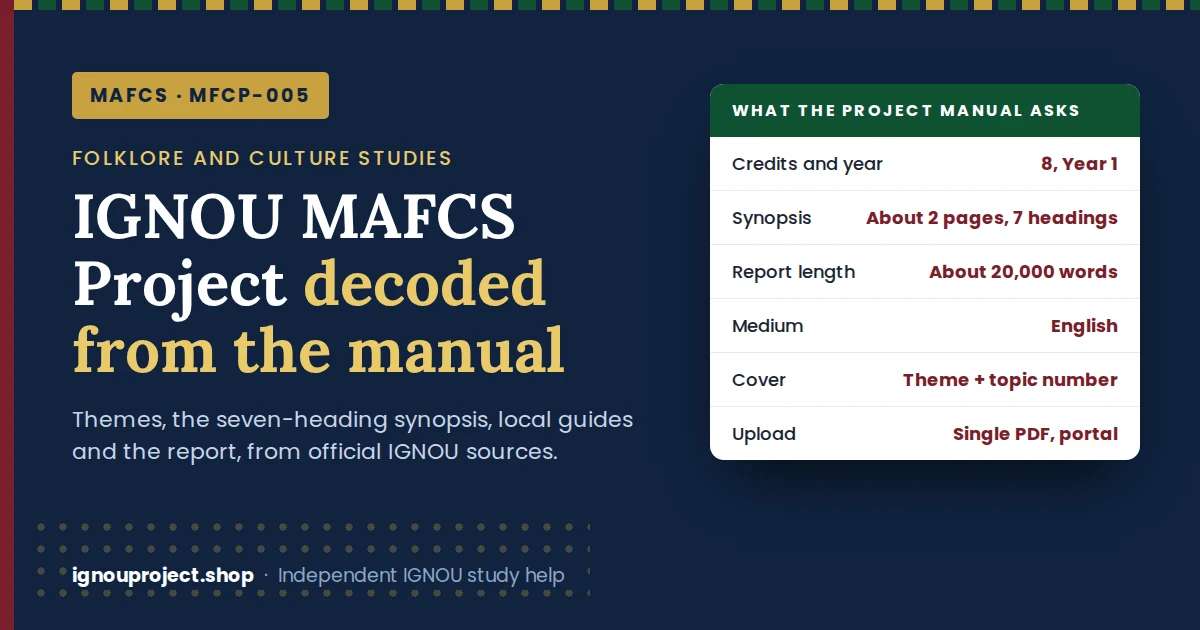
| Synopsis | About two pages, under seven headings, approved before work begins |
| Guide | A local guide: an Academic Counsellor of a study centre, or another teacher with interest or expertise in folklore and culture studies |
| Report length | Approximately 20,000 words |
| Language | English |
| Cover requirement | The theme and the topic number chosen from the manual |
| Submission | Single PDF on the IGNOU online project portal, as notified each session |
| Evaluation fee | Rs. 500 (above-4-credit band, January 2023 admission cycle onwards), paid with the Term-End Examination form |
Timing
Why is MFCP-005 a first-year course, and what does that change?
MFCP-005 is a first-year course because the first year of the Master of Arts (Folklore and Culture Studies) is built as the complete Post Graduate Diploma in Folklore and Culture Studies. The official programme page describes MAFCS as modular, with PGDFCS as its 32-credit first year, and places MFCP-005 in Year 1 with MFC-001 to MFC-004. The second-year courses, MFC-006 to MFC-009, have no project attached.
The project therefore runs in parallel with the theory it draws on. The Project Manual asks for a term paper covering Courses 1 to 4, the same courses being studied that year; waiting until they are “finished” squeezes the synopsis, approval and research into the last months.
The MAFCS assignment booklets for 2024-25 and 2026-27 ask for one tutor-marked assignment per course and describe Course 5 as the project paper, so no TMA exists for MFCP-005. That freed time is what the synopsis needs.
The programme page also lists MFC-010 Translation work (2 credits, Year 2). Learners who already hold the older PGDFCS and are moving into the second year should confirm with SOITS which requirement applies to them; how the prospectus treats that group is explained in this note on PGDFCS to MAFCS credit transfer and MFCP-005.
The official document
What is inside the MFCP 005 Project Manual, and why does it say MFCI-005?
The MFCP 005 Project Manual is the official IGNOU booklet for this course, and the copy on eGyanKosh carries the code MFCI-005 because it was written in May 2009 for the original PGDFCS, then run by the School of Humanities. Its content still matches the MAFCS first-year project: the same four theory courses, the same title and the same Course 5 position.
Its introduction sets the rules (length, language, guide, synopsis format); section 1.2 explains quantitative and qualitative research methods; section 1.3 lists four themes with lettered topics; section 1.4 answers thirteen conceptual questions on folklore, from Palace Paradigm and Sanskritization to language death; and section 1.5 gives a reading list. The conceptual answers in section 1.4 overlap closely with MFC-001 assignment questions, so the manual doubles as revision for that course.
Some administrative details have aged, as the table shows.
| Point | Project Manual (MFCI-005, May 2009) | Current position | What to follow |
|---|---|---|---|
| Course code and credits | MFCI-005, Course 5 of PGDFCS | MFCP-005, Project, 8 credits, MAFCS Year 1 (programme page) | Write MFCP-005 on every form and on the report |
| School | School of Humanities | SOITS (programme page and assignment booklets) | Name SOITS on the cover letter |
| Where the synopsis goes | A postal address for the then Programme Coordinator | The MAFCS Programme Guide names a SOITS contact; portal guidelines also allow the School or Regional Centre route | Confirm the current contact with SOITS or your Regional Centre |
| Report length | Approximately 20,000 words; the page count is left blank | No later official figure located | Plan for about 20,000 words |
| Guide payment | Local guides get academic credit, no payment from the University | No later change located | Do not pay a guide |
| Submission route | Not described in the manual | Single PDF on the online project portal | Follow the portal notice for your session |
Read the Project Manual on eGyanKosh directly; its introduction and section 1.3 decide how the project is planned.
Choosing what to study
Which themes and topics does the Project Manual allow?
The manual offers four themes, one for each first-year theory course, and asks the learner to choose one topic from one theme. Every theme ends with an open option: a case study or special report on the culture and folklore of any region, in India or outside, where the learner belongs or is interested. Independent projects are also allowed with the programme coordinator’s prior approval, sought through the Study Centre or Regional Centre.
| Theme and course | Topics the manual lists | One way to narrow it |
|---|---|---|
| Theme One: Conceptual Perspectives (MFC-001) | Relevance of folklore studies in India, the interdisciplinary approach, Palace Paradigm, Sanskritization, archiving and ethics, language death and preservation, open case study | One endangered language in one district, through its last fluent speakers |
| Theme Two: Tradition, Identity and Cultural Production (MFC-002) | Identity formation in history, tribe and identity, politics and identity, commodification of culture, copyright and commodification, open case study | One craft or performance before and after tourist sales |
| Theme Three: Cultural and Societal Transformation (MFC-003) | A textual performance, translation and the politics of language, classifying a folklore item into a genre, a folk music tradition and its community, a katha tradition, open case study | One folk song tradition in one village: occasions, singers, audience |
| Theme Four: Tribe, Identity, Culture and Lore (MFC-004) | Origin myth of a tribe, survival strategies of a nomadic tribe, a tribe and electoral politics, economic strategies of two tribes in one region, human development of a north-east tribe, open case study | One origin myth as told by two generations of one community |
One instruction in section 1.3 is easy to miss and costs nothing to follow: the theme and the topic number under that theme should be mentioned on the cover of the report. A cover line such as “Theme Three, Topic (d)” tells the evaluator at once where the study sits in the manual.
Proposal
How is the MAFCS synopsis written for MFCP-005?
The MAFCS synopsis is a proposal of approximately two pages, written under the seven headings the Project Manual prescribes and sent for the programme coordinator’s approval before any research begins. The manual states plainly that work on the project starts only after approval is received.
Two of the seven headings, Case Study and Local Guide, are missing from the generic outline most sites reproduce, and a synopsis without them does not match the manual’s format. The example column follows one illustrative Theme Three topic.
| Heading | What the manual asks for | Worked example (illustrative) |
|---|---|---|
| Introduction | The basis of the study, its logic and rationale | Why one community’s wedding songs change as ceremonies shorten |
| Objectives | Specific objectives, the research point | Record the songs still sung, who sings them, at which rites, and what has dropped out |
| Methodology | Qualitative or quantitative data techniques | Qualitative: participant observation, recorded performances, interviews |
| Case Study | Justification of the sampling procedure | One village; lead singers at ceremonies, across two age groups |
| Data Analysis | The tool: questionnaire, interview schedule, ranking schedule or similar | Interview schedule for singers, plus a song log of occasion, date and performer |
| Chapterization | Number and titles of chapters | Five chapters: context, method, the song corpus, change and continuity, conclusions |
| Local Guide | The guide’s resume, signed, with readiness to guide | Resume of an MFC counsellor at the Study Centre, signed and dated |
Put the working title and the theme and topic number above the headings, and name MFCP-005, MAFCS and SOITS on the covering note. Several help pages quote a 1,000-word limit; the manual’s own wording is “approximately two pages”.
Supervision
Who can guide an IGNOU MAFCS project?
An Academic Counsellor of a study centre, or any other teacher with interest or expertise in folklore and culture studies, can act as the local guide for the IGNOU MAFCS project, according to the MFCP-005 Project Manual. Many IGNOU programmes instead list eligible supervisors by qualification.
The manual attaches two conditions. The synopsis must include the local guide’s resume, signed, with a statement of readiness to guide the learner. And local guides receive academic credit but are not entitled to any payment from the University. Some other IGNOU project guidelines pay the guide a token honorarium; the MFCP-005 manual does not, and it does not ask the learner to pay either.
The manual’s own FAQ treats folklore as interdisciplinary, naming history, historical anthropology, sociology, ethno-musicology, literature and politics. A college teacher from one of those subjects who works on folk material is a reasonable person to approach if the resume shows that interest; approval of the synopsis settles it.
Length
How long should the MAFCS project report be?
The MFCP-005 Project Manual asks for a project report or dissertation of approximately 20,000 words. The same sentence in section 1.3 has a blank where a page count on A4 paper should be, so the word figure is the only length the manual actually states, and no later IGNOU document located for this article replaces it.
That figure is far above what circulates. Sales and help pages for this course quote a 60 to 70 page report, a figure that looks carried over from other programmes, and a learner who plans to it ends the first year well short of the manual.
BK Sahni, who has guided 5,00,000 students till date, notes that on MFCP-005 the length question is settled by reading one line of the university’s own manual, yet it is the point most often planned wrongly, because the pages that rank highest for the course never quote that line.
Twenty thousand words comes more easily from collected material than from padding: transcribed songs or tales with translations, interview extracts, descriptions of each performance occasion and a chapter relating the material to the MFC course readings.
Method
Qualitative, quantitative or both: which method fits a folklore project?
The Project Manual accepts all three, and section 1.2 says what each obliges the learner to show. A survey-based report must give the sampling and quantification methods along with the findings. A qualitative report, such as content analysis of already available material, must give proper references and a bibliography.
The manual leans towards qualitative work for folklore, tracing how the field moved from formalist models, such as Propp’s fixed markers in Russian folktales, to reading folklore through its community, place, occasion and performance. Its qualitative sources include archival texts, oral traditions, interviews and diaries; its quantitative tools are questionnaires, interview schedules and focussed group discussions.
Recording oral material for an English report
The manual requires the report in English, while most folklore is collected in other languages. A sensible practice is to transcribe each item in its original language, give an English translation beside or below it, and record who performed it, where, on what occasion and on what date. Theme Three’s translation topic and MFC-003’s section on translation make the same point from the course side: the translation choices are part of the analysis, so note them.
Consent and credit in fieldwork
Section 1.4 of the manual raises the ethics of preserving and owning culture, including whether rights lie with a community or the state. No consent form is prescribed, but asking performers’ permission before recording and naming them in the report keeps the fieldwork in line with what the course teaches.
Submission
How is the IGNOU MAFCS project report submitted now?
The IGNOU MAFCS project report is submitted through the IGNOU online project portal as a single PDF for the course, within the dates notified for the session. The Project Manual says nothing about submission, so the portal guidelines govern; where a help page still prints a postal address at the Student Evaluation Division, the portal notice for your session decides the route.
The original report is scanned into one PDF, and its first page must carry the report title, learner’s name, programme code, enrolment number as printed on the identity card, Regional Centre code, course code, mobile number and email address. Scans must be clear, correctly ordered and in one orientation; incomplete uploads are removed after the last date, and emailed reports are not evaluated. The approved proforma, synopsis, guide’s bio-data and an originality certificate signed and dated by learner and guide are to be included wherever applicable, and the synopsis itself is never uploaded on this portal.
| Evaluation fee | Rs. 300 for project work up to 4 credits and Rs. 500 above 4 credits, for the January 2023 admission cycle onwards; MFCP-005 at 8 credits falls in the Rs. 500 band |
|---|---|
| How it is paid | With the Term-End Examination form; the receipt is uploaded with the report, and a report without the fee paid cannot be considered |
| Viva-voce | Where held, conducted by the concerned faculty under the Regional Centre; ask your Regional Centre |
| Last date | Set by notification each session; for the December 2023 Term-End Examination, for example, the portal gave 30 November 2023 |
Combine both sets of rules on the first page: the portal’s learner particulars, then “Theme __, Topic (__)” and MFCP-005. How the portal rules apply to other programmes is set out in the programme-by-programme IGNOU project hub.
Avoidable setbacks
What sends an MAFCS synopsis or report back?
- The wrong code. MFCI-005 copied from the manual’s cover instead of MFCP-005.
- A topic with no home. A study outside the four themes that was never cleared as an independent project, or a cover without the theme and topic number.
- Five headings instead of seven. No Case Study justification of sampling, or no Local Guide section.
- An unsigned resume. No signature or statement of readiness from the guide.
- A report in another language. The manual asks for English; original-language material goes in as quotation with translation.
- The wrong length. A 60-page plan against a manual figure of about 20,000 words.
- Portal errors. Blurred or disordered scans, a missing first-page particular, or the fee not paid with the Term-End Examination form.
Quick answers
IGNOU MAFCS project: frequently asked questions
What is the course code for the IGNOU MAFCS project?
The programme page lists it as MFCP-005 Project Manual, also searched as MFCP-5, MFCP 005, MFCP005 and MFCP 5. The assignment booklet writes MFC-005 and the eGyanKosh manual uses the older code MFCI-005; all mean the same Course 5 project.
How many credits is MFCP-005, and in which year?
MFCP-005 carries 8 credits and sits in Year 1 of the Master of Arts (Folklore and Culture Studies), according to the official programme page on ignou.ac.in. Year 1 is also the PGDFCS stage of the programme.
Where can the MFCP 005 Project Manual PDF be downloaded?
The official Project Manual is on eGyanKosh, filed under the code MFCI-005 and dated May 2009, with the project rules, a methods unit, four themes, conceptual FAQs and a reading list.
Is there an assignment for MFCP-005?
No. The MAFCS assignment booklets ask for one assignment for each theory course and describe Course 5 as the project paper, so the project replaces a tutor-marked assignment.
Can the MAFCS project be written in Hindi?
The Project Manual states that the medium of the term paper or project should be English. Material collected in Hindi or another language can be quoted with an English translation.
Does IGNOU pay the MAFCS local guide?
No. The Project Manual says local guides receive academic credit and are not entitled to any payment from the University, and it sets no fee for the learner to pay either.
What is the project evaluation fee for MFCP-005?
For learners of the January 2023 admission cycle onwards, the online project portal lists Rs. 500 for project work above 4 credits, which covers the 8-credit MFCP-005. It is paid with the Term-End Examination form.
Verify before you act: the course structure is published on the official MAFCS programme page on ignou.ac.in, and the Project Manual is available on eGyanKosh. Synopsis contacts, portal rules, fees and last dates are notified each session, and the newest notice takes precedence over this page.
If the MFCP-005 synopsis is where the work has stalled, a review of the theme, the seven headings and the sampling justification before it goes for approval can save a round of revision. Details are on the ignouproject.shop project pages.
Independent study-help disclosure: ignouproject.shop is run by Shri Chakradhar Publication Pvt. Ltd. and is not the official website of IGNOU or SOITS. This article summarises published university documents for guidance only; official notifications on ignou.ac.in prevail over anything written here.

BK Sahni iD 0009-0005-8092-459X
Founder, Shri Chakradhar Publication Pvt. Ltd. & its IGNOU Project study-help brand, helping IGNOU distance-learning students since 2010 and having guided 5,00,000 students till date across MBA, MCom, MA & more. Author of IGNOU exam guides, solved assignments & project reference books.
Disclosure: Shri Chakradhar Publication Pvt. Ltd. and ignouproject.shop are independent third-party study-help services, not the official IGNOU website. Always verify final dates and rules on ignou.ac.in.
Leave a Reply