
MAEVS · MEVP-012 · SOITS
IGNOU MAEVS Project (MEVP-012): Choosing a Study Design, Supervisor and Route
The IGNOU MAEVS project is MEVP-012 Project Work, a compulsory 6-credit course in Semester 4 of the Master of Arts (Environmental Studies). The learner finds an eligible supervisor, gets a proposal approved by the Programme Study Centre or Study Centre coordinator, completes an individual study, and submits the report for a 70-mark evaluation and a 30-mark viva-voce.
The course in one view
What is the IGNOU MAEVS project, and what kind of study does it expect?
The IGNOU MAEVS project refers to MEVP-012, the project course of the Master of Arts (Environmental Studies) offered by the School of Inter-Disciplinary and Trans-Disciplinary Studies (SOITS) at Indira Gandhi National Open University. The official programme page lists MEVP-012 at 6 credits in Semester 4, where it sits alongside MEVE-012 Environmental Management, MEVE-015 Disaster Management and MEDS-042 Issues and Challenges in Urban Planning and Development in a 20-credit semester with no electives. The MEVP-012 Handbook on Project Work, issued in 2024 on eGyanKosh, sets the order: choose an eligible supervisor, prepare the proposal with that supervisor, submit it with the approval proforma to the coordinator of the Programme Study Centre or Study Centre, and start the study only after approval. An approved proposal stays valid for one year, or two slots. The report carries 70 marks and the viva-voce 30, with at least 40 per cent required in each.
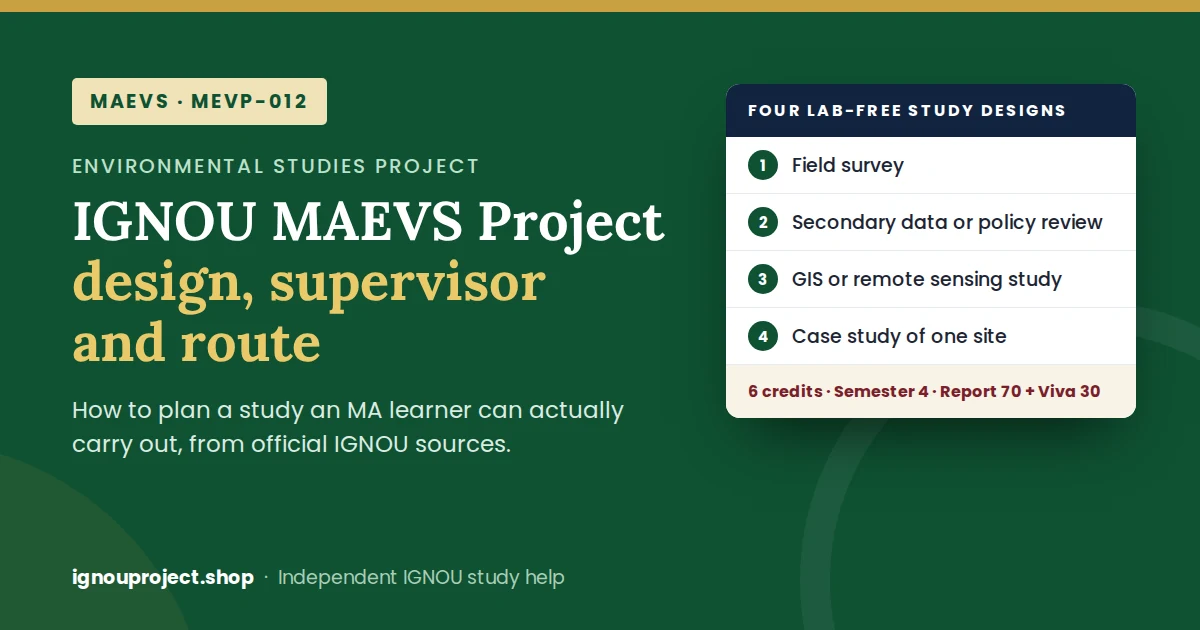
MAEVS admits graduates of any discipline, and none of its courses is a laboratory course. That changes the first decision. For most MAEVS learners the hard question is not the title but the evidence: what can one person reach, measure or document within the one-year life of an approved proposal? The quick facts come first; the design choice follows in the figure.
| Programme | Master of Arts (Environmental Studies), programme code MAEVS, ODL mode, English medium |
|---|---|
| School | School of Inter-Disciplinary and Trans-Disciplinary Studies (SOITS) |
| Project course | MEVP-012 Project Work (listed as Project/Dissertation in the assignment booklet) |
| Credits and semester | 6 credits, Semester 4, compulsory |
| Programme eligibility | Graduate in any discipline from a recognised university or institute |
| Assignment | None listed: the second-year booklet carries TMAs for the other courses but not for MEVP-012 |
| Supervisor | A MAEVS academic counsellor, or a teacher or researcher meeting the handbook’s qualification rule; signed bio-data always required |
| Proposal goes to | Coordinator of your Programme Study Centre or Study Centre, with the proforma |
| Approval reply | Within a month of receipt, according to the handbook |
| Proposal validity | One year (two slots) |
| Evaluation | Report 70 marks, viva-voce 30 marks; minimum 40 per cent in each and overall |
| Report route now | Single PDF on the IGNOU online project portal, within the session’s notified dates |
| Evaluation fee | Rs. 500 (above-4-credit band, January 2023 admission cycle onwards), paid with the Term-End Examination form |
Which course applies
Is MEVP-012 the same as the MSCENV project, MEVP-11?
No. MEVP-012 belongs to the Master of Arts (Environmental Studies) and MEVP-11 to the Master of Science (Environmental Science). Both programmes are run by SOITS and their project handbooks follow a shared template, which is why help pages often mix the two. The codes differ by one digit, the credits differ, and so do the learners each programme admits.
| Point | MAEVS (MEVP-012) | MSCENV (MEVP-11) |
|---|---|---|
| Degree | Master of Arts (Environmental Studies) | Master of Science (Environmental Science) |
| Who is admitted | Graduate in any discipline | Bachelor’s in Science, Engineering, Agricultural Science, Forestry or Veterinary Science |
| Credits and semester | 6 credits, Semester 4 | 8 credits, Semester 4 |
| Laboratory courses | None in the course list | MEVL-011, MEVL-012, MEVL-013 |
| Supervisor pool | Counsellors of MA (Environmental Studies), or teachers and researchers meeting the qualification rule | Counsellors of M.Sc. Environmental Science, with the same qualification rule |
| Approval and validity | Programme Study Centre or Study Centre coordinator; one year (two slots) | Same route and validity |
| Evaluation | Report 70, viva-voce 30 | Report 70, viva-voce 30 |
| Evaluation fee band | Rs. 500 (above 4 credits) | Rs. 500 (above 4 credits) |
In practice, use the MEVP-012 handbook and the proforma titled for MEVP-012. A proposal drafted on the MSCENV proforma names the wrong course and the wrong programme, and a design copied from an MSc sample often assumes laboratory analysis that an MA learner cannot arrange. How the MSc scheme distributes its marks is set out in this explainer on MEVP-11 evaluation and viva; the MAEVS figures follow below.
Supervision
Who can supervise an IGNOU MAEVS project?
The MEVP-012 handbook recognises two kinds of supervisor. The first is an IGNOU academic counsellor at a Learner Support Centre for the MA (Environmental Studies) programme, with relevant experience. The second is a teacher or researcher in Environmental Science, Environmental Studies or a related discipline who holds either a Ph.D. in one of those fields with two years of teaching or research experience, or an M.Sc. in one of those fields with five years of teaching or research experience.
That threshold is more specific than most help pages admit. A lecturer with an M.Sc. and three years of experience does not meet the second route unless already a counsellor for the programme. Check the qualification and the years before asking anyone, because the supervisor’s bio-data travels with the proposal and is the first thing the coordinator reads.
- Bio-data is always required. The proforma asks the learner to enclose the supervisor’s complete, signed bio-data even if the supervisor is an academic counsellor of MAEVS, and it asks that question directly.
- A change of supervisor means resubmission. The handbook directs that the proposal be resubmitted when the supervisor changes, so the approval belongs to the pairing, not only to the topic.
- Supervision is claimed from the university. The handbook carries a Remuneration Bill for Guidance of Project Work (MEVP-012) as an annexure, the form a supervisor completes after guiding the learner. If a learner is asked to pay a supervisor directly, check with the Study Centre before agreeing to anything.
Approval
How does a MEVP-012 proposal get approved?
Through the coordinator of the learner’s Programme Study Centre or Study Centre. The handbook lists each step as possible at any time of the year, so there is no proposal window to wait for:
- Select a supervisor who meets the qualification rule.
- Submit the supervisor’s bio-data to the coordinator.
- Identify the topic and prepare the proposal in consultation with the supervisor.
- Submit the proposal with the Proforma for Approval of Project Proposal (MEVP-012) to the coordinator.
- Wait for the decision, which the handbook says the coordinator communicates within a month of receiving the proposal.
- Once approved, carry out the study and submit the report in a scheduled slot within the one-year validity.
The university’s online project portal guidelines also name the Regional Centre or the concerned School as general channels for synopsis approval. If the Study Centre has no active MAEVS coordinator, ask the Regional Centre in writing which channel applies and keep the reply with the proposal file.
| Item on or with the proforma | What to check |
|---|---|
| Enrolment number | Exactly as on the identity card; the portal later requires the same form, not a control or registration number |
| Study Centre and Regional Centre codes | Match the admission record, since the reply goes to that centre |
| Name, address and mobile number | Current and reachable; the approval or non-approval is communicated on these |
| “Is the supervisor an academic counsellor of MAEVS?” | Answered either way; bio-data is still enclosed |
| Project proposal | Attached, with title, objectives and the planned method stated plainly |
| Supervisor’s bio-data | Complete, signed, and showing the qualification and years that meet the rule |
If the proposal comes back
Non-approval is not the end of the course. The handbook allows a revised proposal to be resubmitted to the same coordinator with a new proforma and a copy of the earlier proforma that was not approved. Read the coordinator’s comments against the marking components below before rewriting, because the reasons for return usually map onto them: an unclear problem, objectives the method cannot answer, or a method the learner cannot carry out. The work must be done individually and independently, so a reworded copy of someone else’s approved proposal is not a safe shortcut.
Marks and chapters
How should the 70 report marks shape your MEVP-012 chapters?
By weight. Annexure IV of the MEVP-012 handbook breaks the 100 marks into components, and the largest single block of the written report is results and discussion, at 30 marks. Planning chapter length and effort in proportion to those weights is the simplest way to stop a report from spending its pages on background and running thin where the marks are.
| Component | Marks | What it should show |
|---|---|---|
| Introduction, with objectives and rationale | 10 (see note) | Why the problem matters in a named place, and objectives the evidence can answer |
| Review of literature | 10 | Studies and official documents that lead to the gap, not a survey of everything written |
| Methodology | 10 | Study area, design, sample, tools, data sources and the analysis applied |
| Results and discussion | 30 | Findings set out objective by objective, compared with standards, rules or earlier studies |
| Conclusions | 10 (see note) | What the findings mean, recommendations tied to specific results, and limitations |
| Viva-voce | 30 | Command of your own objectives, method and results |
The handbook’s general parameters run alongside these numbers: the relevance of the topic to the real world, the methodology, and the presentation of the report in terms of organisation, correctness and clarity. Learners must earn at least 40 per cent in the report and in the viva-voce separately, with 40 per cent overall.
Length is where the circulating advice falls apart. Help pages quote a 1,000-word or 1,500-word proposal and a 10,000 to 15,000-word report; none of these figures appears in the parts of the MEVP-012 handbook reviewed for this article. Agree the length with the supervisor and let the components decide where the words go.
BK Sahni, who has guided 5,00,000 students till date, notes that a word target borrowed from a help page usually swells the literature review and the background chapter, while the 30-mark results and discussion is left with two tables and a paragraph. Writing results first, then building the earlier chapters to support them, reverses that habit.
Choosing what to study
Which MEVP-012 topics work without a laboratory?
Topics built on surveys, documents, maps or a single well-documented site, drawn from the courses the learner has actually studied. Several Semester 3 courses are electives, chosen three from six, so check that a topic rests on a course you took or are prepared to read. The directions below are illustrations, not an approved list; the supervisor and coordinator decide what is acceptable.
| Course it draws on | Example topic direction | Design and evidence |
|---|---|---|
| MEV-017 Environmental Legislations | Household awareness of solid waste segregation rules in one municipal ward | Field survey, structured questionnaire |
| MEVE-017 Environment and Society | Role of a women’s self-help group in managing one village’s water source | Case study, interviews and records |
| MEVE-012 Environmental Management | Environmental management practices in one certified manufacturing unit | Case study, documents and an interview |
| MEVE-015 Disaster Management | Heatwave or flood preparedness in government schools of one block | Survey with a checklist, school plans |
| MEV-024 Climate Change Assessment Tools (elective) | Change in built-up and green area of one town over a decade | GIS, freely available satellite imagery |
| MEDS-042 Urban Planning and Development | Access to public open space across two municipal wards | Ward maps, field observation |
| MED-003 Energy and Environment (elective) | Rooftop solar adoption and its barriers in one residential colony | Field survey, questionnaire |
Three questions settle feasibility faster than any list. Can the respondents, records or site be reached more than once? Is the evidence available now, not after the proposal lapses? Can every objective be answered from that evidence alone? A topic that fails one of them is cheaper to replace before approval than to defend at the viva-voce.
Submission
How is the MEVP-012 report submitted now?
As a single PDF on the IGNOU online project portal, within the last date notified for the session. The MEVP-012 handbook describes a physical route: a bound report sent in an envelope marked “M A (Environmental Studies) MAEVS Project Report (MEVP-012)” on top, with a photocopy kept for the viva-voce. Recent portal guidelines replace the posted copy with an upload, and for a session that has an online portal, the portal notice is the instruction that applies.
The portal sets its own conditions. The original report is scanned into one PDF per course, and the first page carries the report title, the learner’s name, programme code, enrolment number as on the identity card, Regional Centre code, course code, mobile number and email address. The upload must include the approved proposal proforma in original, the synopsis, the guide’s bio-data and an originality certificate signed and dated by both learner and guide. Pages must be clear, correctly ordered and in one orientation. Incomplete submissions are removed after the last date, emailed reports are not considered, and the synopsis itself does not go on this portal.
| Evaluation fee | Rs. 300 up to 4 credits, Rs. 500 above 4 credits (January 2023 admission cycle onwards); MEVP-012 at 6 credits falls in the Rs. 500 band |
|---|---|
| How it is paid | With the Term-End Examination form; the receipt is uploaded with the report, and a report without the fee paid is not evaluated |
| Viva-voce | Handbook: intimated by the Programme Study Centre or Study Centre coordinator, held before the project evaluator. Portal: conducted by the concerned faculties under the Regional Centre. Ask the Regional Centre which arrangement applies in your session |
| Queries | Regional Centre email, or the SED project section at projects@ignou.ac.in |
| Recent last dates | 30 November 2023, 31 May 2024, 30 November 2024, 31 May 2025 and 15 June 2026 for the June 2026 examination |
The last row shows why a fixed “31 May” from an old help page is risky: the June 2026 portal closed on 15 June. Treat every date as set by the current notification. How these portal rules apply across other IGNOU programmes is covered in the programme-by-programme IGNOU project guide.
Avoidable setbacks
What sends a MEVP-012 proposal or report back?
- The wrong course’s paperwork. A proforma or handbook for MEVP-11, the MSCENV project, used in place of the MEVP-012 versions.
- A supervisor outside the rule. Neither a MAEVS counsellor nor a holder of a Ph.D. with two years, or an M.Sc. with five years, of teaching or research experience.
- Bio-data left out. Omitted because the supervisor is a counsellor, though the proforma requires it regardless.
- A design the evidence cannot carry. Laboratory testing proposed with no laboratory, or objectives about a whole state answered from twenty questionnaires.
- Front matter missing from the upload. No approved proforma, synopsis, bio-data or dated originality certificate signed by both.
- Scan and identity faults. Blurred or out-of-order pages, or a registration number in place of the enrolment number.
- Fee not paid with the Term-End Examination form. The report is then not considered.
- Validity lapsed. Both slots pass unused and a fresh proposal becomes necessary.
Quick answers
IGNOU MAEVS project: frequently asked questions
What is the course code for the IGNOU MAEVS project?
MEVP-012. Searches for the IGNOU MAEVS project for MEVP 012 also appear as MEVP-12, MEVP 12 and MEVP012; all refer to the same 6-credit Project Work course of the Master of Arts (Environmental Studies).
Is MEVP-012 compulsory?
Yes. The MAEVS assignment booklet lists Semester 4 as MEVE-012, MEVE-015, MEDS-042 and MEVP-012 without any choice among them, and the programme page places MEVP-012 at 6 credits in that semester.
Is there an assignment (TMA) for MEVP-012?
No TMA is listed. The second-year assignment booklet carries tutor marked assignments for the theory courses but not for MEVP-012, which is assessed through the report and viva-voce.
Does a PGDEVS learner have to do MEVP-012?
The programme page states that learners become eligible for the Post Graduate Diploma in Environmental Studies after completing the first-year courses. MEVP-012 is a Semester 4 course, so it applies to learners continuing to the MA.
How soon is a MEVP-012 proposal approved?
The handbook says the Programme Study Centre or Study Centre coordinator communicates approval or non-approval within a month of receiving the proposal. If nothing arrives, follow up in writing with the same centre.
Is there an official word limit for the MAEVS project?
No word or page limit appears in the parts of the MEVP-012 handbook reviewed for this article. Figures from 10,000 to 15,000 words circulate on help sites; agree the length with the supervisor.
Verify before you act: the course structure is on the official MAEVS programme page, and the MEVP-012 Handbook on Project Work is on eGyanKosh. Portal rules, fees and dates are notified each session, and the newest notice takes precedence over this page.
If the proposal is where the work has stalled, checking the design, objectives and evidence plan against the MEVP-012 marking components before it reaches the coordinator can save a round of revision. Guidance is available through the ignouproject.shop project pages.
Independent study-help disclosure: ignouproject.shop is run by Shri Chakradhar Publication Pvt. Ltd. and is not the official website of IGNOU or SOITS. This article summarises published university documents for guidance only; official notifications on ignou.ac.in prevail over anything written here.

BK Sahni iD 0009-0005-8092-459X
Founder, Shri Chakradhar Publication Pvt. Ltd. & its IGNOU Project study-help brand, helping IGNOU distance-learning students since 2010 and having guided 5,00,000 students till date across MBA, MCom, MA & more. Author of IGNOU exam guides, solved assignments & project reference books.
Disclosure: Shri Chakradhar Publication Pvt. Ltd. and ignouproject.shop are independent third-party study-help services, not the official IGNOU website. Always verify final dates and rules on ignou.ac.in.
Leave a Reply