
MA Economics – School of Social Sciences
IGNOU MAEC Project for MECP 301, 201, & 202: Which Code Is Yours
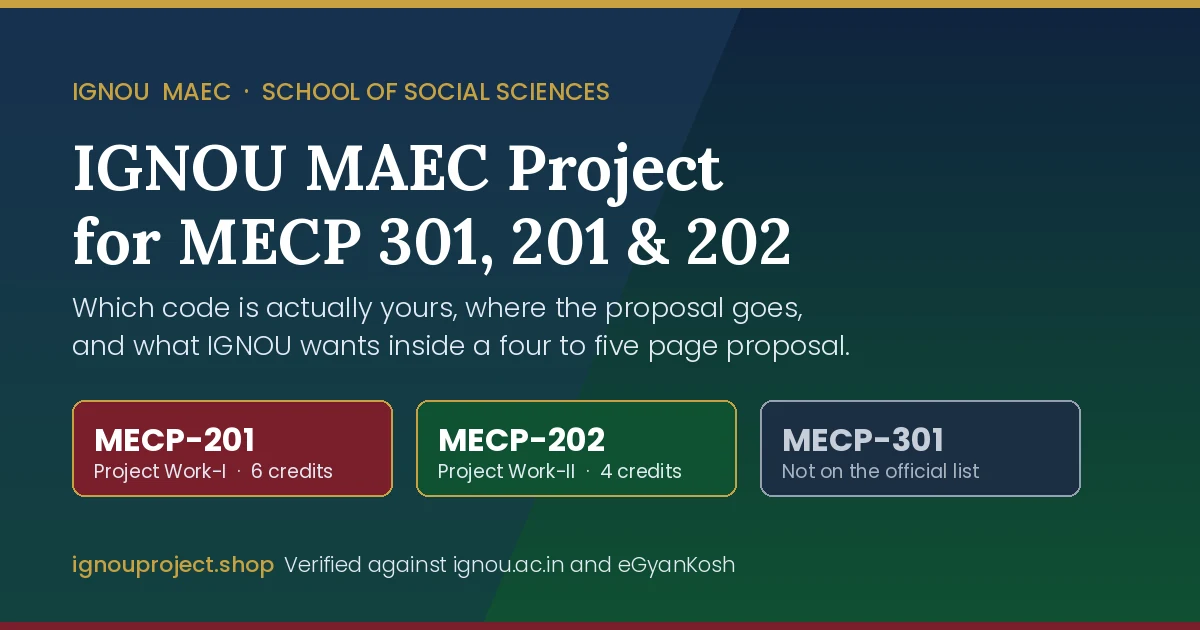
The IGNOU MAEC project is Semester 4 project work in the MA Economics programme. IGNOU’s official MAEC course structure lists two project codes, MECP-201 Project Work-I (6 credits) and MECP-202 Project Work-II (4 credits). MECP-301 is widely searched but does not appear in that published structure, so confirm your code before writing anything.
Start here
Which IGNOU MAEC project code is actually yours: MECP 301, 201 or 202?
The IGNOU MAEC project is the Semester 4 project-work component of the Master of Arts (Economics) programme, offered by the School of Social Sciences at Indira Gandhi National Open University. On the official MAEC programme page at ignou.ac.in, two project courses are listed: MECP-201, Project Work-I, worth 6 credits, and MECP-202, Project Work-II, worth 4 credits. Both sit in Semester 4 of the 80-credit, four-semester MAEC structure. Each is evaluated through a Project Report plus a viva voce rather than a written Term-End Examination, and the project proposal must be approved by the Faculty of Economics at IGNOU Headquarters before the report is written. The code MECP-301 circulates on study-help websites, but it does not appear on IGNOU’s published MAEC course structure.
That last line is the reason this page exists. Students searching for MECP-301 are usually looking at a third-party listing, an older forwarded message, or a coaching page that copied a code from somewhere else. Registering a proposal against a code that your record does not carry is the fastest way to lose a full six-month evaluation cycle.
Two codes are verifiable right now. MECP-201 and MECP-202 are both named on IGNOU’s MAEC programme page and both have a Project-Work Guide published under those codes on eGyanKosh. There is also a documented rename: IGNOU’s own MAEC fourth-semester assignment booklet for 2024-25 states that the existing course codes MECP 101 and MECP 102 were changed to MECP 201 and MECP 202 respectively, and that the Project Guides for those two courses were re-uploaded under the changed codes. So if an older product listing or an older PDF says MECP-101 or MECP-102, that is the same project work under its previous label.
MECP-301 is a different situation. It is not on the official course list, not in the MAEC Programme Guide, and not in the eGyanKosh Semester-IV collection for MAEC. Until IGNOU publishes it, treat it as unconfirmed and check your own record rather than a website.
Reference table
MECP-201 and MECP-202 at a glance
| Detail | MECP-201 | MECP-202 |
|---|---|---|
| Course title | Project Work-I | Project Work-II |
| Credits | 6 | 4 |
| Semester | Semester 4 | Semester 4 |
| Programme | MAEC, Master of Arts (Economics) | MAEC, Master of Arts (Economics) |
| School | School of Social Sciences (SOSS) | School of Social Sciences (SOSS) |
| Attached to which groups | Group B and Group C | Group A and Group D |
| Previous code | MECP-101 | MECP-102 |
| Assignment (TMA) | Not applicable | None, stated in the Programme Guide |
| How it is evaluated | Project Report plus viva voce | Project Report plus viva voce |
| Project evaluation fee band | Above 4 credits, Rs. 500 per course | Up to 4 credits, Rs. 300 per course |
| When the fee is paid | With the Term-End Examination form | With the Term-End Examination form |
| Underpinning theory course | MEC-109, Research Methods in Economics | MEC-109, Research Methods in Economics |
The credit figure is not cosmetic. IGNOU fixed project evaluation fees by credit band from the January 2023 admission cycle, and the current exam portal lists Rs. 300 per course up to 4 credits and Rs. 500 per course above 4 credits. That places MECP-202 in the Rs. 300 band and MECP-201 in the Rs. 500 band. The fee is paid online with the Term-End Examination form, not at the moment you hand in the report.
The rule nobody spells out
Why your specialisation group decides the project code
Semester 4 of MAEC works differently from the first three semesters. Semesters 1 to 3 are entirely compulsory. In Semester 4 you complete 20 credits from one of four specialisation groups: Group A (Data Analytics), Group B (Energy and Environmental Economics), Group C (Insurance and Finance) or Group D (Social Policy). Students who do not want a formal specialisation may take any 20 credits spread across the four groups.
The MECP-202 Project-Work Guide published on eGyanKosh states the allocation directly: under Group A and Group D the project work is MECP-202, worth four credits, while under Group B and Group C the project work is MECP-201, worth six credits. Project work is an optional course inside each group, so opting into it is your decision, but once you are inside a group the code is fixed for you.
One route only
IGNOU’s MAEC Semester 4 structure states that students are not permitted to opt for both MECP 201 and MECP 202. If you have somehow registered for both, raise it with your Regional Centre before you begin writing.
Is the MAEC project compulsory?
Not in the way most pages claim. The FAQ section of the MAEC Programme Guide answers the question about MECP 201 in one line: it is an elective course, and a student has the option of not choosing it. Every group carries project work as one of its optional courses, so a student who fills the 20 credits with theory courses instead will not write a project at all.
That said, plenty of MAEC students do want the project, because it is the only part of the programme where original research, data handling and a viva sit on the grade card together. If you are going on to an M.Phil, a PhD, the Indian Economic Service track or a research role, that matters more than the credits.
Where things go wrong
Where the MECP project proposal actually goes, and where it does not
The proposal does not go to your Study Centre and the finished report does not go to the Faculty of Economics. These are two different addresses in two different buildings, and almost every competing page on this keyword gets one of them wrong.
The MAEC Programme Guide is explicit on both halves. The Project Proposal, endorsed by your supervisor, goes to the Course Coordinator for your project course at Block F, School of Social Sciences, IGNOU Campus, Maidan Garhi, New Delhi 110068. The Programme Guide FAQ asks whether the proposal should be sent to the Study Centre for approval and answers, plainly, no. Approval is granted by the Faculty of Economics at IGNOU Headquarters.
The completed Project Report goes somewhere else entirely. The Programme Guide directs it to the Registrar, Student Evaluation Division, IGNOU, Maidan Garhi, New Delhi 110068, and states that the completed report should not be sent to the Course Coordinator or the Faculty of Economics. A report that lands on the Course Coordinator’s desk is not in the evaluation queue.
Old booklet versus current notification
The MAEC Programme Guide describes posting the finished report to the Registrar, Student Evaluation Division. Recent Student Evaluation Division notifications have moved final project, dissertation and internship submission to an online upload of a single PDF through IGNOU’s project submission link, with the deadline fixed session by session. The postal route is what the booklet says; the online upload is what current notifications require. Check the notification for your session on ignou.ac.in before you print and bind anything.
One consequence worth internalising: the approval stage and the submission stage are not one process with one deadline. Approval sits with the academic faculty and has no fixed calendar date attached to it in the Programme Guide. Submission sits with the Student Evaluation Division and is tied to the Term-End Examination cycle. If you start the proposal in the same month the submission window closes, the arithmetic does not work.
Proposal anatomy
What IGNOU wants inside a four to five page MECP proposal
The MAEC Programme Guide sets the length at four to five pages and names five compulsory sections. This is shorter than the ten to twenty page synopsis students are often told to write, and the brevity is deliberate: the faculty is assessing whether the study is feasible, not reading a draft chapter.
- Introduction. The topic should rest on a brief literature review, and anything you reviewed must be cited here in the author (year) format.
- Objectives. Each objective must begin with a functional verb. This is a rule, not a style note.
- Data Sources with variables identified, and Methodology. State the periodicity of your data (monthly, quarterly, yearly), the formulae for any computation, and the test statistic you intend to use.
- Limitations. State what the study cannot establish and why.
- Chapter Scheme. The intended chapter breakdown of the final report.
The functional-verb rule that decides whether objectives get approved
The Programme Guide gives the verb lists in full. For empirical studies built on quantitative or statistical data, the objective verbs are compute, estimate, test and infer. For qualitative or descriptive studies, they are discuss, explain, bring out, identify and illustrate. The verb examine works in both directions and is the one the guide suggests when you are fitting a regression model to identify determinants of an economic phenomenon.
The reason the rule exists is mechanical. A proposal is approved quickly when there is a one-to-one link between each objective and the corresponding piece of methodology. If an objective says “estimate the elasticity of demand”, the methodology section has an obvious job to do. If it says “study the impact”, there is nothing for the methodology to attach to, and the proposal comes back for revision. The Programme Guide says as much: proposals with that clear linkage get easy approval.
Extra lines required if your study uses a primary survey
Studies based on a primary survey carry four additional requirements inside the methodology section: the area where the survey will be carried out, the survey unit (household, establishment or institution), the sample size, and the method of drawing a random sample where applicable. Leave any of these out and the proposal is incomplete on its face.
From experience
BK Sahni, who has guided 5,00,000 students till date, notes that the single most common reason an economics proposal comes back is not a weak topic but objectives written as topic restatements rather than as verbs the methodology can act on. Rewriting three objectives usually costs an afternoon. Waiting for a second round of comments costs a session.
Supervisor
Who can supervise a MECP project, and what travels with the proposal
The MAEC Programme Guide names two acceptable categories of supervisor: an Academic Counsellor of MEC courses at your Study Centre, or a faculty member of a research institute who is involved in research activities. The proposal is developed in consultation with that supervisor and must be endorsed by them.
The supervisor’s bio-data travels with the proposal and is not optional. The Programme Guide answers the question directly: yes, the supervisor’s CV goes with the proposal, and the supervisor is approved on the basis of that CV. The approval proforma, reproduced as Annexure A in the Project-Work Guide, carries a specific field asking whether the supervisor is an Academic Counsellor of the MA (Economics) programme of IGNOU, with the Study Centre name and code required if the answer is yes.
Read that as two independent approvals in one envelope. The faculty is approving your study design and, separately, approving the person supervising it. A strong proposal with an unsupported supervisor CV can still come back, and so can a well-credentialled supervisor attached to objectives that do not link to a method.
The Programme Guide is equally clear about what happens if a report arrives without either approval in place: a Project Report submitted without a supervisor, or without approval of the proposal by the Faculty of Economics at IGNOU Headquarters, will not be accepted for evaluation by the Student Evaluation Division. The same logic applies across IGNOU programmes, which is why the IGNOU project process guide on this site puts proposal approval ahead of every other step.
Report
Report length, declaration and what the examiner receives
The MAEC Programme Guide states that the Project Report should run to about 15,000 to 20,000 words, roughly 50 to 60 pages, typed double space. Older MEC-era material circulating online quotes 8,000 to 10,000 words across the same 50 to 60 pages. The figure in the current MAEC Programme Guide is the one to work to, and the practical instruction inside it is more useful than either number: keep the topic precise, because the report has to demonstrate analytical and presentation skill rather than coverage.
Two things must be attached to the finished report. The declaration given as Annexure C is signed by you and by your supervisor. A bibliography goes at the end, listing records, documents, reports, interviews, newspapers and magazines under separate heads rather than in one undifferentiated list.
One rule catches people out every session: the topic of your Project Work must be the same as the topic in your approved Proposal. Title drift between approval and submission is treated as a different study. If the research genuinely moves, the fix is a revised proposal, not a quietly renamed report.
Keep a copy. The Project-Work Guide states plainly that the University will not send your work back to you.
If it does not clear
The Rs. 1000 resubmission route almost nobody mentions
Evaluation has two components, the Project Report and the viva voce. According to the MECP Project-Work Guide, if you secure less than 40 per cent in both components separately, the University informs you and sends you the evaluator’s comments. There is a defined route back, and it has a price attached.
- Redo the project work and the report in the light of the evaluator’s comments.
- Attach Annexures B and C. The guide notes specifically that there is no need to attach Annexure A, the proposal approval proforma, a second time.
- Attach a Demand Draft of Rs. 1000 drawn in favour of IGNOU, payable at New Delhi.
- Send the completed work for fresh evaluation to the address given in the Project-Work Guide for your session.
Worth knowing alongside this: IGNOU’s general rules state that re-evaluation of answer scripts is permissible in Term-End Examinations only and not in project or dissertation work, and that improvement in division or class is permitted only in theory papers, not in projects. The resubmission route above is therefore the route, not one option among several.
Avoidable losses
Mistakes that cost MAEC students a full session
- Working from an unverified code. Check your registration record on the Samarth portal or your grade card, not a third-party page listing MECP-301.
- Posting the proposal to the Study Centre. The Programme Guide says no. It goes to the Course Coordinator at the School of Social Sciences, IGNOU Headquarters.
- Sending the finished report to the Faculty of Economics. The report belongs with the Student Evaluation Division, or the online submission portal for your session.
- Objectives without functional verbs. The single most common cause of a revise-and-resubmit on an economics proposal.
- Omitting the supervisor’s bio-data. The supervisor is approved on the basis of that CV, so without it there is nothing to approve.
- Forgetting the project evaluation fee. It is paid with the Term-End Examination form, so a student who files the exam form without ticking the project course has a gap to fix later.
- Changing the title after approval. The submitted topic must match the approved topic.
- Treating the submission deadline as the start date. Approval has to happen first and has no guaranteed turnaround.
Questions students ask
IGNOU MAEC project: frequently asked questions
Is MECP-301 a real IGNOU MA Economics project code?
It does not appear on IGNOU’s published MAEC course structure, in the MAEC Programme Guide, or in the eGyanKosh Semester-IV collection for MAEC. The two project codes listed there are MECP-201 and MECP-202. If your own registration record shows MECP-301, confirm it with your Regional Centre before writing, because the proposal has to be addressed to the coordinator of the correct course.
What is the difference between MECP 201 and MECP 202?
MECP-201 is Project Work-I, worth 6 credits, attached to Group B and Group C in Semester 4. MECP-202 is Project Work-II, worth 4 credits, attached to Group A and Group D. The process, proposal format and evaluation route are the same. You cannot take both.
Are MECP 101 and MECP 102 the same as MECP 201 and MECP 202?
Yes. IGNOU’s MAEC fourth-semester assignment booklet for 2024-25 states that the existing course codes MECP 101 and MECP 102 were changed to MECP 201 and MECP 202 respectively, and that the Project Guides were re-uploaded on eGyanKosh under the changed codes. Informal forms such as MECP 1, MECP1, MECP-01 and MECP001 all refer to the same project course under one of these labels.
How many pages should the MAEC project report be?
The MAEC Programme Guide gives about 15,000 to 20,000 words, roughly 50 to 60 pages, typed double space. Older MEC-era material quotes 8,000 to 10,000 words for the same page range. Work to the current MAEC Programme Guide figure and confirm with your programme guide or Regional Centre if your session’s instructions differ.
How much is the MAEC project evaluation fee?
IGNOU’s current exam portal lists project evaluation fees of Rs. 300 per course up to 4 credits and Rs. 500 per course above 4 credits, paid with the Term-End Examination form. On those bands MECP-202 falls in the Rs. 300 slab and MECP-201 in the Rs. 500 slab. Confirm the current figure on the exam portal when you file your form, since fee slabs are revised by notification.
Can I get my MAEC project re-evaluated if the marks are low?
No. IGNOU’s re-evaluation rules state that re-evaluation applies to Term-End Examination answer scripts only, not to project or dissertation work, and improvement in division or class is allowed only in theory papers. If you score below 40 per cent in both the Project Report and the viva voce separately, the University sends the evaluator’s comments and you resubmit with Annexures B and C and a Demand Draft of Rs. 1000.
When is the last date to submit the MECP project?
IGNOU fixes project, dissertation and internship submission dates by Student Evaluation Division notification for each Term-End Examination session, and those dates are frequently extended. There is no permanent date to memorise. Check the current notification on ignou.ac.in, and file the project evaluation fee with your Term-End Examination form in the same cycle.
Verify before you write
Confirm your course code, credits and Semester 4 group on the official MAEC programme page at ignou.ac.in, and read the Project-Work Guide for your exact code in the MAEC Semester-IV collection on egyankosh.ac.in. Where a session notification differs from the Programme Guide, the notification is the current instruction.
ignouproject.shop is an independent third-party study-help publication. It is not the official IGNOU website and is not affiliated with, endorsed by or connected to Indira Gandhi National Open University. Course codes, credits, fees and submission dates change by notification, so always confirm current requirements against ignou.ac.in and your Regional Centre before acting on anything here.

Independent study-help publication. Not the official IGNOU website and not affiliated with Indira Gandhi National Open University.
Leave a Reply