
MAAE · MAEP-001 · Second year
IGNOU MAAE Project: MAEP-001 Dissertation, Rules and Route
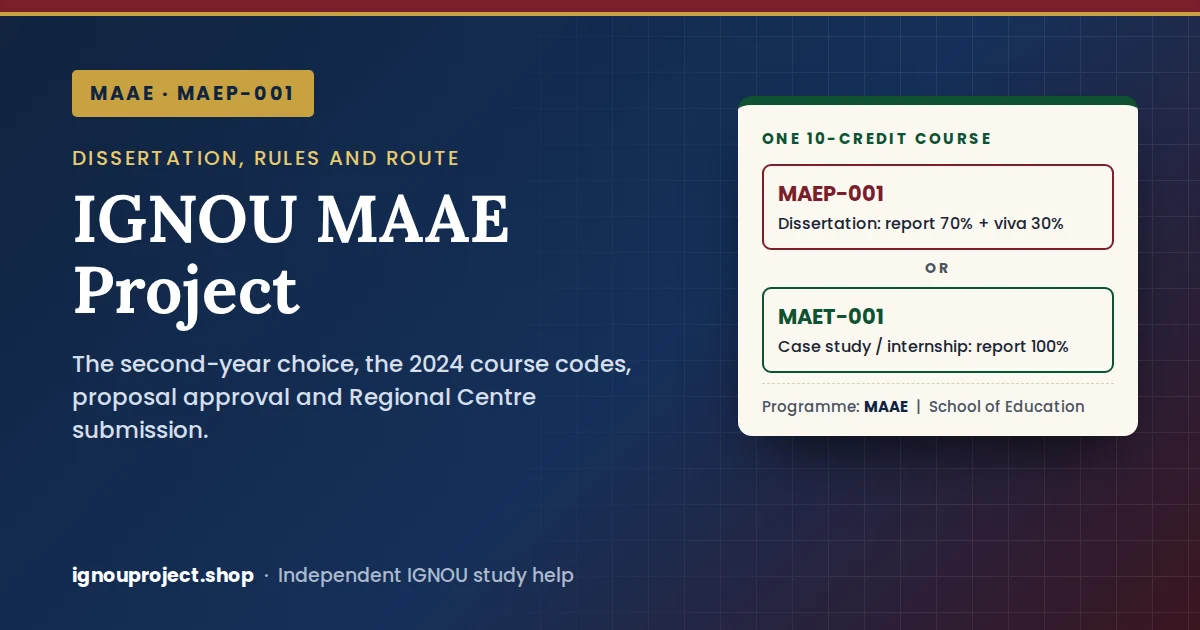
The IGNOU MAAE project is MAEP-001 Dissertation, a 10-credit second-year course of the Master of Arts in Adult Education, offered by the School of Education. It is optional: learners take either MAEP-001 or MAET-001 Case Study / Internship Reports. The dissertation is approved and submitted through the Regional Centre and graded 70% report, 30% viva-voce.
The course in one view
What is the IGNOU MAAE project (MAEP-001 Dissertation)?
The IGNOU MAAE project refers to MAEP-001 Dissertation Work, a 10-credit course in the second year of the Master of Arts in Adult Education (MAAE), an 80-credit programme of the School of Education (SOE), Indira Gandhi National Open University. According to the MAAE Programme Guide dated July 2024, MAEP-001 is one of two alternative 10-credit courses; the other is MAET-001 Case Study / Internship Reports, and a learner completes only one of them. A learner who opts for MAEP-001 carries out a systematic study on a problem drawn from any compulsory or elective MAAE course, under a supervisor approved by the University. The research proposal is submitted to the concerned Regional Centre for approval, and the finished dissertation is also submitted to the Regional Centre. The overall grade combines the dissertation report (70%) and a viva-voce (30%).
This page follows the IGNOU MAAE project from the second-year choice to the viva. The Programme Guide is the base document throughout, because it post-dates the Handbook that most study-help pages still quote. For how project rules differ across other IGNOU programmes, the IGNOU project guide on this site covers the wider picture.
| Course code and title | MAEP-001 Dissertation Work |
|---|---|
| Programme | Master of Arts in Adult Education (MAAE), 80 credits, ODL mode |
| School | School of Education (SOE); the programme began in 2011 under SOEDS and moved to SOE in 2014 |
| Credits | 10 |
| When | Second year, after re-registration |
| Status | Optional: MAEP-001 or MAET-001 Case Study / Internship Reports, one only |
| Study material | Handbook on Dissertation Work (printed 2013), sent in the second-year dispatch |
| Topic base | Any compulsory or optional MAAE course |
| Supervision | Supervisor approved by the University, allotted through the Learner Support Centre or Regional Centre |
| Proposal approval | Concerned Regional Centre |
| Dissertation submitted to | Concerned Regional Centre |
| Evaluation | Dissertation report 70%, viva-voce 30% |
| Medium of the programme | English |
| Time limit | Within the maximum programme duration of four years |
The first decision
Is the MAAE project compulsory, or can MAET-001 replace it?
MAEP-001 is not compulsory. The MAAE Programme Guide (July 2024) lists MAEP-001 Dissertation and MAET-001 Case Study / Internship Reports as optional courses of 10 credits each, and states that the learner selects one course only. Both routes carry the same credit weight in the 80-credit programme, so the choice turns on the kind of work the learner wants to do, not on the degree outcome. In practice, the decision should be made at second-year re-registration, because the Handbook for the chosen course arrives in the second-year dispatch and the work plan starts from it.
| Point | MAEP-001 Dissertation | MAET-001 Case Study / Internship Reports |
|---|---|---|
| Credits | 10 | 10 |
| What is produced | A dissertation on a research problem chosen by the learner | A case study report (an institution, individuals, or a demonstrated product, service or activity), or internship reports |
| Internship detail | Not applicable | Either Activity-B1 (teach at least five non-literate adults to make them literate) or any five of Activities B2 to B21, compiled into one report |
| Guidance | Supervisor approved by the University, allotted through the LSC or RC | As set out in the separate Handbook on Case Study / Internship Reports |
| Proposal approval | Required, from the concerned Regional Centre | No proposal stage is described in the Programme Guide |
| Evaluation | Report 70%, viva-voce 30% | Report 100% |
| Submitted to | Concerned Regional Centre | Concerned LSC or Regional Centre |
The dissertation is the better fit for a learner who wants a piece of independent research on record, for example with the UGC-NET or JRF route in mind, which the Programme Guide names as open to MAAE graduates. The internship route suits a learner already placed in a literacy centre, NGO or extension setting who would rather document field activity than design a study. Neither route is described as easier, and the guide attaches no preference to either.
Old handbook, new programme
Which rules apply: the 2013 Handbook or the 2024 revised MAAE?
Both, with one correction. The Handbook on Dissertation Work for MAEP-001 was printed in 2013, when the programme was still in its first version, while the revised MAAE has been on offer from the January 2024 admission session. The July 2024 Programme Guide says the Handbook remains part of the revised programme because its method is still relevant, but it asks learners to read the codes and titles of the revised framework in place of those printed on pages 5 and 6 of the Handbook. The practical meaning is simple: take the research method from the Handbook, and take course codes, credits and routing from the Programme Guide.
| Year | Courses | Credits |
|---|---|---|
| First year | MAE-001 Understanding Adult Education; MAE-002 Policy Planning and Implementation of Adult Education in India; MAE-006 Adult Learning and 21st Century Skills; MAE-003 Knowledge Management, Information Dissemination and Networking in Adult Education; MAE-004 Extension Education and Development; MES-016 Educational Research | 6 each |
| First year practical | MAEL-101 Community-based Practical Activities | 4 |
| Second year, compulsory | MAE-005 Population and Development Education; MES-131 Educational Technology: An Overview | 6 each |
| Second year, any three | MAEE-001 Sustainable Development; MAEE-002 Basics of Legal Awareness; MESE-061 Open and Distance Learning Systems; MESE-062 Vocational Education; MLL-001 Lifelong Learning: An Overview; MAEE-003 Comparative Adult Education | 6 each |
| Second year, any one | MAEP-001 Dissertation or MAET-001 Case Study / Internship Reports | 10 |
Two older points also changed. The programme started in 2011 under the School of Extension and Development Studies (SOEDS) and moved to the School of Education in 2014, so any instruction in an older reproduction that names SOEDS should be checked against current practice. And the first-year exit award is now the Post-Graduate Diploma in Adult Education (PGDAE), with a Post-Graduate Certificate (PGCAE) after three named courses.
Choosing the problem
Which MAAE courses can the dissertation topic come from?
Any of them. The Programme Guide states that the dissertation problem may be based on any of the compulsory courses or the optional courses of the MAAE programme, which makes the course list the most reliable topic map available. The table below pairs each course’s published focus with one illustrative direction; a real title still needs a named group, a named place and the supervisor’s agreement.
| Course | Published focus includes | Sample direction |
|---|---|---|
| MAE-001 Understanding Adult Education | Andragogy, curriculum transaction, methods of teaching literacy to adults | Methods used by volunteer instructors at selected adult literacy centres |
| MAE-002 Policy Planning and Implementation | Implementing agencies, participatory training, post-literacy and continuing education, Chapter 21 of NEP 2020 | Role of one NGO in continuing education for neo-literates in a district |
| MAE-006 Adult Learning and 21st Century Skills | Information, media and technology literacy; life skills; Skilling India | Digital literacy among adult women members of self-help groups in one block |
| MAE-003 Knowledge Management and Networking | Documentation, information dissemination, libraries in adult learning setups | Use of a public library by neo-literate adults in one town |
| MAE-004 Extension Education and Development | Extension methods and media, programme planning, monitoring and evaluation | Extension methods used by field functionaries and their reach among small farmers |
| MAE-005 Population and Development Education | Family life education, adolescence education, family welfare, demographic dividend | Awareness of family welfare measures among adult learners at selected centres |
| MAEE-002 Basics of Legal Awareness | RTI, domestic violence law, RTE, NREGA, rights of women, workers and senior citizens | Awareness of NREGA work entitlements among rural adults in two villages |
| MLL-001 Lifelong Learning | Lifelong learners, places of learning, policy and practice | Participation of senior citizens in lifelong learning activities in one city ward |
Before the study begins
How does the MAEP-001 proposal get approved?
Through the Regional Centre, after a supervisor has been allotted. The Programme Guide’s second-year schedule sets out three steps for a learner who opts for MAEP-001: contact the concerned Learner Support Centre or Regional Centre to have a guide or supervisor allotted from the approved list; prepare the research proposal in consultation with that supervisor and submit it to the concerned Regional Centre for approval; and only after approval, carry out the study and prepare the report. The same guide directs all project synopsis approval matters to the Regional Centre. The practical meaning is that field work begun before approval risks being wasted if the proposal comes back with changes.
What should the proposal contain?
The proposal format itself sits in the Handbook, but the method behind it is already in the first-year course MES-016 Educational Research. Block 3 of that course covers problem identification, research questions, hypotheses, sampling and tools of data collection; Unit 20 is titled Writing Proposal/Synopsis; and Units 22 and 23 cover the components of a research report and the scheme of chapterisation and referencing. A proposal built from those units normally carries a title, background and rationale, a short review of earlier studies, objectives, research questions or hypotheses, the design, sample and tools, the plan of analysis and a tentative chapter plan. Confirm the exact headings against the Handbook in hand.
What do older Handbook reproductions add?
Several third-party pages reproduce submission details from the 2013 Handbook: a pro forma for proposal approval signed by the learner and supervisor, the supervisor’s consent letter, the supervisor’s bio-data where the supervisor is not an academic counsellor, and a double-spaced A4 proposal. These items could not be checked against an official copy for this article, so treat them as a checklist to confirm with the Regional Centre, not as settled rules.
On supervisor eligibility: the Programme Guide says only that the dissertation is pursued under a supervisor approved by the University and allotted through the LSC or RC. Specific degree requirements that circulate online (for example, a named doctorate) do not appear in the Programme Guide. Ask the Regional Centre for the current approved list rather than recruiting a supervisor independently.
Planning the year
When should each MAAE project step happen?
The Programme Guide gives a second-year schedule for each admission cycle and describes it as facilitative rather than rigid. Mapped to the dissertation, it looks like this:
| January cycle | July cycle | Dissertation step |
|---|---|---|
| January to March | July to September | Re-register for the second year; the MAEP-001 Handbook arrives in the second-year dispatch (or is downloaded by soft-copy learners) |
| March to September | September to March | Study the Handbook; get a supervisor allotted; submit the proposal to the RC; after approval, collect and analyse data |
| September to November | March to May | Complete the dissertation report |
| December | June | Submit the dissertation to the concerned Regional Centre |
Missing the window does not end the course. The guide allows any pending dissertation work to be completed in later years, up to the maximum programme duration of four years from first registration. Exact last dates for each session are fixed by the University, so confirm the current one with the Regional Centre.
Submission and grading
Where is the MAAE dissertation submitted, and how is it graded?
To the concerned Regional Centre. The MAAE Programme Guide (July 2024) says, in both the course description and the schedule, that the learner submits the MAEP-001 dissertation to the Regional Centre for evaluation. Many general IGNOU project pages instead describe posting the report to the Student Evaluation Division in New Delhi or uploading it to the online project portal, because that is the route for several other programmes. The Programme Guide does list the Assistant Registrar (Projects), Student Evaluation Division, at projects@ignou.ac.in for questions on dissertation status and viva-voce marks, so records are held centrally even when the Regional Centre receives the dissertation. The practical meaning: follow the Regional Centre route unless a current notification for MAAE says otherwise, and confirm the mode before binding.
BK Sahni, who has guided 5,00,000 students till date, notes that the submission address is the MAAE detail learners most often get wrong, because instructions written for programmes routed to the Student Evaluation Division get reused for MAEP-001. A two-line email to the Regional Centre asking for the current mode costs a day and can save a lost dissertation.
For grading, the dissertation report carries 70% and the viva-voce 30% of the course grade. The guide currently uses a five-point letter scale and notes a likely move to a ten-point system:
| Grade | Level | Percentage equivalent |
|---|---|---|
| A | Excellent | 80% and above |
| B | Very Good | 60% to 79.9% |
| C | Good | 50% to 59.9% |
| D | Satisfactory | 40% to 49.9% |
| E | Unsatisfactory | Below 40% |
Checking what circulates
What do common MAAE project claims get wrong?
Much of what is written about the IGNOU MAAE project was drafted for other programmes or for the pre-2024 version. Checked against the July 2024 Programme Guide:
| Claim often seen | What the Programme Guide says |
|---|---|
| MAEP-001 is compulsory for every MAAE learner | Optional; MAET-001 Case Study / Internship Reports is the 10-credit alternative |
| Forty per cent is enough to clear the project | Programme completion needs at least a C grade in each course, which the guide’s table equates with 50% and above |
| Post the dissertation to the Registrar, SED, New Delhi | Submit to the concerned Regional Centre |
| The guide must hold a particular doctorate | Supervisor approved by the University, allotted through the LSC or RC; no degree rule is printed in the guide |
| Any social science topic will do | The problem may be based on any compulsory or optional MAAE course |
| Course codes in the Handbook are current | Read the revised codes in place of Handbook pages 5 and 6 |
Four avoidable problems follow from those claims, and each one tends to surface only at the proposal stage:
- A topic outside adult education. Titles about adolescents’ social media use or body image, which appear on several sample lists, are hard to tie to any MAAE course.
- A self-arranged supervisor. The guide expects the supervisor to come from the approved list through the LSC or RC.
- Field work before approval. Data collected against an unapproved proposal may not match the approved objectives.
- Old codes in the proposal. Citing first-version course codes signals that the revised framework was not read.
Quick answers
IGNOU MAAE project: frequently asked questions
Is MAEP 1 the same as MAEP-001?
Yes. MAEP-001 is the canonical code for Dissertation Work in the Master of Arts in Adult Education. Learners also type it as MAEP 1, MAEP-01, MAEP 001 or MAEP001, and many simply say the MAAE project. All of these refer to the same 10-credit course.
How many pages or words should the MAAE dissertation have?
The MAAE Programme Guide (July 2024) does not state a page or word limit for MAEP-001. Figures quoted on help sites could not be traced to an official source for this article, so take the length from the Handbook on Dissertation Work and your supervisor, and confirm with the Regional Centre.
Is there a viva-voce for the MAAE project?
Yes. The viva-voce carries 30% of the MAEP-001 grade, and the dissertation report carries 70%. Queries on viva-voce marks are handled by the Assistant Registrar (Projects), Student Evaluation Division.
Can the MAAE dissertation be written in Hindi?
The Programme Guide gives English as the medium of instruction for MAAE and sets no separate language rule for the dissertation. Confirm with the Regional Centre before writing in any other language.
Can the MAAE dissertation be completed after the second year?
Yes. Pending dissertation work can be completed in a later year, provided it is finished within the maximum MAAE duration of four years from the first registration.
Where is the MAEP-001 Handbook available?
The Handbook on Dissertation Work is sent in the second-year dispatch of materials. Learners who chose soft-copy material download course material through the eGyanKosh link on the IGNOU website.
What happens if the MAAE proposal is not approved?
The Programme Guide sends all synopsis approval matters to the Regional Centre, so the revised proposal goes back there after the changes are worked through with the supervisor. Ask the Regional Centre which documents to attach to a resubmission.
Verify before you act: the full course framework, routing and grading are in the official MAAE Programme Guide on ignou.ac.in, and course material is on eGyanKosh. Items marked above as reproduced Handbook text should be checked against your own copy, and any instruction from your Regional Centre or supervisor takes precedence over this page.
If the proposal stage is where MAEP-001 has stalled, a structured review of the topic, objectives and tools against the MAAE course list, before any field work starts, can save a full round of revision. Details are on the ignouproject.shop project pages.
Independent study-help disclosure: ignouproject.shop is run by Shri Chakradhar Publication Pvt. Ltd. and is not the official website of IGNOU or its School of Education. This article summarises published university documents for guidance only; official notifications on ignou.ac.in prevail over anything written here.

BK Sahni iD 0009-0005-8092-459X
Founder, Shri Chakradhar Publication Pvt. Ltd. & its IGNOU Project study-help brand, helping IGNOU distance-learning students since 2010 and having guided 5,00,000 students till date across MBA, MCom, MA & more. Author of IGNOU exam guides, solved assignments & project reference books.
Disclosure: Shri Chakradhar Publication Pvt. Ltd. and ignouproject.shop are independent third-party study-help services, not the official IGNOU website. Always verify final dates and rules on ignou.ac.in.
Leave a Reply