
M.Com (MCOP-001) · Synopsis Approval
To get an IGNOU MCOP-001 synopsis approved on the first attempt, the proposal has to clear a documentation check before anyone reads the research plan: an eligible guide, the guide’s bio-data signed in original, Annexure-I signed and dated by both parties, and a final title supported by precisely worded objectives.
The short answer
How do you get an IGNOU MCOP-001 synopsis approved?
Learning how to get an IGNOU MCOP-001 synopsis approved starts with accepting that approval is a documentation test before it is an academic one. Under the official MCOP-001 project guidelines issued by the Commerce Discipline of the School of Management Studies, a proposal that arrives without the guide’s detailed bio-data signed in original will not be entertained, however strong the research plan is. The Proforma for Approval of Project Proposal (Annexure-I) must carry the original signatures and dates of both the learner and the guide. The guide must fall into one of the recognised categories, and must have experience in the specific area of the topic. The title written on the proforma is final, because the report has to be submitted on the title that was approved.
Nothing in the research plan is assessed until the paperwork clears. An excellent proposal with an unsigned bio-data is returned; an ordinary proposal with complete paperwork moves to the evaluator.
Gate two
Does your guide actually qualify to supervise MCOP-001?
This is the single most common reason a first attempt fails, because learners often approach whoever is willing rather than whoever is eligible. The official guidelines recognise four categories, and the last of them carries a condition that is easy to miss.
| Category | What the guidelines require |
|---|---|
| Commerce faculty at IGNOU headquarters | Faculty of the Commerce Discipline in the School of Management Studies. |
| Approved academic counsellor | An approved counsellor at a Study Centre with relevant experience. If your guide is a counsellor, the proforma must state the Study Centre and the courses they counsel. |
| Faculty with teaching experience | Five years of postgraduate teaching experience. |
| Working professional | A Master’s degree in commerce or an allied discipline plus five years of experience in the area of your topic after that degree. A marketing topic needs marketing experience; finance experience will not carry it. |
Two practical points sit alongside this. The proforma asks the guide to declare how many learners are already under their guidance for this project course, so a guide who is at capacity can hold your proposal up. And the guidelines record a token honorarium of Rs. 300 per student payable by the University for project guidance, which means an eligible guide is not supposed to charge you privately for the signature.
Gate three
How should MCOP-001 objectives be written?
The official guidelines call the objectives the most important aspect of any project, and they set three tests. Objectives should state clearly and precisely what you expect to know or achieve by the end of the study. They should be stated in behavioural terms — what will actually be measured, compared or established. And they should be expressed in a neutral manner, without an implicit assumption baked into the wording.
That last test is the one most learners fail. “To prove that digital payments have improved customer satisfaction” assumes its own answer; “to examine the relationship between digital payment adoption and customer satisfaction among account holders of two selected banks” does not. BK Sahni, who has guided 5,00,000 students till date, notes that rewriting three or four loaded objectives into neutral, measurable ones is often the entire difference between a proposal that comes back and one that clears.
Gate four
Why is the title you write on the proforma final?
The title entered on the Proforma for Approval is the title the project must be submitted under. The guidelines are explicit that the final report has to be on the title approved by the evaluator, and that no change may be made at the report stage. A title should therefore be concise and should indicate clearly the work being taken up, but it also has to be one you can still defend eight months later with the data you are realistically able to collect.
Because of that, the title, the objectives and the methodology need to be written together rather than in sequence. The chapter-wise structure the approved study will eventually become is set out in the MCOP-001 format and topics guide.
Timing
When should the MCOP-001 synopsis be sent?
The guidelines advise M.Com learners to begin preparing the MCOP-001 synopsis from the third semester onwards. A synopsis may be submitted throughout the year, but the Regional Centre communicates approval or non-approval in writing within roughly two to three months of receiving it. Sending it early is not an optional refinement, then — it is what creates enough room for one revision without losing a submission cycle. You can read the source document, Final Project Guidelines MCOP-001, on eGyanKosh, and confirm your Regional Centre address on the official IGNOU website.
Before you post it
What should you check before sending the MCOP-001 synopsis?
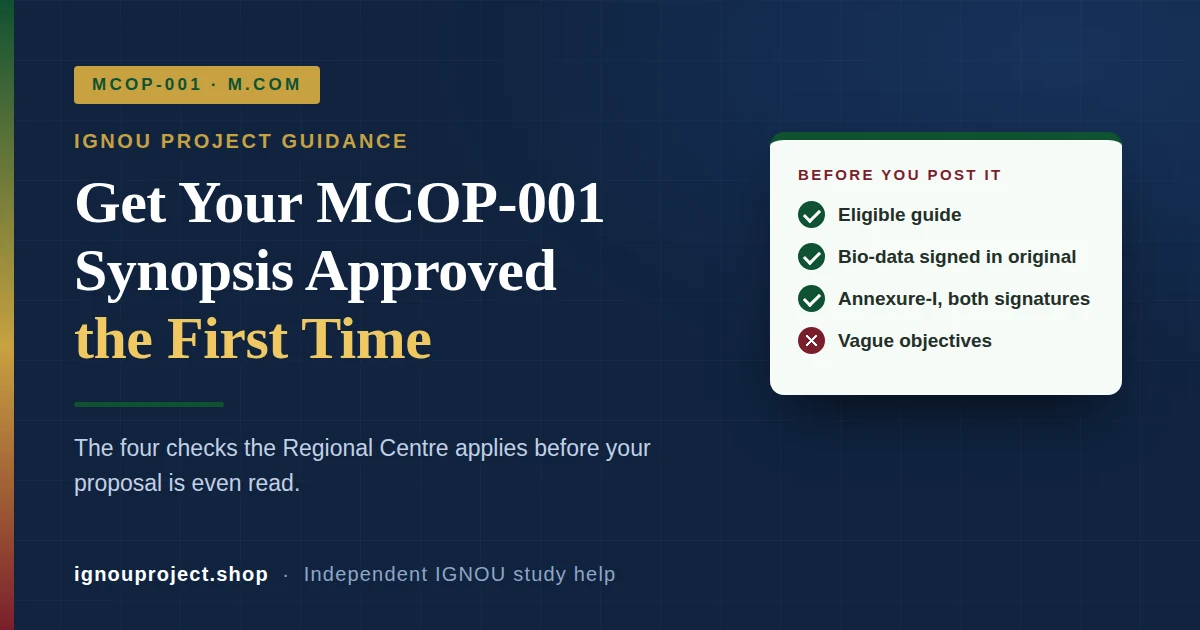
- Annexure-I complete. The Proforma for Approval of Project Proposal filled in, signed and dated by both you and your guide, in original ink.
- Guide’s bio-data attached and signed in original. Without it the proposal is not entertained, and this is checked before anything else.
- Guide eligibility matched to the topic area, not just to the subject in general.
- Counsellor details filled in if your guide is an academic counsellor — Study Centre and courses counselled.
- Enrolment number current. If the four-year maximum duration of the programme has lapsed, re-admission has to be sought first, and an approval held against an older enrolment number must be obtained again against the new one.
- Objectives rewritten neutrally — read each one and ask whether it presumes its own finding.
- Title final and defensible with the data you can actually reach.
- One copy sent, one copy kept, with “MCOP-001” written prominently on the envelope.
Frequently asked questions
How long does IGNOU take to approve an MCOP-001 synopsis?
The guidelines state that written communication about approval or non-approval is sent within about two to three months of the Regional Centre receiving the proposal. Timelines vary between Regional Centres, so treat this as a planning figure and confirm with your own Regional Centre.
Can I start writing the MCOP-001 project before approval?
You can read and plan, but the study itself should not be carried out until written approval is received. The report is assessed against the approved synopsis and the approved title, so work done on an unapproved proposal carries a real risk of being wasted.
Who can be my guide for the IGNOU MCOP-001 project?
Commerce faculty in the School of Management Studies at IGNOU headquarters, an approved academic counsellor with relevant experience, a faculty member with five years of postgraduate teaching experience, or a professional with a Master’s degree in commerce or an allied discipline and five years of experience in the specific area of your topic.
Can I change the MCOP-001 project title after approval?
No. The final report must be submitted on the title approved by the evaluator, and no change is permitted at the report stage. If the direction of your study genuinely has to change, that means a fresh proposal rather than an edit to the report.
If your synopsis is drafted but you are unsure whether the objectives and the guide documentation will clear, a review before you post it is far cheaper than a cycle lost. Details are on the ignouproject.shop pages.

BK Sahni iD 0009-0005-8092-459X
Founder, Shri Chakradhar Publication Pvt. Ltd. & its IGNOU Project study-help brand — helping IGNOU distance-learning students since 2010 (5,00,000+ students supported across MBA, MCom, MA & more). Author of IGNOU exam guides, solved assignments & project reference books.
Disclosure: Shri Chakradhar Publication Pvt. Ltd. and ignouproject.shop are independent third-party study-help services — not the official IGNOU website. Always verify final dates and rules on ignou.ac.in.
Leave a Reply