
MACSR · MEDSP-051 · SOEDS
IGNOU MACSR Project (MEDSP-051): Elective, Topic, Synopsis, Supervisor and Submission
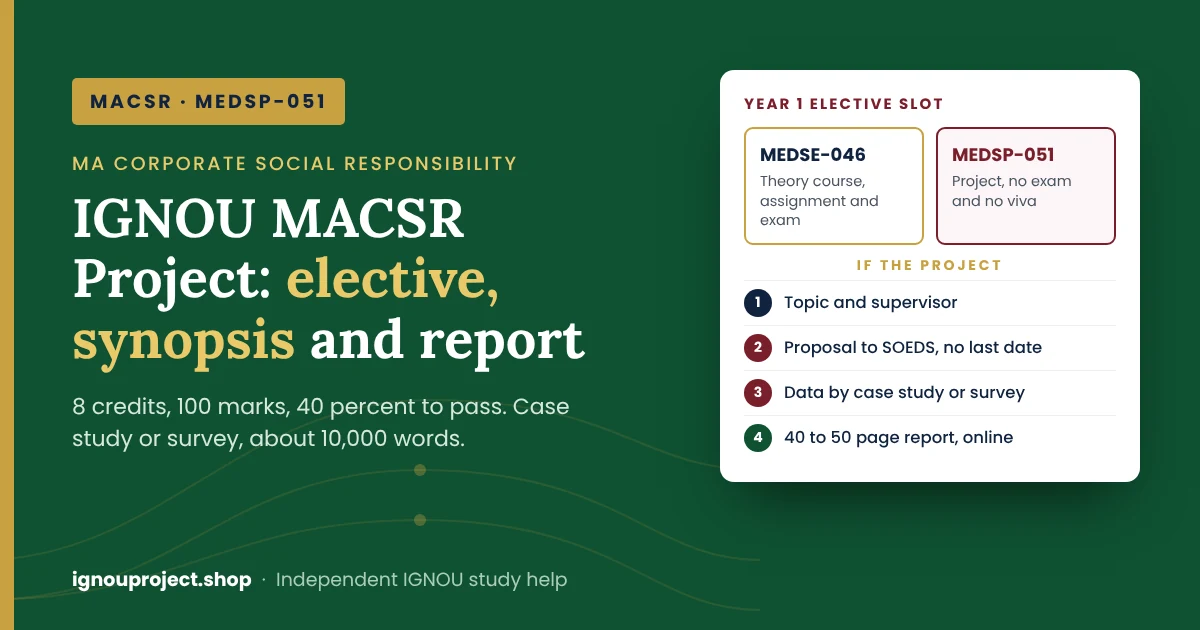
The IGNOU MACSR Project is MEDSP-051, Project Work in CSR, an 8-credit first-year elective of the MA in Corporate Social Responsibility, taken instead of MEDSE-046. The learner gets a proposal approved by the SOEDS programme coordinators, studies a CSR issue by case study or survey, and submits a report of about 10,000 words for 100 marks.
The course in one view
What is the IGNOU MACSR Project (MEDSP-051)?
The IGNOU MACSR Project refers to MEDSP-051, the research course of the Master of Arts in Corporate Social Responsibility (MACSR) offered by the School of Extension and Development Studies (SOEDS) at Indira Gandhi National Open University. The official programme page lists MEDSP-051 at 8 credits in Year 1 and marks it with an asterisk. The SOEDS project orientation slides explain that asterisk: MEDSP-051 and MEDSE-046 Development: Issues and Perspectives are electives, and one of the two has to be selected. A learner who takes the project chooses a CSR topic and a supervisor, sends a proposal with the signed proforma to the programme coordinators for approval, collects data by the case study or survey method, and submits a report of 40 to 50 typed pages, about 10,000 words. The project carries 100 marks, needs 40 percent to pass, and has no assignment, examination or viva.
MEDSP-051 is the code printed on every official document. Students also type it as MEDSP 51, MEDSP-51 or MEDSP051, and each of these spellings points to the same course. The Post Graduate Diploma in Corporate Social Responsibility (PGDCSR) carries the same MEDSP-051 course on its own programme page, and the SOEDS slides cover both programmes under one title, so the rules below apply to either.
| Programme | Master of Arts in Corporate Social Responsibility (MACSR), ODL mode, English medium |
|---|---|
| School | School of Extension and Development Studies (SOEDS) |
| Project course | MEDSP-051 Project Work in CSR |
| Credits and year | 8 credits, Year 1 |
| Status | Elective; the alternative is MEDSE-046 Development: Issues and Perspectives, also 8 credits |
| Year 2 | No project course is listed in Year 2 on the current programme page |
| Proposal goes to | Project Coordinator (PGDCSR / MACSR), SOEDS, Block 15-F, IGNOU, Maidan Garhi, New Delhi 110068, or scanned copies by email |
| Proposal deadline | None; the slides state there is no last date for the proposal |
| Methods named | Case study method and survey method |
| Report length | 40 to 50 typed pages or 10,000 words, with 10 percent variation permitted |
| Evaluation | 100 marks; minimum 40 percent; no assignment, examination or viva |
| December 2026 route | Online upload through the Online Project Management System (OPMS), reached from the Samarth login |
| Fee last date | 30 November 2026 for December 2026, paid through the Samarth login, as notified by the Student Evaluation Division |
| Programme duration | Minimum 24 months, maximum 48 months |
Codes and credits for project courses in other programmes are collected in this table of project codes and credits across programmes, which helps when a learner is comparing MACSR with a sister SOEDS degree.
The elective question
Is the IGNOU MACSR Project compulsory, or can MEDSE-046 replace it?
The IGNOU MACSR Project is not compulsory. MEDSP-051 shares one 8-credit elective slot in Year 1 with MEDSE-046 Development: Issues and Perspectives, and a learner completes the slot with either course. The official programme page marks MEDSP-051 with an asterisk, and the SOEDS orientation slides, prepared by the programme coordinators for the PGDCSR and MACSR programmes, state the rule in one line: one of the two electives has to be selected.
Several help sites describe MEDSP 51 as a mandatory requirement for the degree. That description does not match the programme structure. The practical cost of the error is a decision never made: a learner who assumes the project is unavoidable never weighs it against the theory option, and the two make very different demands.
| Point of comparison | MEDSE-046 Development: Issues and Perspectives | MEDSP-051 project |
|---|---|---|
| Course type | Theory course in five blocks | Project: topic, proposal, data collection and report |
| Credits | 8 | 8 |
| How it is assessed | Assignment and term-end examination, like the other theory courses; SOEDS publishes a MEDSE-046 assignment for PGDCSR and MACSR learners | The report alone, out of 100 marks with 40 percent to pass; no assignment, examination or viva |
| What it needs from the learner | Study of the blocks and examination preparation | A supervisor, an approved proposal, access to a CSR case or respondents, and a report of about 10,000 words |
| Usually suits | Learners with no access to a CSR programme, company data or a willing supervisor | Learners working in a CSR cell, an NGO implementing partner or a government office that handles CSR funds |
BK Sahni, who has guided 5,00,000 students till date, notes that learners already working in a CSR cell or an NGO tend to find the project the lighter of the two electives, because the case and the data sit within reach; learners without that access usually do better with the theory course.
The choice is easier to make early in Year 1. A learner who settles on the project can send the proposal at any time, since the slides set no last date for it, and the months saved go into field work rather than waiting.
Choosing a topic
How to choose MACSR project topics the coordinators will approve
For the IGNOU MACSR Project, the topic is the first thing the programme coordinators judge, and the SOEDS slides give five tests for it:
- Suitability of the topic for a Masters-level CSR study.
- Relevance to CSR, and the time available to finish it.
- Feasibility and cost of collecting the data.
- Challenges in data collection, and how they will be met.
- Communication facilities and local language in the study area.
Official sample topics sit in Annexure-1 of the Project Handbook, and the slides present them as ideas to guide the choice rather than a fixed list. eGyanKosh keeps a MEDSP-051 collection inside its PGDCSR community on eGyanKosh, which is the place to look for the current handbook and its annexures.
Illustrative topic directions, mapped to the course blocks
A topic that grows out of a block already studied is easier to defend in the proposal. The directions below are built from the official block titles of the four core courses; they are illustrations, not an approved list.
| Course and block | Topic direction | Method that fits |
|---|---|---|
| MEDS-051, Block 2: CSR Legislations and Guidelines | How companies in one sector report spending against the CSR provisions of the Companies Act, 2013 | Case study of published CSR reports |
| MEDS-051, Blocks 3 and 4: Key Thematic Areas in CSR | Beneficiary experience of a CSR livelihood or women’s empowerment project in one district | Survey of beneficiaries |
| MEDS-052, Block 3: Stakeholder Engagement | Community participation in the planning of one company’s CSR project | Case study |
| MEDS-053, Block 2: Implementation Partnership | The working relationship between a company and its NGO implementing partner | Case study with interviews |
| MEDS-053, Block 4: CSR Reporting | Quality of CSR disclosure in the annual reports of five listed firms | Case study of documents |
| MEDS-054, Block 1: CSR Programme Planning | A needs assessment for a CSR education or health project in one block or ward | Survey of households |
| MEDS-054, Block 4: CSR Accounting and Audit | A social audit of one CSR programme, with a Social Return on Investment estimate | Case study |
Case study or survey: the two methods the guidelines name
In MEDSP-051, the slides advise learners to use the case study method or the survey method. A case study suits one company’s programme, one NGO partnership or one village intervention, read through documents, interviews and observation. A survey suits questions about many respondents, such as beneficiaries’ awareness or satisfaction, and needs a sampling plan and a questionnaire or interview schedule. Because the proposal must name the locale, the sampling, the instruments and the statistical tools, the method has to be settled before the proposal is written.
The proposal
What goes into the MACSR project synopsis?
The IGNOU MACSR Project synopsis, which the SOEDS documents call the project proposal, has eight parts:
- Title
- Introduction
- Objectives
- Problem statement
- Research methodology: locale, sampling, instruments and statistical tools
- Expected outcome
- Limitations, if any
- References
The slides set no word or page limit for the proposal. Keep it to what the eight headings need, and agree the length with the supervisor before it is sent.
Where the synopsis goes, and when
Three items travel together: the filled-in project proposal proforma (Annexure-II), signed by the learner and the supervisor; the CV of the supervisor; and the proposal itself. The slides address them to the Project Coordinator (PGDCSR / MACSR), SOEDS, Block 15-F, IGNOU, Maidan Garhi, New Delhi 110068. Scanned copies may go by email instead, with the learner’s name, programme, enrolment number, topic and the supervisor’s name, designation and address written in the body of the email.
The 2022 and 2023 slides gave the email address of Prof. P.V.K. Sasidhar, pvksasidhar@ignou.ac.in. The current programme page lists him and Prof. Nisha Varghese as the MACSR programme coordinators, so check that page before sending. There is no last date to submit the proposal, and approval comes back by hard copy or email. Send it early: data collection should start only after approval, while the report deadline is fixed by the term-end examination calendar.
Supervision
Who can be a MACSR project supervisor?
A supervisor for the IGNOU MACSR Project can come from four groups named in the SOEDS slides:
- Academic counsellors of PGDCSR, MACSR, MADVS or MSW
- Teachers or researchers in CSR and development studies
- Faculty at IGNOU headquarters (SOEDS)
- Qualified subject specialists, a group whose wording changed between two versions of the slides
| Version | Wording of the fourth category |
|---|---|
| May 2022 slides (July 2021 and January 2022 sessions) | PhD in Development Studies, Economics, Sociology, Public Administration, Political Science, Extension Education, MSW or any related discipline |
| April 2023 slides | PhD, or a Masters degree with 5 years of experience, in Development Studies, Economics, Sociology, Public Administration, Political Science, Extension Education, Social Work or any related discipline relevant to the topic |
The April 2023 wording is the later one and is the version to follow unless the coordinators say otherwise. It widens the pool: a CSR or development professional with a Masters degree and five years of experience can now supervise, where the 2022 wording asked for a PhD. Because the supervisor’s CV travels with the proposal, the CV should show the degree, the discipline and the years of experience plainly.
The slides also define the supervisor’s role: help with topic selection and the review of literature, help with empirical data collection, encourage original work, give a letter of authorisation, and correct the report before submission.
The report
How long is the IGNOU MACSR Project report, and what goes in it?
The IGNOU MACSR Project report runs to 40 to 50 typed pages, or 10,000 words, with a variation of 10 percent permitted. The length and the sections both come from the SOEDS slides of April 2023. Learners asking about the MACSR project word limit should write to that band, which works out to roughly 9,000 to 11,000 words once the permitted variation is applied, rather than to a page count padded with large type and wide spacing.
MACSR project report format, page by page
- Title page with the course code MEDSP-051, the programme, the learner’s name and enrolment number.
- Second page: the approved project proposal proforma.
- Third page: the certificate of originality, signed by the student and the supervisor.
- Title and introduction, setting out the CSR context of the study.
- Objectives and the problem statement.
- Research methodology, with locale, sampling, instruments and statistical tools used.
- Results and discussion, the longest part of the report.
- Summary, limitations and references.
The proposal had an “expected outcome” heading; in the report, that place is taken by results and discussion, followed by the summary. A questionnaire or interview schedule, if one was used, sits sensibly in an appendix after the references, though the slides do not list appendices.
One more document check matters for online upload. The guidelines on the June 2026 online project portal asked learners to include the duly approved proforma, the synopsis and the bio-data of the project guide, with the originality certificate signed by both learner and guide, wherever applicable. Placing the approved synopsis and the supervisor’s CV after the originality certificate satisfies both the SOEDS page order and the portal checklist.
Submission
Where to submit: OPMS, the last date and the project fee
The IGNOU MACSR Project report for the December 2026 term-end examination goes online, through the Online Project Management System (OPMS) of the Student Evaluation Division. IGNOU’s official X account announced the OPMS launch on 16 October 2026, describing a system built by the Student Evaluation Division with BISAG-N and SAMARTH for projects, dissertations, internships and field work, and it posted a notification on submission through OPMS the same day. Education news coverage that week reports that learners reach OPMS through their Samarth account and that the last date for December 2026 is 30 November 2026. Read the SED notification itself before relying on that date.
The SOEDS slides describe the older routes: one bound or spiral-bound copy to the Assistant Registrar (Project Section), Student Evaluation Division, IGNOU, Maidan Garhi, New Delhi 110068, or online submission, with deadlines of 31 May for the June examination and 30 November for the December examination. Those two dates are the historical pattern, not a promise for any session. For June 2026, the upload page on onlineproject.ignou.ac.in closed on an extended date of 15 June 2026. For December 2026, according to the launch coverage, OPMS project submission takes the place of that session page and runs online only; send a posted copy only if a notification asks for one.
The MACSR project submission last date for December 2026 is therefore the OPMS date in the SED notification, reported as 30 November 2026, not a date copied from an older booklet. How the same rules apply to other courses is set out in the programme-by-programme IGNOU project hub.
The MACSR project evaluation fee
The MACSR project evaluation fee is paid separately from the upload. The Student Evaluation Division notification of 18 September 2026 states that fees for project, internship and practical courses for the December 2026 term-end examination are paid only through the learner’s own Samarth login, that the last date is 30 November 2026, and that no fee is accepted after it. The amount for MEDSP-051 appears in the Samarth account; pay it from there, before the upload, and keep the receipt.
Avoidable setbacks
Why a MACSR proposal or report comes back
Most returns on the IGNOU MACSR Project trace to a short list of avoidable errors. A MACSR project rejected at the proposal stage costs only time, because the proposal has no last date; a report returned after evaluation can push the result to a later term-end examination.
- Topic outside CSR. A general development topic with no company, CSR committee or CSR fund in it fails the relevance test.
- Data out of reach. A study that depends on internal company data the learner cannot obtain fails the feasibility and cost tests.
- A thin supervisor CV. The CV does not show the degree, discipline and years of experience that the April 2023 wording asks for.
- An incomplete set. The Annexure-II proforma is unsigned, or the supervisor’s CV is missing from the envelope or email.
- A method without a plan. A survey with no sampling plan, or a case study with no access to the case.
- A report outside the band. Far below or far above 40 to 50 pages and 10,000 words, beyond the 10 percent variation.
- Missing front pages. No approved proforma on the second page, or no signed originality certificate on the third.
- Fee or portal errors. The fee not paid through Samarth by the notified date, or the report uploaded through an old session link.
Quick answers
IGNOU MACSR Project: frequently asked questions
Is MEDSP 51 the same as MEDSP-051?
Yes. MEDSP-051 is the official code of the IGNOU MACSR Project. MEDSP 51, MEDSP-51, MEDSP 051 and MEDSP051 are the spellings students search for, and all of them refer to the same 8-credit course.
Where can the official MACSR project guidelines be found?
In three places: the MEDSP-051 course description on the MACSR programme page at ignou.ac.in, the SOEDS project orientation slides prepared by the programme coordinators (the April 2023 version is hosted on the website of the IGNOU Regional Centre Delhi-3), and the MEDSP-051 collection in the PGDCSR community on eGyanKosh.
Is there an official MACSR project sample?
No sample report appears in the official sources reviewed for this page. The nearest official material is the list of sample topics in Annexure-1 of the Project Handbook. A MACSR project sample from any other source shows one way of writing, not an approved format.
Is there a MACSR project viva?
No. The SOEDS slides state that there is no assignment, examination or viva for project work, so the report alone is evaluated, out of 100 marks with 40 percent needed to pass.
Does a PGDCSR project count towards MACSR?
The MACSR programme page allows learners who have completed PGDCSR to take lateral entry into Year 2 of MACSR through credit transfer. The PGDCSR project is the same MEDSP-051 course, and MACSR lists no project in Year 2, so such a learner does not face a second project. Confirm the credit transfer for your own record with your Regional Centre.
Is there a last date for the MACSR project synopsis?
No. The SOEDS slides state that there is no last date to submit the proposal. The date that matters is the report deadline for the term-end examination you are aiming at.
Verify before you act: the IGNOU MACSR Project rules on this page come from the official MACSR programme page and the SOEDS project slides. The OPMS route, the project fee and every last date are set by Student Evaluation Division notifications each session, and the newest notice on ignou.ac.in always takes precedence over this page.
If the work has stalled between topic and approval, a review of the proposal, the Annexure-II proforma and the supervisor’s CV against these MEDSP-051 requirements, before they reach SOEDS, can save a round of correction. Details are on the ignouproject.shop project pages.
Independent study-help disclosure: ignouproject.shop is run by Shri Chakradhar Publication Pvt. Ltd. and is not the official website of IGNOU or SOEDS. This article summarises published university documents for guidance only; official notifications on ignou.ac.in prevail over anything written here.

BK Sahni iD 0009-0005-8092-459X
Founder, Shri Chakradhar Publication Pvt. Ltd. & its IGNOU Project study-help brand, helping IGNOU distance-learning students since 2010 and having guided 5,00,000 students till date across MBA, MCom, MA & more. Author of IGNOU exam guides, solved assignments & project reference books.
Disclosure: Shri Chakradhar Publication Pvt. Ltd. and ignouproject.shop are independent third-party study-help services, not the official IGNOU website. Always verify final dates and rules on ignou.ac.in.
Leave a Reply