
MADVS · MDVP-117 · SOEDS
IGNOU MADVS Project (MDVP-117): Elective, Proposal, Report and Submission
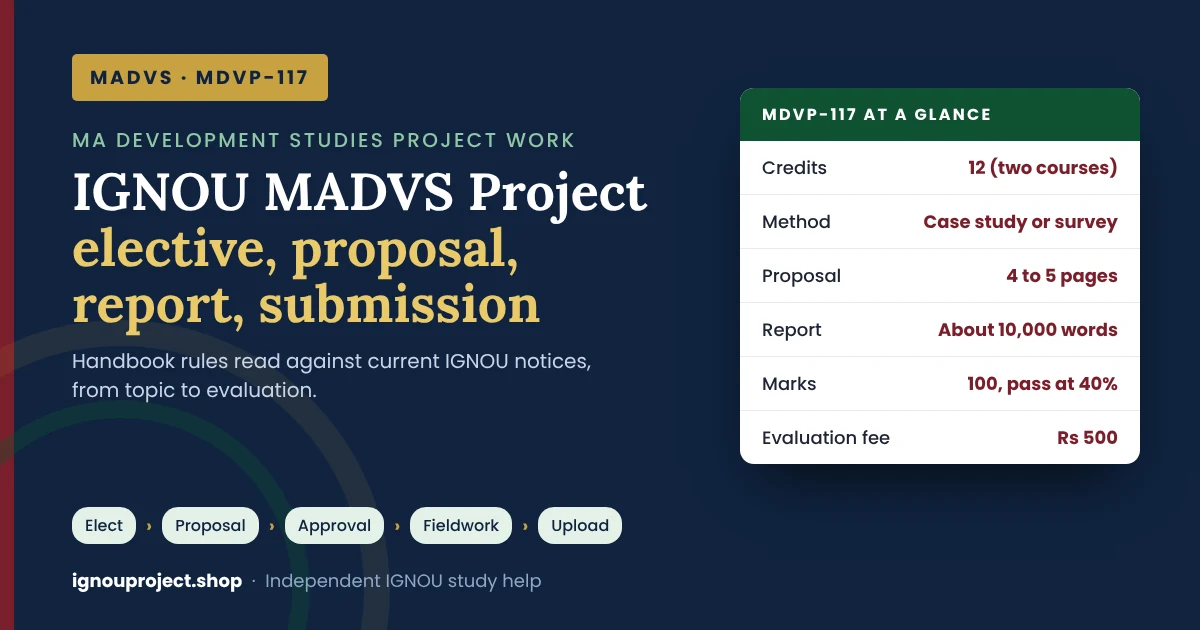
The IGNOU MADVS Project is MDVP-117 Project Work, a second-year elective of the Master of Arts (Development Studies). It takes the place of two courses (12 credits in the project handbook), is built on a case study or a survey, and moves from an approved proposal to a report of about 10,000 words marked out of 100.
The course in one view
What is the IGNOU MADVS project (MDVP-117)?
The IGNOU MADVS project refers to MDVP-117 Project Work, the research component of the Master of Arts (Development Studies) (MADVS) offered by the School of Extension and Development Studies (SOEDS) at Indira Gandhi National Open University. MDVP-117 is an elective. In the second year a learner chooses 36 credits from a pool of courses, and IGNOU’s programme listings describe the project as equivalent to two courses, or 12 credits, so it takes the place of two 6-credit electives. The 2019 Handbook on Project Work for MDVP-117, published on eGyanKosh, asks learners to use either a case study method or a survey method, to have a proposal approved by SOEDS with an eligible supervisor, and to write a report of about 40 to 50 typed pages, roughly 10,000 words. The report is marked out of 100, and 40 percent is needed to pass. Report submission has since moved from post to IGNOU’s online project portal.
Searches for the IGNOU MA Development Studies project, the MADVS dissertation or MDVP 117 all lead to this one course. Most of what a learner needs is in that single handbook. The MADVS project guidelines in it were written for postal submission, though, and a few of its instructions now sit alongside newer portal rules, so this page reads the handbook against the current notices and says which one applies where they differ.
| Programme | Master of Arts (Development Studies), code MADVS, Open and Distance Learning, English medium, examined year-wise |
|---|---|
| School | School of Extension and Development Studies (SOEDS) |
| Project course | MDVP-117 Project Work, a second-year elective |
| Credits | 12, equal to two courses, in the handbook and IGNOU Regional Centre listings; the ignou.ac.in course tile currently shows 6 (explained below) |
| Study hours | About 360 at 12 credits, since IGNOU counts one credit as 30 hours of study |
| Method | Case study method or survey method |
| Proposal | 4 to 5 typed pages, with the Annexure II proforma signed by the supervisor and the supervisor’s bio-data |
| Approval reply | Within four weeks of the proposal reaching the School, by email and post |
| Report length | About 40 to 50 typed pages at 1.5 line spacing, roughly 10,000 words excluding appendices, with 10 percent variation allowed either way |
| Marks | 100, with a minimum of 40 percent to pass |
| Evaluation fee | Rs. 500 (project work above 4 credits), paid with the Term-End Examination form |
| Report route today | Single PDF upload on onlineproject.ignou.ac.in, one link per examination cycle |
The second-year decision
Should the IGNOU MADVS project be chosen over two more electives?
The IGNOU MADVS project is optional, and the choice is made at re-registration for the second year, before any proposal is written. IGNOU’s Regional Centre programme listings and the January 2020 Common Prospectus set the second year as “choose any 36 credits” and list MDVP-117 at 12 credits; the Regional Centre listing adds that project work is equivalent to two courses. A learner who takes the project therefore studies four 6-credit electives alongside it; a learner who skips it studies six.
| Code | Course | Assessed by |
|---|---|---|
| MDV-105 | Development Planning and Management | Assignment and Term-End Examination |
| MDV-108 | Development Communication and Extension | Assignment and Term-End Examination |
| MDV-110 | Training and Development | Assignment and Term-End Examination |
| MDV-111 | Local Self Governance and Development | Assignment and Term-End Examination |
| MDV-115 | Health and Development | Assignment and Term-End Examination |
| MDVP-117 | Project Work (elective) | Project report, 100 marks |
Five 6-credit courses cannot fill 36 credits on their own, so the pool offered at re-registration includes further electives. That list, not this table, is the one that counts.
12 credits or 6: settling the MADVS project credits
The MADVS project credits appear two ways in IGNOU’s own material. The MDVP-117 handbook opens by calling the course “12 credits elected by you”, and Regional Centre programme pages list it at 12, equal to two courses, inside a 72-credit programme. The MADVS syllabus page on ignou.ac.in currently shows the project tile as 6 credits and labels its type “Theory”, the same label it gives every course on the page, which suggests a template field rather than a change of rule. Until IGNOU says otherwise, 12 is the documented value. One thing does not depend on the answer: the evaluation fee is the same Rs. 500 for any project above 4 credits.
BK Sahni, who has guided 5,00,000 students till date, advises learners to settle the credit question in writing with their Regional Centre before re-registering, because the second-year electives are fixed at that point and the project uses two of the six slots. A written reply is also the document to show if the grade card later counts the credits differently.
The table below is a planning aid, not an IGNOU rule. It sets out the situations in which the extra work of a field study tends to pay off and the ones in which two taught courses are the safer route.
| The project fits when | Two electives fit better when |
|---|---|
| The learner works in, or can reach, a panchayat, NGO, scheme office or community for data | No field site or respondent group can be reached within the time available |
| A supervisor who meets the handbook’s criteria is available locally | No eligible supervisor can be found before the proposal date |
| The learner wants a written study to show employers in the development sector | The learner prefers assignment-plus-examination assessment |
| There are at least six to eight months before the target examination cycle | The programme’s maximum duration is close and a proposal rejection would cost a cycle |
Dates
When should an MDVP-117 proposal be sent, and is there an MADVS project last date?
For the IGNOU MADVS project, the handbook gives advisory proposal dates linked to the admission cycle: learners admitted in a January session are advised to send the proposal by 30 April, and those admitted in a July session by 31 October. The handbook also says proposals are accepted throughout the year, with a matching delay in completing the programme. SOEDS then sends a written approval or non-approval within four weeks of receiving the proposal. In practice, that means the proposal date decides which examination cycle the report can realistically reach.
| Stage | Handbook (2019) | Current position |
|---|---|---|
| Proposal, January admissions | By 30 April | Advisory, confirm with SOEDS |
| Proposal, July admissions | By 31 October | Advisory, confirm with SOEDS |
| Approval reply | Within four weeks, by email and post | No later rule found |
| Report for June TEE results | Sent between 1 December and 31 May | Portal last date notified each cycle; 15 June 2026 for June 2026, 31 May 2025 for June 2025 |
| Report for December TEE results | Sent between 1 June and 30 November | 30 November in the December 2023 and 2024 cycles; the December 2026 link was not open on 17 October 2026 |
There is no fixed MADVS project last date that holds every year; each portal notice sets its own, so the safe habit is to read the notice for the cycle being targeted. The arithmetic matters more than the date itself. A learner admitted in July 2025 and now in the second year meets the handbook’s 31 October date in a fortnight; with four weeks for approval, a reply would arrive close to the end of November, which leaves no time for fieldwork before a December cycle and points the report towards the June 2027 cycle instead.
Guidance
Who can be an MADVS project supervisor?
The IGNOU MADVS project needs a supervisor whom SOEDS accepts, and the handbook names three groups of eligible people. If the School does not accept the proposed supervisor, the learner is told, changes the supervisor and sends the proposal again with the new supervisor’s signature, and it is treated as a new proposal. The same applies to a learner who changes supervisor later for any reason.
| Category | Condition in the handbook |
|---|---|
| Academic Counsellors of MADVS at Study Centres | Relevant experience; the proposal must state which courses the counsellor teaches, since when, and the name and code of the Study Centre |
| Teachers, researchers or development professionals | In Development Studies or a related discipline such as Extension Education, Social Work, Economics, Sociology, Public Administration, Political Science or Rural Development; PhD preferred, or M.Phil or Masters with 5 years of experience |
| Faculty at IGNOU headquarters | School of Extension and Development Studies |
Whoever supervises has to supply a signed bio-data of about two pages with full contact details, academic background and work experience. The proforma warns that a proposal without the complete signed bio-data will not be entertained, even when the supervisor is already an IGNOU MADVS counsellor. The University pays the supervisor a token honorarium, stated in the handbook as Rs. 300 per student and open to revision, against the Annexure IV remuneration bill. The supervisor can also issue the authorisation letter that lets a learner collect data; the Study Centre or Regional Centre may issue it instead.
Proposal stage
What goes into the IGNOU MADVS synopsis and proposal pack?
The IGNOU MADVS project proposal, which learners usually call the synopsis, is a short typed document of 4 to 5 pages. The handbook uses “project proposal” throughout and “synopsis” once, when it asks learners to keep a copy, so both words mean the same document here. The MADVS project proposal must carry these parts, in this order:
- Title, naming the place, the scheme or group studied and, where relevant, the period.
- Introduction.
- Objectives.
- Problem statement.
- Research methodology: locale, sampling, data collection instruments and the statistical tools to be used.
- Limitations, if any.
- References.
Three items travel together: the Annexure II proforma for approval, filled in and signed by both learner and supervisor; one copy of the typed proposal; and the supervisor’s signed bio-data. The handbook addresses the pack to the Project Coordinator (MADVS), School of Extension and Development Studies, Block 15-F, IGNOU, Maidan Garhi, New Delhi-110068, with “Project Proposal-MDVP-117” written at the top right corner of the envelope. Current portal guidelines confirm that a proposal goes to the concerned School or through the Regional Centre, and is never uploaded on the report portal; whether SOEDS now also accepts it by email is worth asking the programme coordinators before posting. How to frame objectives that an approver can test is covered in this guide to writing project objectives.
If an MADVS project proposal is rejected
A proposal that is not approved comes back with comments and suggestions. The revised version goes in with a fresh proforma, together with a copy of the proposal that was not approved, the old proforma carrying the evaluator’s comments, and the Project Proposal (P.P.) Number the School allotted. Leaving out the old papers is a common reason for a second delay, because the reviewer cannot see what was asked for.
Choosing what to study
MADVS project topics: which ones work with a case study or a survey?
Good MADVS project topics are narrow enough for one person and tied to evidence that can actually be collected. Annexure I of the IGNOU MADVS project handbook lists 40 sample areas and says plainly that learners are not limited to them. The handbook asks the learner to weigh the topic’s relevance to development studies, the time available, whether data can be collected in that time, the cost, and access to communication facilities and the local language. The method then follows from the question: a case study studies one unit in depth, whether a person, a family, an institution or a community, while a survey collects comparable answers from many respondents.
| Theme | Sample areas named in the handbook | Method that usually fits |
|---|---|---|
| Agriculture and rural livelihoods | Farmers’ perceptions on crop insurance; impact of crop diversification on income; role of women in agriculture; vulnerability of farmers to climate change | Survey of farmers in one block |
| Programme evaluation | Evaluation of MGNREGA, the ICDS programme, Sarva Shiksha Abhiyan, contract farming or a farmers’ training programme; functioning of the Mid-day Meal Scheme | Survey of beneficiaries, or a case study of one unit |
| Urban services and governance | Users’ satisfaction with urban services; urban e-governance in a city; case study of a Nagar Panchayat or municipality | Case study of one body, or a user survey |
| Urban environment | Solid waste management in a city or town; impact of urbanisation on rivers; air pollution in Delhi | Case study with records and observation |
| Migration and health | Socio-economic conditions of urban migrant labour; health status of women or children in an urban slum | Survey with an interview schedule |
| Planning tools | Community needs assessment on a development issue; SWOT analysis of a development programme | Mixed: group discussion plus a short survey |
A handbook area is a starting point, not a title. “Evaluation of MGNREGA” becomes workable once it names one gram panchayat, one aspect such as timeliness of wage payment, and one group of respondents. No official MADVS project sample report has been published; the nearest thing is the model title page in Annexure V, which uses “Evaluation of Contract Farming” as its example title.
Writing the report
How long is an IGNOU MADVS project report, and in what order?
An IGNOU MADVS project report runs to about 40 to 50 typed pages at 1.5 line spacing and should not exceed roughly 10,000 words, excluding appendices and exhibits; the handbook allows 10 percent variation either way, so about 9,000 to 11,000 words is within the MADVS project word limit. The report is written in English, on A4 paper, and references follow APA style, listed alphabetically.
The handbook describes the MADVS project report format twice, once as a short list and once in detail, and the two differ slightly: the short list ends with a Summary, the detailed one with Conclusion, Limitations and Suggestions for Further Work. Combining both gives an order that satisfies either reading:
- Title page, as in Annexure V, showing course code MDVP-117, title, name, enrolment number, address, School and year.
- The approved project proposal proforma, as the second page.
- Certificate of originality, Annexure III, signed by learner and supervisor.
- Acknowledgements, if any, and the table of contents.
- Introduction, with objectives, problem statement and rationale.
- Review of literature.
- Research methodology: locale, sample, tools and statistical techniques.
- Results and discussion, with tables and graphs.
- Summary and conclusion, then limitations and suggestions for further work.
- References in APA style.
- Appendix: the interview schedule or questionnaire used.
For data collection, analysis and report writing, the handbook points back to Blocks 4 and 5 of MDV-106 Research Methodology in Development Studies, and to Block 1 of the same course for writing a proposal. MDV-106 is a first-year course, so the material a learner has already studied doubles as the project’s method manual.
Submission and marks
How is the MDVP-117 report submitted and marked today?
The IGNOU MADVS project report is now uploaded, not posted. The handbook was written for a hard-bound copy sent by Registered or Speed Post; IGNOU’s online project portal, which opens a fresh link for each examination cycle, has replaced that route for MADVS project submission. Where the two disagree, the portal notice for the session is the current rule.
| Item | Handbook (2019) | Portal guidelines (current) |
|---|---|---|
| Medium | One hard-bound A4 copy by Registered or Speed Post to the Assistant Registrar (Project Section), Student Evaluation Division | The original report scanned into a single PDF for the course, pages clear and in order |
| Identification | “PROJECT REPORT- MDVP-117” written on the envelope | First page shows title, name, programme code, enrolment number as on the ID card, Regional Centre code, course code, mobile and email |
| Enclosures | Cover letter and the supervisor’s Annexure IV remuneration bill | Approved proposal proforma, synopsis, guide’s bio-data, signed originality certificate and the fee receipt |
| Evaluation fee | Not mentioned | Rs. 500 for project work above 4 credits, paid with the TEE form; without it the report is not evaluated |
| Viva-voce | Not mentioned | Conducted under the concerned faculty’s guidelines through the Regional Centre |
| Not accepted | Not stated | Reports by email; incomplete uploads, which are removed after the last date |
Two gaps are worth closing early. The portal list does not mention the supervisor’s remuneration bill, which the handbook says must accompany the report, so the Regional Centre should be asked how SOEDS now wants it sent. And the MADVS project viva is not described in the handbook at all, so its schedule comes only from the Regional Centre.
Evaluation itself has not changed. The project carries 100 marks, a learner needs at least 40 percent to complete it, and the Student Evaluation Division picks the examiner from a list approved by SOEDS. The handbook adds that evaluated reports are not returned, so a complete copy, with its data, should be kept. How the portal cycles work across programmes is set out on the ignouproject.shop project hub.
Avoidable setbacks
What gets an MDVP-117 proposal or report sent back?
Most problems with an IGNOU MADVS project are visible at the paperwork stage:
- No signed supervisor bio-data. The proforma states that such a proposal is not entertained, counsellor or not.
- An unexplained supervisor change. A new supervisor means a new proposal on a new proforma.
- A broad, national topic. One learner cannot survey “MGNREGA in India”; one panchayat is a study.
- A methodology section with no locale or sample. The handbook names locale, sampling, instruments and statistical tools as required parts.
- A resubmission without the old papers. The rejected proposal, its commented proforma and the P.P. Number go back in with the revision.
- A report far outside the length band, or without the approved proforma as its second page.
- Fee not paid with the TEE form, or a report sent by email instead of the portal.
Quick answers
IGNOU MADVS project: questions students ask
Is MDVP 117 the same as MDVP-117?
Yes. IGNOU writes the code as MDVP-117, and learners also search for it as MDVP 117 and MDVP117. All of these mean the Project Work course of the Master of Arts (Development Studies).
Is the IGNOU MADVS project compulsory?
No. The IGNOU MADVS project is listed as an elective among the second-year courses, equal to two 6-credit courses, so a learner may choose two more electives instead.
Where is the MADVS project handbook?
The MDVP-117 Project Work handbook, dated 2019, is on eGyanKosh under School of Extension and Development Studies, MADVS, Second Year. It contains the sample topic areas, the proposal proforma, the originality certificate, the remuneration bill and the model title page.
Can the project be written in Hindi?
The handbook states that the language for the project work is English, and the programme’s medium of instruction is English.
What is the MADVS project evaluation fee?
Rs. 500, the band IGNOU sets for project work above 4 credits from the January 2023 admission cycle onwards. It is paid with the Term-End Examination form, and the receipt goes with the report.
Can a PGDDVS holder take the project?
The MADVS page on ignou.ac.in says learners who completed the PG Diploma in Development Studies can enter the second year through credit transfer. The second-year elective choice, including MDVP-117, would then apply; confirm the credit transfer terms with the Regional Centre.
Verify before acting: the IGNOU MADVS project is governed by IGNOU’s own documents and notices, not by this page. The course handbook is the MDVP-117 Project Work handbook on eGyanKosh, and the course list and programme coordinators are on the MADVS programme page on ignou.ac.in. The newest portal notice always takes precedence over older dates.
If the topic, the supervisor paperwork or the proposal date is where the work has stalled, a review of the draft proposal against the handbook’s required parts can save a resubmission. Details are on the ignouproject.shop project pages.
Independent study-help disclosure: ignouproject.shop is run by Shri Chakradhar Publication Pvt. Ltd. and is not the official website of IGNOU or SOEDS. This article summarises published university documents for guidance only; official notifications on ignou.ac.in prevail over anything written here.

BK Sahni iD 0009-0005-8092-459X
Founder, Shri Chakradhar Publication Pvt. Ltd. & its IGNOU Project study-help brand, helping IGNOU distance-learning students since 2010 and having guided 5,00,000 students till date across MBA, MCom, MA & more. Author of IGNOU exam guides, solved assignments & project reference books.
Disclosure: Shri Chakradhar Publication Pvt. Ltd. and ignouproject.shop are independent third-party study-help services, not the official IGNOU website. Always verify final dates and rules on ignou.ac.in.
Leave a Reply