
MAHUE · MHUP-014 · SOITS
IGNOU MAHUE Project: Planning the MHUP-014 Dissertation in MA Human Values and Ethics
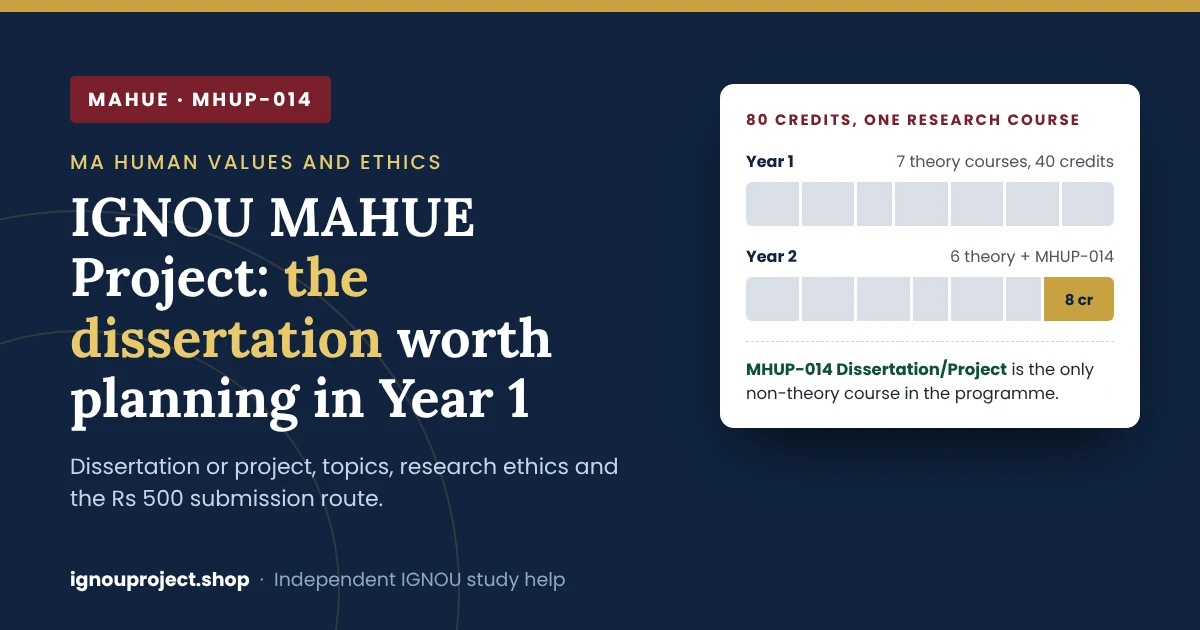
The IGNOU MAHUE project is MHUP-014 Dissertation/Project, the 8-credit second-year course of the MA in Human Values and Ethics at SOITS. It is the only course in the 80-credit programme that is not a theory paper, and because MAHUE opened in January 2026, the first learners reach it in 2027. The planning can begin in Year 1.
Status on 8 October 2026: the course code, credits and year are published. No MHUP-014 project manual, proposal proforma or supervisor list was found on ignou.ac.in. This page separates the confirmed rules from the open ones.
The course in one view
What is the IGNOU MAHUE project (MHUP-014 Dissertation/Project)?
The IGNOU MAHUE project refers to MHUP-014 Dissertation/Project, the research course of the Master of Arts in Human Values and Ethics (MAHUE) at Indira Gandhi National Open University. The School of Inter-Disciplinary and Trans-Disciplinary Studies (SOITS) offers the programme in open and distance learning mode. Academic Programme Launch Notification No. 173, dated 6 February 2026, introduced MAHUE from the January 2026 session as an 80-credit, English-medium programme with annual examinations, open to any graduate. The official programme page lists MHUP-014 in Year 2 as a Project-type course of 8 credits, beside the six second-year theory courses MHU-008 to MHU-013. Every other MAHUE course, MHU-001 to MHU-013, is a theory course. The title names both forms of work: a dissertation argued from texts, or a project built on data collected from people or institutions.
The dissertation therefore carries one-tenth of the degree’s credits and one-fifth of the second year’s. That weight, together with the fact that MAHUE is a new programme, explains why the dissertation needs earlier planning than the theory courses. A learner who waits for a course manual before choosing a topic may find the second year half gone.
| Course | MHUP-014 Dissertation/Project; the P marks the project course, while the theory courses run MHU-001 to MHU-013 |
|---|---|
| Programme | Master of Arts in Human Values and Ethics (MAHUE), ODL mode, English medium, eligibility any graduation |
| School | School of Inter-Disciplinary and Trans-Disciplinary Studies (SOITS) |
| Credits and year | 8 credits, Project type, second year |
| Weight | 8 of the programme’s 80 credits; 8 of the 40 second-year credits |
| Launch | Notification No. 173 of 6 February 2026; offered from the January 2026 session |
| Examination mode | Annual |
| Duration | Minimum 24 months, maximum 48 months |
| Project manual and proforma | None found on ignou.ac.in as of 8 October 2026 |
| Evaluation fee | Rs 500 band (project work above 4 credits, January 2023 admission cycle onwards), paid with the Term-End Examination form |
| Submission route | Online project portal page for each Term-End Examination session, one PDF per course |
| Last date | Fixed by notification each session; the June 2026 portal page closed on 15 June 2026 (a past date, not a forecast) |
| Programme coordinator | Dr Abhishek Mishra, SOITS, as named in the launch notification |
Settled and unsettled
Which MHUP-014 rules are confirmed, and which are not yet published?
Only the structural facts are confirmed. The code, the 8 credits, the second-year placement and the Project course type appear on both the MAHUE programme page and the launch notification. The procedure around the dissertation, from who may supervise it to how long it should be, has no MHUP-014 document behind it yet. The general rules on the online project portal fill part of that gap, because they apply to every IGNOU programme with project work.
| Item | Status | Source, or where to confirm |
|---|---|---|
| Code, title, 8 credits, Year 2 | Confirmed | MAHUE programme page; Notification No. 173 |
| Only non-theory course in MAHUE | Confirmed | Course list: MHU-001 to MHU-013 are all marked Theory |
| Evaluation fee band | General rule | Portal fee table: Rs 500 above 4 credits, from the January 2023 admission cycle |
| One PDF per course on the session portal | General rule | Portal notice for each Term-End Examination session |
| Where the proposal goes for approval | General rule | Portal guidance: the concerned School or Regional Centre; ask SOITS which applies |
| Supervisor eligibility | Not published | SOITS programme coordinator |
| Proposal format and proforma | Not published | SOITS, or the MAHUE programme guide when issued |
| Word or page limit | Not published | Supervisor, in writing |
| Marks and their split | Not published | Programme guide or project manual when issued |
| Viva-voce | Not stated for MHUP-014 | Portal: where held, a viva runs under the Regional Centre |
Two figures that differ between official sources
Credits for MHU-003. The launch notification gives MHU-003 Philosophy of Human Being 4 credits; the current programme page shows 6. The arithmetic favours the notification. With 4 credits, the seven first-year courses total 40 and the programme totals 80, the figure both documents state. With 6, the total becomes 82. The notification also leaves the credit cell for MHU-010 blank, and the programme page’s figure of 6 is the one that brings the second year to exactly 40. None of this changes MHUP-014, which is 8 credits in both, but it matters to anyone counting credits toward the degree.
Programme fee. The notification sets Rs 15,000 for the programme, Rs 7,500 per year. The programme page now shows Rs 8,000 per year, excluding examination fees. The live page is the later document and should be treated as current, with the admission or re-registration portal as the final word.
BK Sahni, who has guided 5,00,000 students till date, notes that the first batch of a new IGNOU programme tends to lose time in the same way: learners wait for a project manual, it arrives late, and the proposal is then written in a rush. A one-page topic note prepared in Year 1, plus a written question to SOITS about the proposal format, keeps the second year free for the research itself.
Choosing the form
Should an MHUP-014 study be a dissertation or a project?
The research question decides, not the learner’s preference. A question about what ought to be done, or what a value or principle means, leads to a dissertation argued from texts. A question about what people believe or how an institution behaves leads to a project built on data collected from people or documents.
The course title Dissertation/Project allows both, and the MAHUE syllabus supports both. The first-year course MHU-007 Research and Innovation Ethics sets assignment questions on informed consent, research involving human subjects and research misconduct, which are the concerns of empirical work. Courses such as MHU-002 Human Values in Various Indian Philosophy and MHU-005 Fundamental of Ethics, by contrast, train the textual and conceptual reading a dissertation depends on. In practice, the learner should name the form in the proposal and let the supervisor confirm it.
| Point | Dissertation (conceptual) | Project (empirical) |
|---|---|---|
| Question type | Normative or conceptual: what ought to be done, what a value means | Descriptive: what people believe, how an institution acts |
| Main sources | Primary texts, codes of conduct, constitutional and policy documents, scholarly literature | Questionnaires, interview schedules, case records, published reports |
| Core method | Conceptual analysis, comparison of ethical frameworks, critique | Survey, interviews, case study, content analysis |
| Ethics load | Accurate citation, fair representation of opposing views, originality | Informed consent, voluntary participation, confidentiality, data care |
| Typical weakness | Summaries of thinkers with no position of the writer’s own | Self-reported answers on honesty or integrity taken at face value |
| Suits | Learners with library or journal access and an interest in theory | Working professionals with access to a school, office, hospital or firm |
For the conceptual form, the method of moving from a doubt to a thesis and then to objections, set out in the MA Philosophy dissertation guide on this site, transfers well to an ethics dissertation. MAHUE and MAPY are both SOITS programmes, and the reading habits overlap.
Where topics come from
Which MAHUE courses give the strongest MHUP-014 topics?
Topics that grow out of a course already studied are easier to defend, because the reading list is partly built. The table pairs MAHUE course titles from the official course list with possible directions. These are illustrations to discuss with a supervisor, not an approved list.
| Course | Possible direction | Likely form |
|---|---|---|
| MHU-002 Human Values in Various Indian Philosophy | Nishkama karma in the Bhagavad Gita as a standard for public service | Dissertation |
| MHU-004 Values and Decision-Making | How school heads resolve value conflicts in admission decisions: interviews in one district | Project |
| MHU-006 Social and Environmental Ethics | One urban tree-felling dispute read through ecological and conservation ethics | Dissertation or case study |
| MHU-007 Research and Innovation Ethics | How postgraduate researchers in one university understand informed consent | Project |
| MHU-008 Values and Ethics in Education and Media | Value content in one state board’s Class 6 to 8 textbooks: a content analysis | Project |
| MHU-009 Resolving Ethical Dilemma | Three published Indian whistleblower cases analysed through duty-based and outcome-based reasoning | Dissertation |
| MHU-010 Values and Ethics in Leadership and Governance | Comparing two official codes of conduct for public servants | Dissertation |
| MHU-011 Business Ethics and CSR | How small listed firms describe CSR spending in annual reports: a content analysis | Project |
| MHU-012 Ethics in Professional Fields | Pharmacists’ handling of requests to sell medicines without a prescription in one town | Project |
| MHU-013 Cross-Cultural Aspects of Values and Ethics | Gratitude and obligation in Indian and Japanese workplace norms, from published studies | Dissertation |
Each direction above names one concept, one setting and one body of evidence. That is the scale an 8-credit study can handle. “Values in Indian society” names none of the three, and a supervisor will ask for it to be narrowed before anything else is discussed.
Research ethics as method
How does MHU-007 shape the ethics section of an MHUP-014 proposal?
It sets the standard the proposal will be read against. MHU-007 Research and Innovation Ethics is a first-year MAHUE course, and its assignment questions for the December 2026 term-end examination ask learners to explain informed consent, distinguish research misconduct from responsible practice, and show how a researcher limits harm and avoids deception with human subjects. The June 2026 set adds ethical review committees, data management and academic integrity.
A values and ethics dissertation is read in a discipline built on exactly those principles. An empirical MHUP-014 proposal with no consent procedure, or a conceptual one with careless citation, contradicts the subject of the degree itself. The practical step is to write the ethics plan as its own short section of the proposal, using the vocabulary of MHU-007.
- Consent. A plain-language information sheet and consent form for every respondent, kept with the data.
- Voluntary participation. A stated right to skip questions or withdraw.
- Confidentiality. No names in the report unless permission is written; institutions anonymised on request.
- Permission. A letter from the head of any school, office or firm where data is collected.
- No deception. The real purpose of the study stated to respondents.
- Integrity. Every quotation cited, and a signed declaration of originality at the front.
One gap is worth knowing about. The published MAHUE course list has no separate research methodology course; all thirteen theory titles deal with values and ethics. Method reading therefore has to come from elsewhere. A research methodology block from another IGNOU programme on eGyanKosh, chosen with the supervisor, is a practical source, since IGNOU’s self-learning material is open to read there.
Timing
When should a MAHUE learner start the MHUP-014 dissertation?
In the first year, well before MHUP-014 is formally registered. MHUP-014 is a second-year course on an annual programme, so a learner admitted in January 2026 cannot submit it before 2027. The minimum duration of 24 months points the same way. The months in between are where an unhurried topic choice gets made.
- Year 1, during MHU-005 and MHU-007. Keep a short topic note: two or three questions that keep returning while reading, with the course each came from.
- Before second-year re-registration. Check that MHUP-014 appears in the second-year course list for the batch, and look for any project guidelines added to the MAHUE page on ignou.ac.in.
- At the start of Year 2. Write to the SOITS programme coordinator, or the Regional Centre if SOITS directs it there, with a draft title and a one-paragraph plan. Ask three things: the proposal format, the supervisor rules, and where the proposal should be sent.
- Before collecting any data. Get the proposal approved in writing. Keep the approval with the date on it.
- Middle of Year 2. Finish the reading or fieldwork and draft the chapters with the supervisor.
- When filling the Term-End Examination form. Pay the project evaluation fee with it.
- By the notified last date. Upload the report as one PDF on the portal page for that session.
The first document
What should an MHUP-014 proposal contain until SOITS publishes a format?
A short proposal that states the question, the position or expected finding, and the plan for reaching it. Until an MHUP-014 proforma exists, the elements below cover what most IGNOU proposal formats ask for, adjusted for an ethics study.
- Title. One concept, one setting, one body of evidence.
- Problem statement. Why the question matters for human values or applied ethics, in a paragraph.
- Research question or thesis. A question for a project; a claim to be defended for a dissertation.
- Objectives. Three or four, each answerable by one chapter. This guide to writing IGNOU project objectives covers the wording.
- Review of literature. The main texts or studies, separated into primary sources and commentary.
- Form and method. Dissertation or project, and the method that follows from it.
- Ethics plan. The consent, confidentiality and integrity points listed above.
- Chapter outline and references. A tentative plan and the sources already in hand, in one citation style.
Length is the open question. One other SOITS master’s programme offers a reference point: the MDIP-001 manual for the MA in Migration and Diaspora asks for a proposal of 1,200 to 1,500 words and routes it to the programme coordinators, as explained in the MAMIDI project guide. That is a pattern within the School, not a rule for MHUP-014. Ask before assuming it applies.
Submission and fee
How is the MAHUE dissertation submitted, and what does it cost?
It is uploaded as one PDF on the online project portal page opened for the Term-End Examination session, and the evaluation fee is Rs 500. The portal sets Rs 300 for project work up to 4 credits and Rs 500 above 4 credits for learners from the January 2023 admission cycle onwards. MHUP-014 carries 8 credits and every MAHUE learner was admitted from January 2026, so the Rs 500 band applies to all of them without exception.
The fee is paid with the Term-End Examination form, and the portal notices state that a report without the fee is not evaluated. The same notices reject reports sent by email and do not consider incomplete submissions. The portal opens a fresh page each session; the June 2026 page closed on 15 June 2026, which shows the pattern but is not a forecast for any later cycle. Queries go to the Regional Centre email or to the project section of the Student Evaluation Division at projects@ignou.ac.in.
In practice, the Term-End Examination form deadline becomes the fee deadline for the dissertation, often well before the upload deadline. How these portal rules play out across other programmes is set out in the IGNOU project hub on this site.
What weakens the work
What weakens a human values and ethics dissertation?
- A sermon instead of a study. Conclusions such as “society must return to values” that no chapter has argued for or measured.
- Undefined values. Honesty, integrity or dharma used throughout without a working definition in the opening chapter.
- No framework. Cases described with no ethical lens, whether duty-based, outcome-based, virtue-based or one of the Indian traditions studied in MHU-002.
- Self-report taken as fact. Asking respondents whether they are honest and reporting the answers as a finding about honesty.
- Missing consent. Respondents named or identifiable, or no consent form in the appendix.
- A topic without edges. “Ethics in India” or “values in education” with no setting and no defined evidence.
- Course material copied in. Paragraphs lifted from the MHU units themselves; the people reading the dissertation know that material well.
- Data before approval. Interviews conducted before the proposal is approved in writing.
Quick answers
IGNOU MAHUE project: frequently asked questions
Is MHUP 14 the same as MHUP-014?
Yes. MHUP-014 is the official code for Dissertation/Project in the MA in Human Values and Ethics. Learners also write it as MHUP 014, MHUP-14, MHUP 14 or MHUP014. MHU-014 drops the P that marks the project course; there is no theory course with that code.
How many credits does the IGNOU MAHUE dissertation carry?
MHUP-014 carries 8 credits in the second year, according to the MAHUE programme page and Launch Notification No. 173. That is 8 of the programme’s 80 credits.
Is MHUP-014 compulsory in MAHUE?
The published structure lists MHUP-014 among seven second-year courses and shows no alternative course in its place. Confirm with the MAHUE programme guide or the SOITS programme coordinator whether any substitute exists for a batch.
Is there an official MHUP-014 project manual or synopsis format?
None was found on ignou.ac.in as of 8 October 2026. Until one is issued, ask SOITS in writing for the proposal format and keep the reply with the proposal.
Who can supervise the MHUP-014 dissertation?
No supervisor eligibility rule for MHUP-014 has been published. Ask the SOITS programme coordinator before approaching anyone, because other IGNOU programmes set eligibility conditions and a proposal signed by an ineligible guide can be returned.
What is the project evaluation fee for MHUP-014?
Rs 500, the band for project work above 4 credits for learners from the January 2023 admission cycle onwards. It is paid with the Term-End Examination form, and a copy of the receipt is submitted with the report.
Does the PG Diploma in Human Values and Ethics include a dissertation?
The PGDHUE programme page lists only MHU-001 to MHU-007. MHUP-014 belongs to the second year of the MA, so the dissertation is part of MAHUE, not the PG Diploma.
Verify before you act: the course list, credits and fee are published on the official IGNOU MAHUE programme page, and IGNOU’s self-learning material is on eGyanKosh. Any MHUP-014 manual SOITS issues later, and the portal notice for your own session, take precedence over this page.
If choosing between a dissertation and a project, or narrowing a topic, is where the work has stalled, a review of the one-page plan before it goes to SOITS can save a round of revision. Details are on the ignouproject.shop project pages.
Independent study-help disclosure: ignouproject.shop is run by Shri Chakradhar Publication Pvt. Ltd. and is not the official website of IGNOU or its School of Inter-Disciplinary and Trans-Disciplinary Studies. This article summarises published university documents for guidance only; official notifications on ignou.ac.in prevail over anything written here.

BK Sahni iD 0009-0005-8092-459X
Founder, Shri Chakradhar Publication Pvt. Ltd. & its IGNOU Project study-help brand, helping IGNOU distance-learning students since 2010 and having guided 5,00,000 students till date across MBA, MCom, MA & more. Author of IGNOU exam guides, solved assignments & project reference books.
Disclosure: Shri Chakradhar Publication Pvt. Ltd. and ignouproject.shop are independent third-party study-help services, not the official IGNOU website. Always verify final dates and rules on ignou.ac.in.
Leave a Reply