
MAMIDI · MDIP-001 · SOITS
IGNOU MAMIDI Project (MDIP-001): Proposal, Mentor, Method and Submission
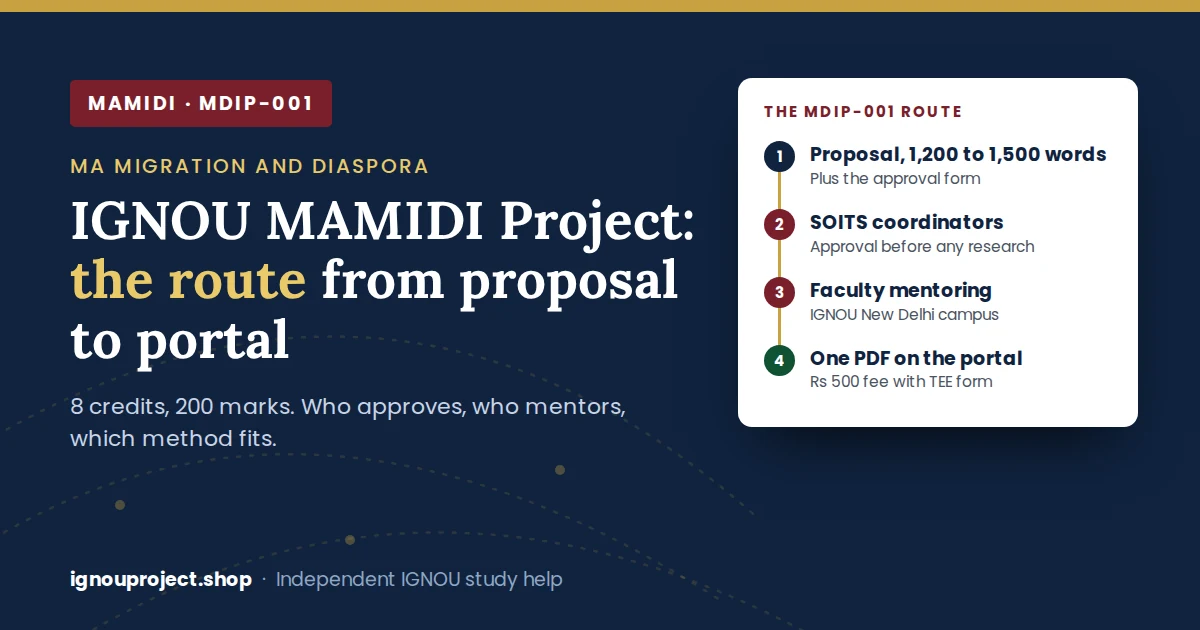
The IGNOU MAMIDI project is MDIP-001 Project Work, an 8-credit, 200-mark course in Semester 4 of the MA in Migration and Diaspora. The learner gets a 1,200 to 1,500 word proposal approved by the programme coordinators at SOITS, carries out the study with faculty mentorship, and uploads the report on the online project portal.
The course in one view
What is the IGNOU MAMIDI project (MDIP-001)?
The IGNOU MAMIDI project refers to MDIP-001 Project Work, the research component of the Master of Arts (Migration and Diaspora) programme offered by the School of Inter-Disciplinary and Trans-Disciplinary Studies (SOITS) at Indira Gandhi National Open University. The official programme page lists MDIP-001 at 8 credits in Semester 4, alongside MDI-009, MDI-010 and MPSE-011. The MDIP-001 Project Manual sets the project at 200 marks and excludes it from the assignments that every theory course carries. Before any archival, media or field work begins, the learner must get the topic and a proposal of 1,200 to 1,500 words, reference list included, approved by the programme coordinators at SOITS. Mentoring comes from IGNOU faculty at the New Delhi campus, by email or face-to-face sessions, rather than from a supervisor at a local Study Centre. The finished report is uploaded on the University’s online project portal.
That mentoring arrangement is what separates MDIP-001 from most IGNOU project courses. Elsewhere, a local guide signs a proforma and a Study Centre or Regional Centre handles approval. A MAMIDI learner who follows a generic IGNOU synopsis guide can send the right document to the wrong office.
| Programme | Master of Arts (Migration and Diaspora), programme code MAMIDI, ODL mode, English medium |
|---|---|
| School | School of Inter-Disciplinary and Trans-Disciplinary Studies (SOITS) |
| Project course | MDIP-001 Project Work; the manual’s heading labels it “Elective” |
| Credits and semester | 8 credits, Semester 4 |
| Marks | 200; the manual publishes no component split |
| Assignment | None for MDIP-001 |
| Proposal | 1,200 to 1,500 words including the reference list, plus the one-page Approval of Research Project form |
| Proposal goes to | The programme coordinators at SOITS: soft copy to pgdmidi@ignou.ac.in, or hard copy to Block 15, IGNOU, Maidan Garhi, New Delhi 110068 |
| Mentoring | IGNOU faculty at the New Delhi campus, by email or face-to-face sessions |
| Data tools named | Content analysis, case study, questionnaire, interview schedule |
| Report route | One PDF for the course on the online project portal, as notified each session |
| Evaluation fee | Rs. 500 (project work above 4 credits, January 2023 admission cycle onwards), paid with the Term-End Examination form |
| Last date | Fixed by notification each session; confirm on ignou.ac.in |
| Programme duration | Minimum 24 months, maximum 48 months |
One figure in older coverage needs a correction. Press reports at the January 2023 launch described the MA as a one-year programme; the current programme page lists a minimum of 24 months and describes MAMIDI as an 80-credit modular programme. The programme page is the reference, and it is why MDIP-001 sits in the fourth semester rather than at the end of a single year.
Mentoring
Who guides an MDIP-001 project if there is no local supervisor?
IGNOU faculty at the New Delhi campus guide it, according to the MDIP-001 Project Manual. The manual says the learner receives mentorship in preparing the proposal once IGNOU approves the project work, and may take help from mentors located at the University’s New Delhi campus, by email or in face-to-face sessions, to complete it.
The manual’s Step 2 carries the heading “Consultation with Supervisor and Project Approval”, yet its text names no local supervisor, sets out no supervisor eligibility list and includes no bio-data format. The people it does name are the Programme Coordinators of the MA in Migration and Diaspora, Dr. Sadananda Sahoo and Prof. Nandini Sinha Kapur, with Prof. Shubhangi Vaidya added as a Course Coordinator. The programme page on ignou.ac.in lists the same three faculty members against the MDIP-001 course.
The portal guidelines add one complication. For every programme, they ask learners to include the approved proposal proforma, the synopsis, the bio-data of the project guide and an originality certificate signed by learner and guide, each “wherever applicable”. MDIP-001 has its own one-page approval form instead of a guide proforma, so not every item on that list maps onto this course.
In practice: attach the signed approval form and the approval reply from SOITS, the approved proposal and a signed declaration that the work is original. If a local academic is helping informally, ask the programme coordinators in writing, before upload rather than after, whether that person’s bio-data is wanted.
BK Sahni, who has guided 5,00,000 students till date, notes that MDIP-001 learners lose the most time at exactly this point: searching for a local guide and a supervisor proforma that the manual never asks for. Writing first to the programme coordinators, with a draft topic attached, is the quicker way to find out who will mentor the work.
Approval
How do you get the MDIP-001 proposal approved?
Send two documents to the programme coordinators at SOITS and wait for approval before starting the research. The manual is explicit that the approval has to be submitted before work on the project begins, and that the proposal must show the research is significant, necessary and feasible within the normal time period.
| Item | Project proposal | Approval of Research Project form |
|---|---|---|
| Length | 1,200 to 1,500 words, including the reference list or bibliography | One page: two or three paragraphs on the proposed project |
| Contents | Title page, topic statement, aims and objectives, literature review, study design, research methods, tentative chapter outline, references | Proposed title, the short description, place, date, signature and enrolment number |
| Purpose | Shows the study is significant, feasible and original | Formal request to begin the project |
| Where it goes | Soft copy to pgdmidi@ignou.ac.in, or hard copy to Dr. Sadananda Sahoo, SOITS, Block 15, IGNOU, Maidan Garhi, New Delhi 110068 | To the Programme Coordinator at pgdmidi@ignou.ac.in |
Note the address. The manual uses pgdmidi@ignou.ac.in, the mailbox of the Post Graduate Diploma in Migration and Diaspora, which shares its first-year courses with this modular MA. The January 2023 MAMIDI assignment booklet lists a second address, mamidi@ignou.ac.in, against Prof. Nandini Sinha Kapur. Send the proposal to the address the manual names, copy the second, and keep the sent email with its date as proof of submission.
What each part of the proposal has to do
- Title page. The manual’s wording asks for “the degree programme to which you are applying”, a phrase carried over from a general proposal template. Write the programme you are enrolled in instead: MA (Migration and Diaspora), MAMIDI, course MDIP-001, with your name and enrolment number.
- Topic statement. Place the topic inside its subject area and say what the study will add.
- Aims and objectives. State the specific objectives and, where suitable, the research questions. Keep them few enough for one learner to answer; this guide to writing IGNOU project objectives covers the wording.
- Review of the literature. A short review of significant work, enough to show where the study fits.
- Study design. The theoretical approach chosen, and why.
- Research methods. Type of information, sources, main methods, resources needed and any ethical or safety issues. Ethics matters more here than in most programmes, because migrants, returnees and trafficking survivors are often vulnerable respondents.
- Tentative chapter outline. Optional at this stage, but it becomes the skeleton of the final report.
- References. The manual’s worked examples use APA style for journals, books, edited books and websites. Claims on generic pages that IGNOU prescribes Chicago style do not come from this manual.
When to send it
Ideally during Semester 3. The programme page places MSO-002 Research Methodologies and Methods, an 8-credit course, in Semester 3, and the manual advises starting the project only after gaining theoretical and conceptual clarity on the subject. Drafting the proposal while MSO-002 is still fresh, and sending it before Semester 4 begins, leaves the fourth semester for the research itself.
Method
Which research method suits which MAMIDI project topic?
The method follows the source. The MDIP-001 Project Manual lists seven suggested topic areas, encourages work on archives and return migration in particular, and names four data tools. The matrix below pairs each area with the tool that fits its usual source. The examples are illustrations built from the manual and official course titles, not an approved list.
| Suggested area | Method that fits | Typical source | Course it draws on |
|---|---|---|---|
| Historiography and archival studies | Content analysis | Colonial emigration reports, indenture records, old newspapers | MDI-004 Indian Diaspora: An Overview |
| Diaspora films and literature | Content analysis | A defined set of novels or films | MDI-006 Indian Diaspora: Socio-Cultural Facets |
| Biographical studies | Interview schedule, case study | Life histories of migrants or returnees | MDI-004, MDI-006 |
| Diasporic poetry | Content analysis | Collections by diaspora poets | MDI-006 |
| Popular culture | Content analysis, case study | Festivals, music, food writing of one community | MDI-006, MDIE-002 Diasporas in India |
| New media and diaspora | Content analysis | Social media pages, blogs, websites, advertisements, television shows | MDI-006 |
| Case studies on diaspora engagement | Case study | Policy documents, association records, interviews | MDI-005 Indian Diaspora: Politico-Economic and Policy Aspects |
| Return migration (encouraged) | Interview schedule or questionnaire | Returnee households in one district or town | MDI-004, MDI-007 Theories of Labour and Labour Markets |
Content analysis, case study, questionnaire or interview schedule?
Content analysis codes text, images or broadcasts into categories and reads patterns across them. The manual credits it with easy access, low cost and no influence on the people studied, and warns that it describes patterns without explaining the reasons behind them. It suits archives, literature and new media.
A case study examines one or more real situations through several sources of evidence. The manual names four types (illustrative, exploratory, cumulative and critical instance) and five steps, from establishing the present status of the case to follow-up.
A questionnaire needs respondents who can read and are willing to cooperate, and the manual ties it to quantitative work. An interview schedule is put to respondents in person, so it works regardless of literacy, at a higher cost in time and travel. For return migrants and their families, that difference often decides the method.
How much statistics does the MAMIDI project need?
Basic analysis is enough unless the learner is already comfortable with statistics. The MDIP-001 Project Manual states that the project is meant as an introduction to the basics of research and that advanced statistical analysis is not expected. Clear tables, percentages and simple comparisons, followed by careful interpretation, meet that standard. The marks are better spent on reading the data against the migration and diaspora concepts taught in MDI-001 and MDI-002.
Writing up
How should the final MDIP-001 report be organised?
The MDIP-001 Project Manual does not prescribe a separate chapter scheme for the final report. Its section titled “Structure of the Project” reads as a proposal structure, running from title page to references and ending with a tentative chapter outline. That outline, agreed with the mentor, is the intended skeleton of the report.
A common arrangement for a migration and diaspora study is shown below. It is a sensible default, not a University requirement:
- Introduction, objectives and research questions
- Review of literature
- Study design and methodology, including ethics and limitations
- Two or three analysis chapters, organised by theme, period or community
- Conclusions and, where relevant, policy suggestions
- References in one consistent style
- Appendices: coding sheet, questionnaire or interview schedule, archival list or media sample
The front pages carry the paperwork. Place the signed Approval of Research Project form and the SOITS approval reply immediately after the title page; the manual itself ends with a sample title page for the MDIP-001 report. No word or page limit for the final report appears in the manual, and figures quoted on help sites have no traceable source for this course. Agree the length with the mentor.
Submission
Where is the MAMIDI project report submitted now?
On the University’s online project portal, as a single PDF for the course, by the last date notified for the session. The MDIP-001 Project Manual gives an older route: upload at a June 2021 link on projects.ignou.ac.in, or post a hard copy to Dr. Sadananda Sahoo at SOITS. The manual itself flags with an asterisk that these links change from time to time and should be checked against IGNOU notifications.
The current portal opens a new page for each Term-End Examination session on onlineproject.ignou.ac.in. For the June 2026 session, the page closed on 15 June 2026; that date is a historical reference, not a forecast. The portal rejects reports sent by email, removes incomplete uploads after the last date, and is not meant for synopses or assignments. Where the manual and the live portal notice differ, the portal notice for your session governs; if the coordinators also want a hard copy, get that instruction in writing.
| File | The original report scanned as one PDF for MDIP-001; pages clear, in sequence, well lit and in one orientation |
|---|---|
| First page of the PDF | Report title, learner’s name, programme code (MAMIDI), enrolment number as on the identity card, Regional Centre code, course code (MDIP-001), mobile number and email address |
| Evaluation fee | Rs. 300 for project work up to 4 credits, Rs. 500 above 4 credits, for the January 2023 admission cycle onwards; MDIP-001 at 8 credits falls in the Rs. 500 band |
| How the fee is paid | With the Term-End Examination form; the receipt is uploaded with the report, and a report without the fee is not evaluated |
| Viva-voce | The MDIP-001 manual does not mention one; the portal states that viva-voce, where held, is conducted by faculty under the Regional Centre |
| Queries | Your Regional Centre email, or the SED project section at projects@ignou.ac.in |
The fee band needs no guesswork for this programme. MAMIDI admitted its first learners in the January 2023 cycle, so every MAMIDI learner falls within the cycle the portal’s fee table covers. Because the fee travels with the Term-End Examination form, the exam-form deadline is in effect the fee deadline for the project. How the same portal rules apply to other programmes is set out in the programme-by-programme IGNOU project hub.
Avoidable setbacks
What sends an MDIP-001 proposal or report back?
- Wrong office. The proposal goes to a Study Centre or Regional Centre because a generic guide said so, instead of to the programme coordinators at SOITS.
- Work started early. Fieldwork or interviews begin before approval, which the manual says must come first.
- A proposal twice the length. A 3,000-word “synopsis” from a generic template, against the manual’s 1,200 to 1,500 words including references.
- A topic without edges. “Indian diaspora around the world” fails the manual’s own tests of data feasibility within the time available and financial feasibility.
- The wrong instrument. A written questionnaire for respondents who cannot read it, where the manual points to an interview schedule.
- Template wording left in. A title page that still says “the degree programme to which you are applying”.
- Upload faults. Blurred or dim scans, pages out of sequence, mixed orientation, or a report sent by email.
- Fee missing. The Rs. 500 fee not paid with the Term-End Examination form, so the report is not considered.
Quick answers
IGNOU MAMIDI project: frequently asked questions
What is the course code for the IGNOU MAMIDI project?
It is MDIP-001 Project Work. Students also search for it as MDIP 001, MDIP-01, MDIP 1 and MDIP001; all refer to the same 8-credit project course of the MA in Migration and Diaspora.
How many credits and marks does MDIP-001 carry?
MDIP-001 carries 8 credits in Semester 4, according to the programme page on ignou.ac.in, and 200 marks, according to the MDIP-001 Project Manual. The manual publishes no split between components.
Is MDIP-001 compulsory or elective?
The manual’s heading labels it “Elective”, but the programme page lists no alternative 8-credit course in Semester 4. Confirm with the programme coordinators or the Programme Guide whether a substitute exists for your batch.
Where is the MAMIDI project proposal sent?
To the programme coordinators at SOITS: by email to pgdmidi@ignou.ac.in, or as a hard copy to Dr. Sadananda Sahoo, SOITS, Block 15, IGNOU, Maidan Garhi, New Delhi 110068, together with the Approval of Research Project form.
How long should the MDIP-001 proposal be?
No longer than 1,200 to 1,500 words, including the reference list or bibliography. No official word or page limit for the final report appears in the manual.
What is the project evaluation fee for MDIP-001?
Rs. 500, the portal’s band for project work above 4 credits from the January 2023 admission cycle onwards. It is paid with the Term-End Examination form, and the receipt is uploaded with the report.
Is there a viva-voce for the MAMIDI project?
The MDIP-001 Project Manual does not mention one. The online project portal states that viva-voce, where held, is conducted by faculty under the Regional Centre, so ask your Regional Centre after submission.
Verify before you act: the course structure is published on the official MAMIDI programme page, and the MDIP-001 Project Manual is linked from it. Portal rules, fees and last dates are notified each session, and the newest notice always takes precedence over this page.
If the proposal is where the work has stalled, a review of the topic, method and 1,500-word draft against the MDIP-001 manual before it reaches SOITS can save a round of revision. Details are on the ignouproject.shop project pages.
Independent study-help disclosure: ignouproject.shop is run by Shri Chakradhar Publication Pvt. Ltd. and is not the official website of IGNOU or SOITS. This article summarises published university documents for guidance only; official notifications on ignou.ac.in prevail over anything written here.

BK Sahni iD 0009-0005-8092-459X
Founder, Shri Chakradhar Publication Pvt. Ltd. & its IGNOU Project study-help brand, helping IGNOU distance-learning students since 2010 and having guided 5,00,000 students till date across MBA, MCom, MA & more. Author of IGNOU exam guides, solved assignments & project reference books.
Disclosure: Shri Chakradhar Publication Pvt. Ltd. and ignouproject.shop are independent third-party study-help services, not the official IGNOU website. Always verify final dates and rules on ignou.ac.in.
Leave a Reply