
MAENOH · MEVP-001 · SOITS
IGNOU MAENOH Project for MEVP-001: Credits, Supervisor, Synopsis and Marks
The IGNOU MAENOH project is MEVP-001 Project Work, a 4-credit course of the Master of Arts (Environmental and Occupational Health) run by SOITS. The learner drafts a proposal with an eligible supervisor, gets it approved through the Regional Centre, and submits a report of about 10,000 words, marked out of 100 with a 30-mark viva-voce.
The course in one view
What is the IGNOU MAENOH project for MEVP-001?
The IGNOU MAENOH project refers to MEVP-001 Project Work, the research course of the Master of Arts (Environmental and Occupational Health), an 80-credit ODL programme of the School of Inter-Disciplinary and Trans-Disciplinary Studies (SOITS) at Indira Gandhi National Open University, offered from the January 2025 session. MEVP-001 carries 4 credits. Its governing document is the MEVP-001 Handbook on Project Work (IGNOU, 2022), written for the MA and the PG Diploma in Environmental and Occupational Health. The learner selects a topic with an eligible supervisor and sends the approval proforma, one signed copy of the proposal and the supervisor’s bio-data to the Regional Centre, which should reply in writing within six weeks. The report runs to about 40 to 50 double-spaced pages, roughly 10,000 words, and is marked out of 100: 70 for the report and 30 for the viva-voce, with 40 per cent needed to pass.
Much of what circulates about this course was written for the older one-year PG Diploma or borrows figures from other programmes. The table below uses only IGNOU’s own documents: the programme page, Launch Notification No. 157, the 2022 handbook and the online project portal.
| Programme | Master of Arts (Environmental and Occupational Health), code MAENOH, ODL mode, English medium |
|---|---|
| School | School of Inter-Disciplinary and Trans-Disciplinary Studies (SOITS) |
| Launch | Academic Programme Launch Notification No. 157 of 8 November 2024, offered from the January 2025 session |
| Programme structure | 80 credits, minimum 2 years and maximum 4 years, annual examination |
| Project course | MEVP-001 Project Work, 4 credits, listed under the II Year courses in Notification No. 157 |
| Governing handbook | MEVP-001 Handbook on Project Work for MAEOH and PGDEOH, IGNOU 2022 |
| Supervisor | Headquarters faculty, or an academic counsellor with a Ph.D., an M.Sc. or MA plus 2 years of relevant experience, or an MD or MBBS |
| Proposal goes to | Your Regional Centre: approval proforma, one copy of the proposal signed by the supervisor, and the supervisor’s bio-data |
| Suggested proposal dates | By 30 April for January admissions and 31 October for July admissions; proposals are accepted throughout the year |
| Report length | About 40 to 50 double-spaced typed pages, roughly 10,000 words excluding appendices, with 10 per cent variation allowed either way |
| Marks | 100 in total: 70 for the report, 30 for the viva-voce; minimum 40 per cent to pass |
| Evaluation fee | Rs. 300, the up-to-4-credit band for January 2023 admissions onwards, paid with the Term-End Examination form |
| Final report route | Single PDF on the IGNOU online project portal in recent sessions; last date notified each session |
Timing
Is MEVP-001 a first-year or a second-year course in MAENOH?
Plan for the second year. Academic Programme Launch Notification No. 157, which created the Master of Arts (Environmental and Occupational Health), lists ten I Year courses (MEV-001 to MEV-005 and MEVE-001 to MEVE-005, 40 credits) and places MEVP-001 Project among the ten II Year courses, alongside MEVE-015 Disaster Management, MIS-021 Safety Philosophy and Principles of Accident Prevention, MPA-006 Disaster Medicine and MEVE-011 Global Climate Change.
The MAENOH programme page on ignou.ac.in tags MEVP-001 as “Yearly 1” and MEVE-005 as “Yearly 2”, while the PG Diploma notification counts MEVE-005 among the first-year courses. The two tags look transposed, and neither changes the credit value, which every official source gives as 4.
In practice, treat MEVP-001 as a Year 2 course and prepare for it at the end of Year 1. The handbook accepts proposals throughout the year; confirm with your Regional Centre when a proposal will be accepted against your current registration.
What if you exit after Year 1 with the PG Diploma?
Then there is no project. The MAENOH programme page describes an exit option with a PG Diploma after the first year, and Notification No. 158 for the Post Graduate Diploma (Environmental and Occupational Health), code PGDENOH, lists ten 4-credit courses and no project course. MEVP-001 belongs to the MA route only.
What if you already hold the older PGDEOH diploma?
The programme page allows holders of the existing 32-credit PG Diploma to join the second year of the MA, on condition that they complete all 40 credits of II Year courses plus one additional 4-credit elective from the first year. The older PGDEOH already contained MEVP-001 as a 4-credit project, and the page does not say whether a project passed under that diploma is counted again. Put that question to the SOITS programme coordinators in writing before re-registering, and keep the reply.
BK Sahni, who has guided 5,00,000 students till date, notes that MAENOH learners who read “8 credits” on help pages tend to design a dissertation-sized study for what is a 4-credit course, then run out of time in the data stage. Sizing the study to the handbook’s 40 to 50 pages from the first draft avoids that.
The rulebook
Which document sets the MEVP-001 rules for the MA?
The MEVP-001 Handbook on Project Work, published by IGNOU in 2022 for the MA and the PG Diploma in Environmental and Occupational Health. Prepared by the programme coordinators, Prof. B. Rupini and Dr. Sushmitha Baskar of SOITS and Prof. Ruchika Kuba of the School of Health Sciences, it covers topics, supervisors, the proposal, report format, evaluation and the forms.
Two details help when reading it. First, it predates the MAENOH code: the cover, the proforma and the originality certificate say “MAEOH” and “PGDEOH”, and the proforma asks whether the supervisor is an academic counsellor of PGDEOH. Second, parts of its topic and survey guidance refer to “urban planning and development”, wording carried over from another SOITS handbook. Read those lines as relevance to environmental and occupational health.
eGyanKosh catalogues the handbook in its PGDEOH collection as MEVP-001 Project Work (2022), and the IGNOU Regional Centre Chandigarh website hosts a PDF copy.
Supervision
Who can supervise an IGNOU MAENOH project?
The MEVP-001 handbook names two groups of eligible supervisors. The first is faculty at IGNOU headquarters. The second is academic counsellors holding a Ph.D., or an M.Sc. or MA with 2 years of experience in a relevant discipline, or an MD or MBBS in a relevant area.
Relevant disciplines include botany, zoology, physics, chemistry, biochemistry, microbiology, biotechnology, life science, genetics, engineering in any specialisation, medicine in all specialisations and paramedical fields, gender and development, sociology, geology, geography, and extension and development studies. A counsellor supervisor must state which courses they counsel, since when, and the name and code of their study centre.
- A supervisor can be refused on their own. If the programme coordinators at the Regional Centre do not accept the proposed supervisor, the learner changes the supervisor and submits the proposal afresh on a new proforma, as a new proposal.
- Changing supervisor later works the same way. Any change, for any reason, means a new proforma signed by the new supervisor.
- The University pays the supervisor. A token honorarium is paid under University norms and claimed on the Annexure IV bill.
- Access letters are part of the supervisor’s role. The handbook lists a letter of authorisation for data collection among the supervisor’s responsibilities, and says the study centre or Regional Centre can also issue one.
That last point matters in this programme: a study of workplace hazards needs a factory, clinic or site willing to admit a learner, and a university authorisation letter helps secure that access.
Approval
How do you get the MEVP-001 synopsis approved?
The synopsis, which the handbook calls the project proposal, is approved through your Regional Centre. The handbook sets out the sequence below.
- Test the topic. The handbook asks learners to weigh suitability, time available, feasibility of data collection within the time limit, the challenges and cost of collecting data, and communication facilities and local language.
- Write the proposal. It should state the title, introduction, objectives, problem statement, research methodology (locale, sampling, instruments and statistical tools), limitations and references.
- Complete the proforma. The Annexure II proforma records enrolment number, study centre, Regional Centre, title and supervisor details, signed and dated by learner and supervisor.
- Attach the supervisor’s bio-data. It must be complete and signed. The handbook states that a proposal without it is not entertained, even when the supervisor is an academic counsellor of the programme.
- Send it to the Regional Centre and keep a copy. Learners admitted in January are advised to submit by 30 April and those admitted in July by 31 October, though proposals are accepted throughout the year. The Regional Centre assigns a Project Proposal Number.
- Wait for the written decision. The handbook says approval or non-approval is communicated within six weeks of receipt, by email and by post.
If the proposal is not approved, the evaluator’s comments come back with it. The revised version goes in with a revised proforma, a copy of the rejected proposal, the proforma bearing the evaluator’s comments, and the Project Proposal Number already allotted. The office-use block of the proforma records separate verdicts for the proposal and the supervisor, so read both before revising anything.
Marks first, pages second
How should the MEVP-001 marks shape the report?
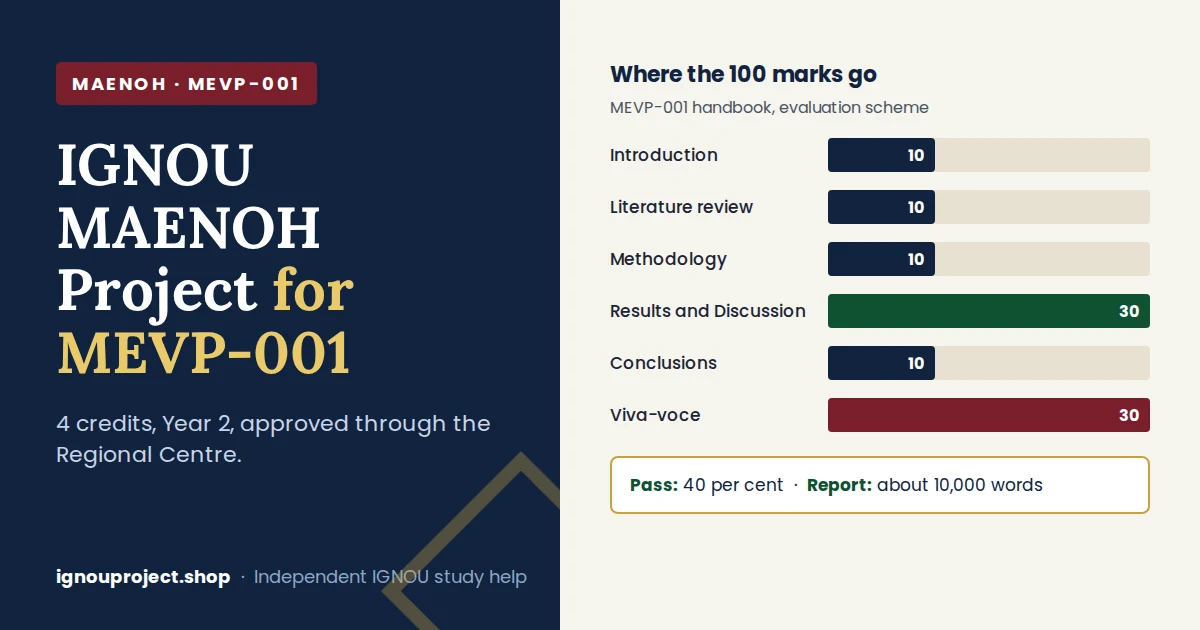
The evaluation scheme in Annexure V of the MEVP-001 handbook splits the 100 marks across five written components and the viva-voce. Results and Discussion alone carries 30 marks, as much as the introduction, the literature review and the methodology put together, so that chapter deserves the largest share of the page budget. A learner needs at least 40 per cent of the total to pass.
| Component | Marks | Planning example: pages | Planning example: words |
|---|---|---|---|
| Introduction (with objectives and rationale) | 10 | About 6 | About 1,400 |
| Review of the literature | 10 | About 6 | About 1,400 |
| Methodology | 10 | About 6 | About 1,400 |
| Results and Discussion | 30 | About 16 to 17 | About 4,300 |
| Conclusions (with limitations and suggestions) | 10 | About 6 | About 1,400 |
| Viva-voce | 30 | Not written | Know your own data |
| Total | 100 | About 40 to 41 | About 10,000 |
The example divides the handbook’s 10,000-word guide in proportion to the 70 written marks; with the permitted 10 per cent either way, the report can run from roughly 9,000 to 11,000 words, excluding appendices. The viva-voce rewards a learner who can explain why each sampling point or respondent group was chosen.
In what order should the MEVP-001 report be bound?
The handbook’s format section gives this order: title page (title, name, address, enrolment number and year), certificate of originality signed by learner and supervisor, acknowledgement, table of contents, introduction with objectives and rationale, review of the literature, methodology, results and discussion, conclusion, limitations, suggestions for further work, references, and appendices. The appendices carry the interview schedule or questionnaire, and copies of the approved proforma, the approved proposal and the supervisor’s bio-data.
Which reference style does MEVP-001 use?
APA, listed alphabetically. The handbook gives worked APA examples for books, journal articles, book chapters and websites; keep in-text citations and the reference list consistent with them.
Choosing the study
Which topics and methods suit an environmental and occupational health project?
Topics that one learner can reach, measure and finish inside the second year. Annexure I of the handbook lists eighteen sample areas, from water, air and soil pollution surveys to e-waste, toxicants in food, infectious hazards in health care settings and disaster management, and describes them as ideas rather than a closed list. For the IGNOU MAENOH project, the table below narrows some of them into workable studies tied to MAENOH courses.
| Handbook sample area | Narrower working version | Method | Course it draws on |
|---|---|---|---|
| Infectious hazards in health care settings | Biomedical waste segregation practices in two private clinics | Case study | MEVE-002 Health Care |
| Industrial pollution of a town or city | Noise awareness and hearing protection use among workers in small fabrication units | Survey | MEVE-004 Industrial Sector |
| Sustainable agricultural management practices | Pesticide handling and protective practices among farmers of one village | Survey | MEVE-003 Agriculture and Allied Sector |
| Disaster management | Heatwave preparedness in one municipal ward | Case study | MEVE-015 Disaster Management |
| Gender issues in agriculture and rural livelihoods | Occupational health complaints of women farm workers during harvest | Survey | MGSE-004 |
Case study or survey: which fits the question?
The handbook devotes most of its pages to these two methods. A case study examines one unit in depth, such as a clinic, a factory or a ward, and suits “how” and “why” questions. A survey gathers comparable answers from many respondents through a questionnaire or interview schedule, and suits questions about how common a practice or complaint is. The handbook also advises a pilot survey, voluntary participation and confidentiality.
Consent and confidentiality carry extra weight when workers describe their own health or their employer’s safety record, so build both into the method section and keep names out of the report. How objectives, questionnaire items and findings should line up is explained in this guide to IGNOU project questionnaires and data collection.
Submission and fee
How is the MEVP-001 report submitted, and what does it cost?
For recent sessions, as a single PDF on the IGNOU online project portal by the notified last date, with the evaluation fee already paid. The MEVP-001 handbook describes an older route: one typed copy to the Regional Centre, which allots a Project Report Number, schedules the viva-voce and sends marks to the Student Evaluation Division. Under that route, reports received from 1 December to 31 May were declared with the June Term-End Examination, and those from 1 June to 30 November with the December one.
The portal guidelines for the June 2026 Term-End Examination set their own conditions. The report is scanned into one PDF per course, and the first page must carry the title, learner’s name, programme code, enrolment number as on the identity card, Regional Centre code, course code, mobile number and email. The approved proforma, the synopsis, the supervisor’s bio-data and an originality certificate signed and dated by learner and supervisor go inside. Scans must be clear, in sequence and in one orientation; incomplete uploads are removed after the last date, and emailed reports are not considered. The viva-voce is conducted by faculty under the Regional Centre.
| Evaluation fee | Rs. 300 for project work up to 4 credits (Rs. 500 applies only above 4 credits), for the January 2023 admission cycle onwards; MEVP-001 at 4 credits falls in the Rs. 300 band |
|---|---|
| How it is paid | With the Term-End Examination form; the receipt goes with the report, and a report without the fee paid is not considered for evaluation |
| Last date | Notified each session; for the June 2026 Term-End Examination the portal gave 15 June 2026 |
| Queries | Your Regional Centre email, or the SED project section at projects@ignou.ac.in |
Where the handbook and the portal notice differ, follow the notice for your session; since the portal text still mentions hard copies, ask your Regional Centre whether a printed copy is also wanted. How the same portal rules apply across other IGNOU programmes is set out in the programme-by-programme IGNOU project hub.
Avoidable setbacks
Where do MAENOH projects usually go wrong?
- Sizing the study to the wrong credit value. MEVP-001 is a 4-credit course with a 40 to 50 page report; a study planned for 8 credits rarely finishes on time.
- A thin proforma for a counsellor supervisor. Counselling details are left out, or the signed bio-data is skipped because the supervisor is a counsellor.
- No access letter. Workplace data collection stalls because nobody requested an authorisation letter.
- A short Results and Discussion chapter. The 30-mark component gets a few tables with no comparison against standards or earlier studies.
- Programme name confusion. The handbook’s templates say MAEOH; the portal’s first page asks for the programme code as on your identity card, so copy it from there.
- Fee missed with the Term-End Examination form. The report is then not considered, however complete it is.
Quick answers
IGNOU MAENOH project: frequently asked questions
What is the course code for the IGNOU MAENOH project?
MEVP-001 Project Work. Students also search for it as MEVP 001, MEVP001, MEVP-01, MEVP 1 and MEVP1, and IGNOU pages use both MAENOH and MAEOH for the programme. All refer to the same 4-credit project course.
Is the MAENOH project 4 credits or 8 credits?
4 credits. The MEVP-001 handbook, the MAENOH programme page and Launch Notification No. 157 all give MEVP-001 as a 4-credit course.
Can MEVP-001 be started in the first year?
Notification No. 157 places it in the II Year. Settling a topic and supervisor late in Year 1 is sensible; confirm with your Regional Centre when a proposal can be submitted.
What is the word limit for the MEVP-001 report?
About 40 to 50 double-spaced typed pages, not exceeding roughly 10,000 words excluding appendices and exhibits, with 10 per cent variation permitted either way.
Do PG Diploma (PGDENOH) learners have to do MEVP-001?
No project course appears in Launch Notification No. 158 for PGDENOH, which lists ten 4-credit courses. MEVP-001 is part of the MA.
What is the project evaluation fee for MEVP-001?
Rs. 300, the portal’s band for project work up to 4 credits for January 2023 admissions onwards, paid with the Term-End Examination form.
Verify before you act: the course list is on the official MAENOH programme page, and the MEVP-001 Project Work handbook is catalogued on eGyanKosh. Portal rules, fees and last dates are notified each session, and the newest notice takes precedence over this page.
If the proposal is where the work has stalled, checking the topic, objectives and sampling plan against the MEVP-001 evaluation scheme before submission can save a round of revision; details are on the ignouproject.shop project pages.
Independent study-help disclosure: ignouproject.shop is run by Shri Chakradhar Publication Pvt. Ltd. and is not the official website of IGNOU or SOITS. This article summarises published university documents for guidance only; official notifications on ignou.ac.in prevail over anything written here.

BK Sahni iD 0009-0005-8092-459X
Founder, Shri Chakradhar Publication Pvt. Ltd. & its IGNOU Project study-help brand, helping IGNOU distance-learning students since 2010 and having guided 5,00,000 students till date across MBA, MCom, MA & more. Author of IGNOU exam guides, solved assignments & project reference books.
Disclosure: Shri Chakradhar Publication Pvt. Ltd. and ignouproject.shop are independent third-party study-help services, not the official IGNOU website. Always verify final dates and rules on ignou.ac.in.
Leave a Reply