
MAPY · MPYP-001 · MA Philosophy
IGNOU MAPY Project: The MPYP 1 Dissertation in MA Philosophy
The IGNOU MAPY project is MPYP-001 Dissertation/Project work, a 4-credit second-year course in the Master of Arts (Philosophy). It is optional, listed among the Year 2 choices beside the MPYE electives. Unlike survey projects, it is a library-based philosophical study built on texts, arguments and critical analysis, written under a supervisor.
The course in one view
What is the IGNOU MAPY project for the MPYP 1 dissertation?
The IGNOU MAPY project refers to MPYP-001 Dissertation/Project work, a 4-credit course listed in the second year of the Master of Arts (Philosophy), or MAPY, at Indira Gandhi National Open University. eGyanKosh files the course under the School of Inter-Disciplinary and Trans-Disciplinary Studies (SOITS). The MAPY programme requires 64 credits: 16 from the compulsory courses MPY-001 Indian Philosophy and MPY-002 Western Philosophy, and 48 from electives, six in each year. MPYP-001 carries the same 4-credit weight as each second-year elective, so a learner who takes it spends one Year 2 choice on the dissertation instead of another MPYE course. The official course material treats the dissertation as a research paper in philosophy, with units on systematic research in philosophy, writing a research paper and presenting it. The work is textual and argumentative, built on primary texts and scholarly literature rather than a field survey.
That last point changes almost everything about how the IGNOU MAPY project should be planned. Most help pages borrow the survey template used for MBA or social science projects, with a questionnaire, a sample size and data tables. A philosophy dissertation rarely needs any of those. What it needs is a sharp question, a defensible position, and a disciplined way of arguing for it.
| Course | MPYP-001 Dissertation/Project work (often written MPYP 1) |
|---|---|
| Programme | Master of Arts (Philosophy), MAPY, open and distance learning |
| School | School of Inter-Disciplinary and Trans-Disciplinary Studies (SOITS), as listed on eGyanKosh |
| Credits | 4 (ignou.ac.in programme page) |
| Year | Second year of the programme |
| Status | Optional; one of the Year 2 course choices |
| Nature of work | Library-based research paper in philosophy, argued from texts |
| Official material | MPYP-001 units on eGyanKosh, including Systematic Research in Philosophy, Writing a Research Paper, and Presentation of Research Paper |
| Language | Programme offered in English; learners may write examinations in Hindi |
| Evaluation fee | Rs 300, the band for project work up to 4 credits on the IGNOU online project portal |
| Submission | Session-wise online upload portal; follow the notice for your session |
| Last dates | Historically 31 May for the June term-end cycle and 30 November for December; fixed by notification each session |
The first decision
Is the MAPY dissertation compulsory, and should you choose it?
No. MPYP-001 is optional. The IGNOU programme page lists it with the second-year courses at 4 credits, while the only compulsory courses in MAPY are MPY-001 in the first year and MPY-002 in the second. A learner who does not want a dissertation completes the second year with six MPYE electives instead.
The choice is normally made when courses are selected for the second year at re-registration, so it pays to decide before that form is filled. Confirm with your Regional Centre whether a change is possible after re-registration; this page does not assume it is.
MPYP-001 tends to suit you if
- You plan a PhD, UGC NET preparation or teaching, where a written research paper is useful evidence.
- One question from your first-year reading has stayed with you.
- You can reach a library or reliable online journals regularly.
- You can keep in touch with a supervisor over several months.
Another elective may fit better if
- You prefer a set syllabus, assignments and a term-end examination.
- Your year is already crowded with work or other courses.
- No supervisor contact has been arranged and time is short.
- You have not yet read enough in any one area to hold a position.
What kind of research this is
How is a philosophy dissertation different from a survey-based IGNOU project?
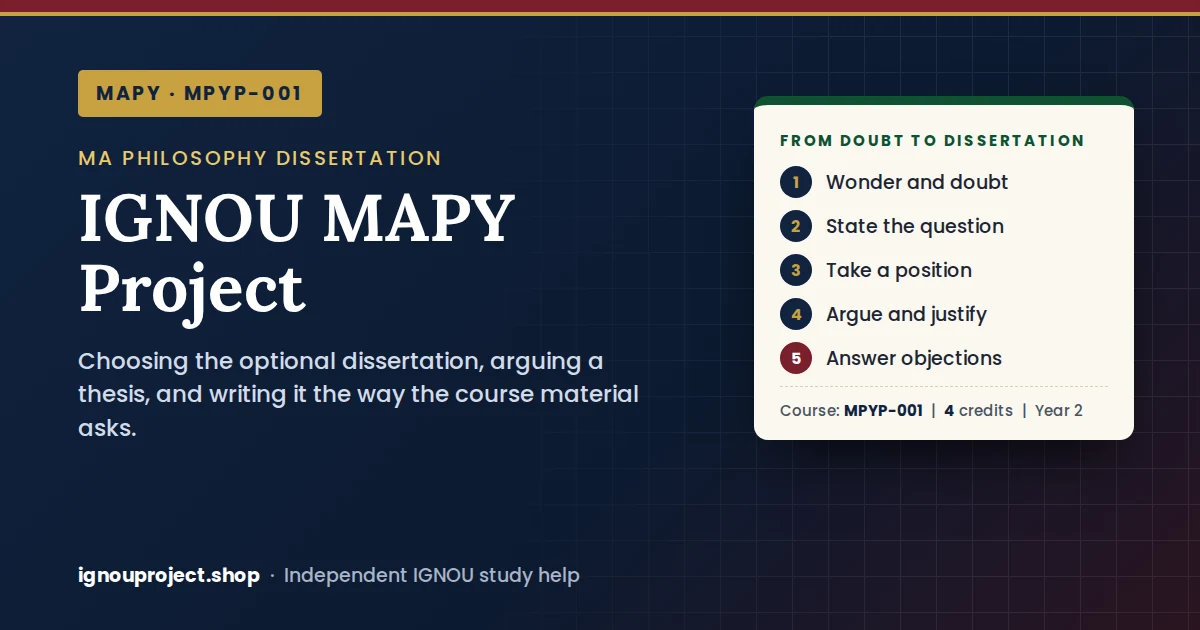
A MAPY dissertation argues; it does not measure. MPYE-007 Research Methodology in Philosophy, a first-year MAPY elective, names the library as the starting point for philosophical research and describes the human mind and language as the researcher’s main tools. It sets out philosophical method in five moves: wonder or doubt about an accepted belief, a clearly stated question, a proposed solution, arguments that justify it, and criticism by others that forces revision.
That method is the design of the study. Where an MBA project defines a sample and a questionnaire, an MPYP-001 dissertation defines a problem, the texts that bear on it, and the line of argument it will defend. In practice, a learner who took MPYE-007 in the first year already has the vocabulary; one who did not should read its units before drafting a proposal, since they are on eGyanKosh with the rest of the MAPY material.
Empirical work is not ruled out. MPYE-007 discusses quantitative and qualitative methods, and a topic in applied ethics might use interviews. But the default expectation for a philosophy dissertation is conceptual and textual analysis, and a survey added only to look scientific usually weakens the argument.
Where topics come from
Which MAPY courses can an MPYP-001 dissertation topic come from?
The safest topics grow out of courses already studied, because the reading list is partly built. The table pairs MAPY courses from the ignou.ac.in course list with dissertation directions. The directions are illustrations for discussion with a supervisor, not an approved list.
| Course | Dissertation direction | Main primary texts |
|---|---|---|
| MPY-001 Indian Philosophy | The concept of liberation in Samkhya and Advaita Vedanta: a comparison | Samkhya Karika; Shankara’s commentaries |
| MPY-002 Western Philosophy | Descartes’ method of doubt and Hume’s scepticism about the self | Meditations; A Treatise of Human Nature |
| MPYE-002 Ethics | Kant’s idea of duty applied to truthfulness at work | Groundwork of the Metaphysics of Morals |
| MPYE-006 Dalit Philosophy | Ambedkar’s critique of caste as a critique of moral authority | Annihilation of Caste |
| MPYE-012 Tribal Philosophy | Ideas of land and community in one tribal tradition | Recorded oral narratives; ethnographic sources |
| MPYE-014 Philosophy of Mind | Can a machine have understanding? Searle’s Chinese room revisited | Searle’s paper and the replies to it |
| MPYE-015 Gandhian Philosophy | Truth and non-violence as one concept in Gandhi | Hind Swaraj; An Autobiography |
| MPYE-013 Philosophy of Technology | Heidegger’s question concerning technology and everyday smartphone use | The Question Concerning Technology |
Narrow before committing. “Gandhi’s philosophy” is a library, not a topic. “The relation between truth and non-violence in Hind Swaraj” names one idea, one thinker and one text, which is the scale a 4-credit dissertation can handle well.
The first document
What goes into the MPYP-001 synopsis or proposal?
The proposal states the problem, the position to be defended and the plan for defending it. No MPYP-001 proposal proforma appeared on ignou.ac.in during research for this page, so the format should be confirmed with the supervisor or the Regional Centre. The elements below follow the philosophical method described in MPYE-007 and suit most supervisors.
| Element | What it answers | Philosophy-specific note |
|---|---|---|
| Title | What exactly is studied? | Name the thinker, concept or text; a colon may separate a subtitle |
| Problem statement | What is the doubt or question? | State it as a question that can be argued, not a theme |
| Thesis statement | What will the dissertation claim? | Takes the place a hypothesis holds in a survey project |
| Objectives | What steps lead to the claim? | Three or four, each matching a chapter |
| Review of literature | Who has said what already? | Separate primary texts from commentaries and journal articles |
| Method | How will the claim be argued? | Conceptual analysis, textual interpretation, comparison or critique |
| Chapter plan | How is the argument divided? | Each chapter a thematic unity |
| Preliminary bibliography | Which sources are in hand? | One alphabetical list, as the course material asks |
Length and format
How many pages or words should the MAPY dissertation run to?
No fixed page count for MPYP-001 appears on the ignou.ac.in programme page. The MAPY research methodology unit tells learners to adhere to recommended page limits set by the guide, which places the decision with the supervisor. Help sites, meanwhile, print figures that do not agree with each other.
| Figure seen | Where it appears | Status |
|---|---|---|
| A recommended limit of about 50 pages | Format notes on some help sites | No official MPYP-001 source found |
| Around 100 A4 pages | Service pages for MPYP-001 | No official MPYP-001 source found |
| 10,000 to 15,000 words, 80 to 100 pages | Project help directories | No official MPYP-001 source found; the word and page counts do not match each other |
| Page limits set by the guide | MPYE-007 Research Methodology in Philosophy, Unit 1 | IGNOU course material |
BK Sahni, who has guided 5,00,000 students till date, notes that philosophy learners who fix a page target before a thesis statement usually end up padding: long biographies of the thinker, summaries of whole books, and a conclusion that repeats the introduction. A better order is to agree the claim and chapter plan with the supervisor first, then ask for the expected length in writing.
Rules from the course material
What writing rules does the MPYP-001 course material set?
The unit Writing a Research Paper, filed on eGyanKosh under MPYP-001, gives concrete conventions that most generic guides skip. They are worth adopting from the first draft.
Chapters and headings
- A long paper such as a dissertation is divided into numbered chapters, and each chapter begins on a new page.
- Chapter length may vary, because each chapter is a thematic unity.
- Short chapter titles are preferred, with no more than three levels of subtitles.
- Titles and subtitles take no full stop, comma or semicolon; a colon may separate a subtitle from a title.
Citations and references
- A citation is an abbreviated reference in the text, of the kind the unit illustrates as (Pandikattu 1998), linked to a full entry in the references.
- The reference list is not split into categories such as books and articles.
- Encyclopaedias and dictionaries do not feature in the reference list.
- Long quotations are indented rather than placed in double quotation marks; footnotes are the place for the original text of a passage translated in the body.
The conclusion
The unit says plainly that the conclusion is not conclusive: the learner does not offer dogmatic proofs or claim to have settled the question for good. In a long dissertation the conclusion may run to a few pages. For examiners, a conclusion that states what was shown, what remains open and where the argument could go next reads as mature philosophical work.
Submission and fee
How is the MAPY dissertation submitted, and what does it cost?
The project evaluation fee for MPYP-001 falls in the lowest band. The instructions on IGNOU’s online project portal set Rs 300 for project work up to 4 credits and Rs 500 above 4 credits, paid with the term-end examination form. Keep the receipt; upload instructions in some sessions have asked for it.
On the route, the documents disagree by date. Older help pages print the postal address of the Registrar, Student Evaluation Division, at Maidan Garhi, New Delhi. Recent sessions have used a session-specific upload portal on onlineproject.ignou.ac.in for a single PDF. Treat the portal notice for your own term-end cycle as current, and confirm with the Regional Centre if the notice does not mention MAPY.
- Finalise the dissertation with the supervisor and obtain any certificate or signature the supervisor requires.
- Pay the evaluation fee with the term-end examination form.
- Upload the report on the portal notified for the session, before the notified last date.
- Save the confirmation screen or email as proof of submission.
Whether a viva voce is held for MPYP-001 was not confirmed in the documents reviewed, so ask the Regional Centre rather than rely on general statements. The wider steps that apply across programmes are set out in the IGNOU project guide on this site, which this page supports for MA Philosophy.
What goes wrong
Why do MAPY dissertations get sent back for revision?
- A theme instead of a question. “Buddhist ethics” gives the examiner nothing to test; “Is compassion a duty in Shantideva?” does.
- No position of one’s own. A chain of summaries of what others said, with no claim argued, is a literature review, not a dissertation.
- Secondary sources only. Commentaries are cited but the primary text is never quoted or read closely.
- A borrowed survey design. A questionnaire bolted onto a conceptual topic, producing tables that no chapter uses.
- Straw objections. Only weak criticisms are answered; the strongest reply to the thesis is missing.
- Loose referencing. Dictionary or encyclopaedia entries in the references, or a list split by source type, against the conventions in the course material.
- Copied text. Paragraphs lifted from online summaries of a thinker; supervisors and evaluators read the same summaries.
Quick answers
IGNOU MAPY project: frequently asked questions
Is MPYP 1 the same as MPYP-001?
Yes. MPYP-001 is the official code for Dissertation/Project work in the Master of Arts (Philosophy). Learners also write it as MPYP 1, MPYP-01, MPYP 001 or MPYP001, and many simply call it the IGNOU MAPY project. All of these refer to the same 4-credit second-year course.
Is the MPYP-001 dissertation compulsory in IGNOU MAPY?
No. The compulsory MAPY courses are MPY-001 Indian Philosophy and MPY-002 Western Philosophy. MPYP-001 is listed among the second-year choices, so a learner can complete the programme with MPYE electives instead.
Does a MAPY dissertation need a hypothesis or a questionnaire?
Usually not. Philosophical research works from a problem and a thesis statement defended by argument, with the library as its starting point. A questionnaire fits only an applied topic where the supervisor agrees that empirical data is needed.
What is the evaluation fee for MPYP-001?
MPYP-001 carries 4 credits, and IGNOU’s online project portal sets Rs 300 for project work up to 4 credits, paid with the term-end examination form. Check the fee on the current examination form, as rates are set by the university.
Where can the MPYP-001 guidelines and study material be downloaded?
The MPYP-001 units, including Systematic Research in Philosophy and Writing a Research Paper, are on eGyanKosh under the MAPY second-year collection. The MPYE-007 Research Methodology in Philosophy units sit in the first-year collection and are useful background.
Can the MAPY dissertation be written in Hindi?
IGNOU offers MAPY in English and permits learners to write examinations in Hindi. No document reviewed for this page sets a separate language rule for the dissertation, so confirm the language with the supervisor or the Regional Centre before starting.
What if no supervisor has been assigned for MPYP-001?
Contact the study centre coordinator first, then the Regional Centre, and keep a written record of the request. Starting the reading and a draft problem statement meanwhile is sensible, but agree the final topic with the supervisor before writing chapters.
Verify before you act: the current MAPY course list and credits are on the official IGNOU MAPY programme page, and the MPYP-001 and MPYE-007 units are on eGyanKosh. Submission dates, fees and the upload route are fixed by notification each session, and instructions from your supervisor or Regional Centre take precedence over this page.
If the proposal stage is where the dissertation has stalled, a structured review of the problem statement, thesis and chapter plan before full writing begins can save a round of rewriting. Details are on the ignouproject.shop project pages.
Independent study-help disclosure: ignouproject.shop is run by Shri Chakradhar Publication Pvt. Ltd. and is not the official website of IGNOU or its School of Inter-Disciplinary and Trans-Disciplinary Studies. This article summarises published university documents for guidance only; official notifications on ignou.ac.in prevail over anything written here.

BK Sahni iD 0009-0005-8092-459X
Founder, Shri Chakradhar Publication Pvt. Ltd. & its IGNOU Project study-help brand, helping IGNOU distance-learning students since 2010 and having guided 5,00,000 students till date across MBA, MCom, MA & more. Author of IGNOU exam guides, solved assignments & project reference books.
Disclosure: Shri Chakradhar Publication Pvt. Ltd. and ignouproject.shop are independent third-party study-help services, not the official IGNOU website. Always verify final dates and rules on ignou.ac.in.
Leave a Reply