
IGNOU MAANY / Discipline of Anthropology, School of Social Sciences
IGNOU MAANY Dissertation (MANP 101): From Topic to Final Report
The IGNOU MAANY dissertation is MANP 101, a compulsory 8-credit, 100-mark research study in any sub-field of anthropology, taken in Semester IV of the Master of Arts (Anthropology). It has no assignment and no term-end examination, so the grade rests entirely on the dissertation a learner designs, researches and writes.
This page is about the research itself: shaping an anthropological question, building the synopsis, handling fieldwork and organising the report. The administrative side (course mailboxes, evaluation fee slabs and the single-PDF checklist) is set out in the MAANY project guide covering MANE-106 and MANP-101, and is not repeated here.
Start here
What is the IGNOU MAANY dissertation, and how is it assessed?
The IGNOU MAANY dissertation is the compulsory research course MANP 101 in the Master of Arts (Anthropology), the restructured MAANY programme offered by the Discipline of Anthropology in the School of Social Sciences at Indira Gandhi National Open University. It sits in Semester IV, carries 8 credits and 100 marks, and has only a project component, with no assignment and no term-end examination. The MAANY Programme Guide describes MANP 101 as a research study in any sub-field of anthropology and states that evaluation is based entirely on the project. Before the study begins, the learner chooses a mentor, supervisor or guide and sends the synopsis to the course mailbox for approval. The detailed rules on the project and on mentor selection are placed in the course manual rather than in the Programme Guide, and the same guide states that there is no viva voce examination for the dissertation.
| Course code and title | MANP 101, Dissertation |
|---|---|
| Programme | MAANY, Master of Arts (Anthropology), restructured in line with NEP 2020 |
| School and discipline | School of Social Sciences, Discipline of Anthropology |
| Semester and status | Semester IV, compulsory course |
| Credits and marks | 8 credits, 100 marks |
| Components | Project only. No assignment, no term-end examination |
| Scope | A research study in any sub-field of anthropology |
| Synopsis approval | Sent to manp101@ignou.ac.in before the study starts |
| Viva voce | The Programme Guide states there is none for the dissertation |
| Semester IV companion courses | MANL 101 Practical in Physical/Biological Anthropology (8 credits) and one multidisciplinary course |
| Word or page limit | Not stated in the Programme Guide. Confirm in the MANP 101 manual or with your Regional Centre |
| Submission window | Fixed by notification each session. Confirm the current one |
Course structure
Where does MANP 101 sit in the MAANY course structure, and is MANE 106 also yours?
MANP 101 is compulsory for every MAANY learner. MANE 106 is not. That distinction is missing from almost every page that ranks for anthropology project searches, and it changes how much project work a learner actually has.
Is MANE 106 compulsory for MAANY learners?
No. In the MAANY Programme Guide course table, MANE 106 is Ethnographic Training, a 4-credit, project-only course listed among the Semester III Group B electives, from which a learner chooses any two. A learner who picks two other Group B courses has no MANE 106 on the registration at all. The same guide refers to MANE 106 as the Project Report in its submission instructions, which is why many learners assume it is a second compulsory project. The practical meaning is simple: check the two Group B electives on your own registration record. If MANE 106 is not one of them, MANP 101 is your only project course.
| Semester | Course | Code | Credits | Evaluation |
|---|---|---|---|---|
| III, Group B elective | Ethnography | MANE 105 | 4 | Assignment and TEE |
| III, Group B elective | Ethnographic Training | MANE 106 | 4 | Project only |
| III, Group B elective | Urban Anthropology | MANE 107 | 4 | Assignment and TEE |
| III, Group B elective | Visual Anthropology | MANE 108 | 4 | Assignment and TEE |
| IV, compulsory | Practical in Physical/Biological Anthropology | MANL 101 | 8 | Practical, laboratory work |
| IV, compulsory | Dissertation | MANP 101 | 8 | Project only |
| IV | One multidisciplinary or interdisciplinary course | From the list in the guide | Confirm in the guide | Confirm in the guide |
Two things follow from this table. First, a learner who chose MANE 105 Ethnography in Semester III has already studied the method that most social-cultural dissertations rely on, and should use that course material when writing the methodology chapter. Second, Semester IV pairs two 8-credit courses that both pull the learner away from the desk: MANL 101 needs laboratory attendance, and MANP 101 needs time in the field.
BK Sahni, who has guided 5,00,000 students till date, notes that this pairing is where MAANY dissertations tend to slip: learners who wait until the MANL 101 practical is over before starting fieldwork often find the submission window closing while the field notes are still half written.
Published or not
What does IGNOU publish about the MANP 101 dissertation, and what is left to the manual?
Many pages quote page counts, word ranges and chapter templates for the anthropology dissertation without naming a source. The MAANY Programme Guide is short on these points by design: it states the credits, the scope and the evaluation basis, and sends the detailed project rules to the course manual. The table separates the two.
| Point | Position in the MAANY Programme Guide | What to do |
|---|---|---|
| Credits and marks | Stated: 8 credits, 100 marks | Nothing to confirm |
| Scope of the study | Stated: any sub-field of anthropology | Choose the sub-field with your guide |
| Basis of evaluation | Stated: entirely the project | Treat the report as the whole grade |
| Viva voce | Stated: no viva voce for the dissertation | Confirm with your Regional Centre for your session |
| Mentor or guide selection | Referred to the respective manual | Obtain the MANP 101 manual before choosing a guide |
| Word count or page count | Not stated in the dissertation passage | Treat any quoted figure as unverified until the manual or Regional Centre confirms it |
| Chapter scheme | Not stated in the dissertation passage | Use the working plan below and agree it with your guide |
| Synopsis template | Not printed in the dissertation passage | Follow the manual; the components below are a sound default |
| Approval copy | Stated: attach a copy of the approval to the dissertation | Keep the approval reply safe from the day it arrives |
| Submission route | Stated: Student Evaluation Division, or upload only where the University provides a link | Follow the notice for your term-end examination session |
Why do older MAAN dissertation rules still appear in MAANY searches?
Older MAAN rules appear because the earlier Master of Arts (Anthropology) programme, MAAN, had its own dissertation course, MANP 001 Fieldwork and Dissertation, and its guide set different rules. The MAAN Programme Guide sent synopses for all three MAAN project courses to a single address, maan@ignou.ac.in, directed the MANP 001 dissertation to the Regional Centre, and said the Regional Centre would arrange its evaluation and viva voce. The MAANY Programme Guide replaces this for MAANY learners: MANP 101 has its own mailbox, and the guide states there is no viva voce for the dissertation. Both documents sit on eGyanKosh, so search results mix them freely. For anyone registered in MAANY, the MAANY guide is the current instruction, and a page describing a Regional Centre viva for MANP 001 is describing a different programme.
Choosing a topic
How do you turn an anthropology interest into a MANP 101 dissertation question?
The restructured MAANY programme is built around four branches of the discipline: social-cultural, biological, archaeological and applied anthropology. Because MANP 101 accepts a study in any sub-field, the first real decision is which branch the question belongs to. That choice then decides the method, the kind of guide needed and the permissions involved.
| Branch | Question shape | Methods that usually fit | Watch for |
|---|---|---|---|
| Social-cultural | How a practice, institution or belief works or is changing in one named community | Participant observation, key-informant interviews, genealogies, case studies | Repeated access to the same households, and consent in small communities where everyone knows everyone |
| Biological | How a measurable trait, growth pattern or health indicator varies within a defined group | Anthropometry, standardised measurement schedules, simple statistical comparison | Guardian consent for minors, consistent instruments, and a sample large enough to compare |
| Archaeological | How a community knows, uses or remembers a named site or material tradition | Site survey and documentation, oral history, archival and museum records | Permission from the relevant authority for any protected site; excavation is rarely practical for an individual learner |
| Applied | How a programme, scheme or intervention is understood and experienced by the people it serves | Interview schedules, focus group discussions, case studies | Keeping an anthropological lens, so the study does not become a plain administrative survey |
What makes a dissertation topic workable within one semester?
- A field site the learner can reach more than once, ideally close to home, because a single visit rarely produces usable ethnographic material.
- A unit small enough to describe well: one village, one ward, one occupational group or one institution.
- A question that the learner’s own observation and interviews can answer, rather than one that needs national data.
- A method the learner can carry out alone, with instruments that can be tested on a pilot visit.
- A guide who works in the same branch, so the method is supervised by someone who uses it.
Three working titles show the level of focus that tends to work. They are illustrations of scale, not approved or recommended topics: “Changing marriage payments among one weaving community in a named district”; “Nutritional status of adolescent girls in one tribal village, using anthropometric measures”; and “How beneficiaries in one block understand a public health scheme”. Each names a group, a place and a single question.
Before approval
What should a MANP 101 synopsis contain?
A MANP 101 synopsis should set out the question, the field site, the method and the plan clearly enough for the approving faculty to judge whether the study is anthropological and feasible. The MAANY Programme Guide does not print a synopsis template in its dissertation passage and refers learners to the manual, so the manual governs wherever it differs. In its absence, the components below form a sound default, and each one earns its place by answering a question the reviewer will ask.
- Working title, naming the group, the place and the theme.
- Background: why the theme matters within anthropology, in a few paragraphs.
- Statement of the problem: the gap or puzzle the study addresses.
- Research objectives: three or four, each starting with a verb that describes something observable, such as “to document”, “to compare” or “to identify”.
- Review of literature: the main ethnographies and studies on the theme, and what they leave open.
- Field site and people: where the study happens and who takes part.
- Methodology: approach, tools, sample and how it is drawn, and the planned period in the field.
- Ethical considerations: how consent is taken and how identities are protected.
- Tentative chapter plan and a phase-wise timeline.
- References, in one consistent citation style.
Weak objectives are the most common reason a synopsis reads as unfocused. “To study the culture of the community” cannot be finished; “to document the stages of a named life-cycle ritual as practised in the village today” can. The synopsis goes only to manp101@ignou.ac.in, and fieldwork begins only after the approval reply arrives.
In the field
How should fieldwork for an anthropology dissertation be handled?
Fieldwork is where the dissertation earns its marks, and where avoidable problems usually start. The MAANY Programme Guide does not set out a fieldwork protocol in its dissertation passage, so the points below reflect standard practice in anthropological research. Check the MANP 101 manual for anything it adds.
- Consent first. Explain the purpose of the study in the participant’s language before any interview, measurement or photograph, and record that consent was given. For anyone under 18, consent comes from a parent or guardian as well.
- Field notes every day. Write them the same evening, with date, place and who was present. Memory fades quickly, and the notes become the evidence base for the findings chapters.
- Interview schedule or questionnaire. An interview schedule is filled in by the researcher during a conversation and suits most anthropological work; a questionnaire is filled in by the respondent and suits literate groups. Test either on a pilot visit and revise it before the main round.
- Photographs and names. Use photographs only with permission, and replace personal names with codes or pseudonyms in the report unless participants agree otherwise.
- Secondary data in its place. Census tables, district records and earlier ethnographies help describe the field site, but the core findings of an anthropology dissertation come from the learner’s own fieldwork.
Writing up
What chapter plan works for the MAANY dissertation report?
The Programme Guide does not fix a chapter scheme for MANP 101, so the plan below is a working convention used widely in anthropology dissertations, to be agreed with the guide and adjusted to anything the manual specifies.
- Preliminary pages: title page showing the learner’s name, enrolment number, programme code MAANY and course code MANP 101; a copy of the synopsis approval; the declaration and certificate pages the manual requires; acknowledgements; contents; lists of tables, figures and plates.
- Chapter 1, Introduction: theme, problem, objectives and the significance of the study.
- Chapter 2, Review of literature: organised by idea, not as a list of summaries.
- Chapter 3, Field site and methodology: profile of the area and people, sampling, tools, duration of fieldwork, ethical steps and limitations.
- Chapters 4 and 5, Findings: ethnographic description or data analysis, arranged objective by objective.
- Chapter 6, Discussion and conclusion: what the findings mean against the literature, and what remains open.
- References in the same style used in the synopsis.
- Appendices: interview schedule or questionnaire, genealogical charts, maps, consented photographs and any measurement forms.
Arranging the findings chapters objective by objective makes the evaluator’s job easy, because each objective promised in the synopsis visibly receives an answer. The first-page particulars and file rules for the final PDF are listed in the MAANY project submission checklist.
Timing
When should a MAANY learner start the dissertation?
A MAANY learner should start planning MANP 101 as soon as the course appears on the registration, well before Semester IV coursework peaks, because approval, fieldwork and writing each take time that cannot be compressed at the end. Whether a synopsis can be sent before re-registration for Semester IV is not stated in the Programme Guide, so confirm that with your Regional Centre.
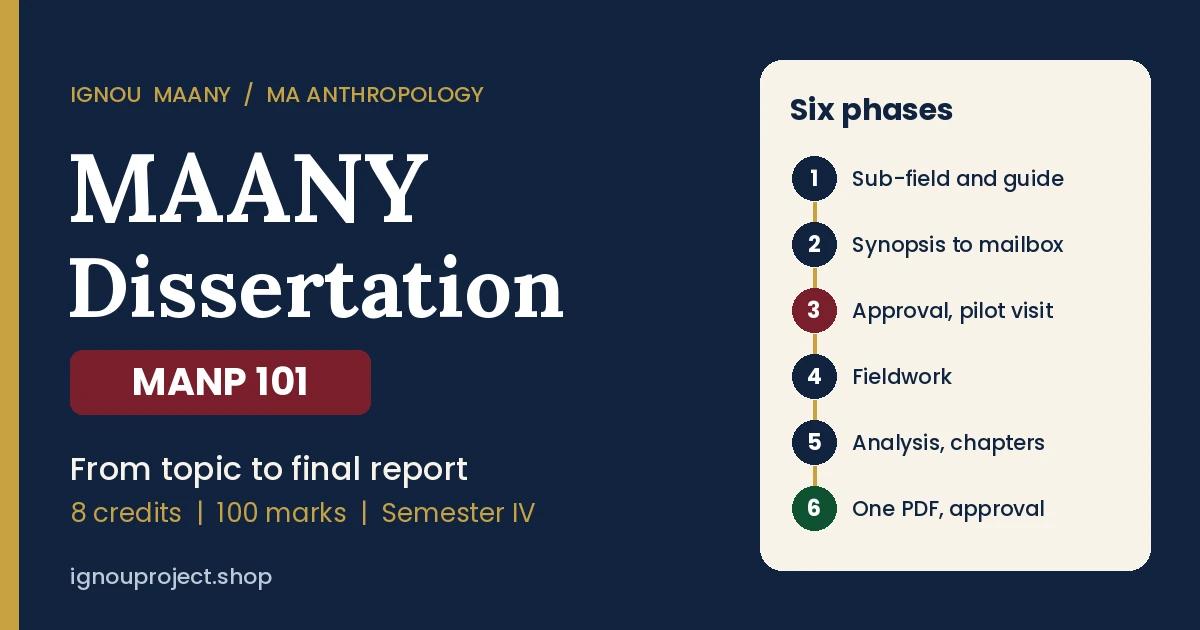
| Phase | What happens | Done when |
|---|---|---|
| 1. Scoping | Choose the branch, the field site and a guide in that branch | A one-line question and a guide who agrees to supervise |
| 2. Synopsis | Draft, revise with the guide, send to manp101@ignou.ac.in | Synopsis sent and a copy kept |
| 3. Approval and pilot | Wait for approval; test the tools on a short visit | Approval reply received; tools revised |
| 4. Fieldwork | Main data collection, planned around MANL 101 practical dates | Every objective has data behind it |
| 5. Writing | Analysis and chapters, reviewed by the guide | Guide signs off the final draft |
| 6. Compilation | Single PDF with the approval copy, ready for the session’s link or address | Submitted within the notified window |
Submission windows are fixed by IGNOU notification for each term-end examination session and have been extended in some past sessions. Read the notice for your own session on ignou.ac.in rather than relying on a date quoted elsewhere. For how project work runs across other IGNOU programmes, the IGNOU project guide covers the common procedure.
Questions learners ask
IGNOU MAANY dissertation FAQ
How many words or pages should the MAANY dissertation be?
The MAANY Programme Guide does not state a word count or page count for MANP 101 in its dissertation passage. It refers learners to the course manual for project details. Treat any figure quoted online as unverified until the MANP 101 manual or your Regional Centre confirms it, and let the objectives decide the length.
Is MANE 106 compulsory along with MANP 101?
No. MANP 101 Dissertation is compulsory in Semester IV. MANE 106 Ethnographic Training is a 4-credit, project-only elective in Semester III Group B, where learners choose any two courses. Only learners who selected MANE 106 have that second project.
Can the MANP 101 dissertation use only secondary data?
The Programme Guide describes MANP 101 as a research study and does not publish a rule on data sources in its dissertation passage. Anthropology dissertations are normally built on the learner’s own fieldwork, with secondary data used to describe the setting. Agree the data plan with your guide and state it in the synopsis so the approval covers it.
Where are the MANP 101 dissertation guidelines published?
The MAANY Programme Guide on eGyanKosh describes the course, and it names the course manual as the source for project and mentor details. Learners search for the code as MANP 101, MANP-101 or MANP101. Results for MANP-001, MANP 001 or MANP 1 belong to the older MAAN programme and describe different rules.
Can the dissertation be on biological or archaeological anthropology?
Yes. The Programme Guide allows a research study in any sub-field of anthropology. A biological topic usually relies on anthropometric or similar measurement, and an archaeological topic usually works through site documentation, oral history and records. Choose a guide who works in the same branch.
Is there a viva voce for MANP 101?
The MAANY Programme Guide states that there is no viva voce examination for the dissertation. The older MAAN guide did provide a Regional Centre viva for MANP 001, which is a different programme. Confirm the position for your session with your Regional Centre.
Verify before you act. Course codes, credits, elective lists and submission windows are set by Indira Gandhi National Open University and can change by notification. Check the MAANY programme page on ignou.ac.in and the Master of Arts (Anthropology) MAANY Programme Guide on egyankosh.ac.in, and ask your Regional Centre for the MANP 101 manual, before finalising anything on this page.
Disclosure: ignouproject.shop is an independent study-help publication. It is not the official IGNOU website, is not affiliated with, endorsed by or connected to Indira Gandhi National Open University, and does not issue approvals, marks or results. Official information always comes from ignou.ac.in and from your Regional Centre.

Leave a Reply