
MLIS Project Work and Dissertation (MLIP-002)
IGNOU MLIS Dissertation: How to Write MLIP-002, Chapter by Chapter
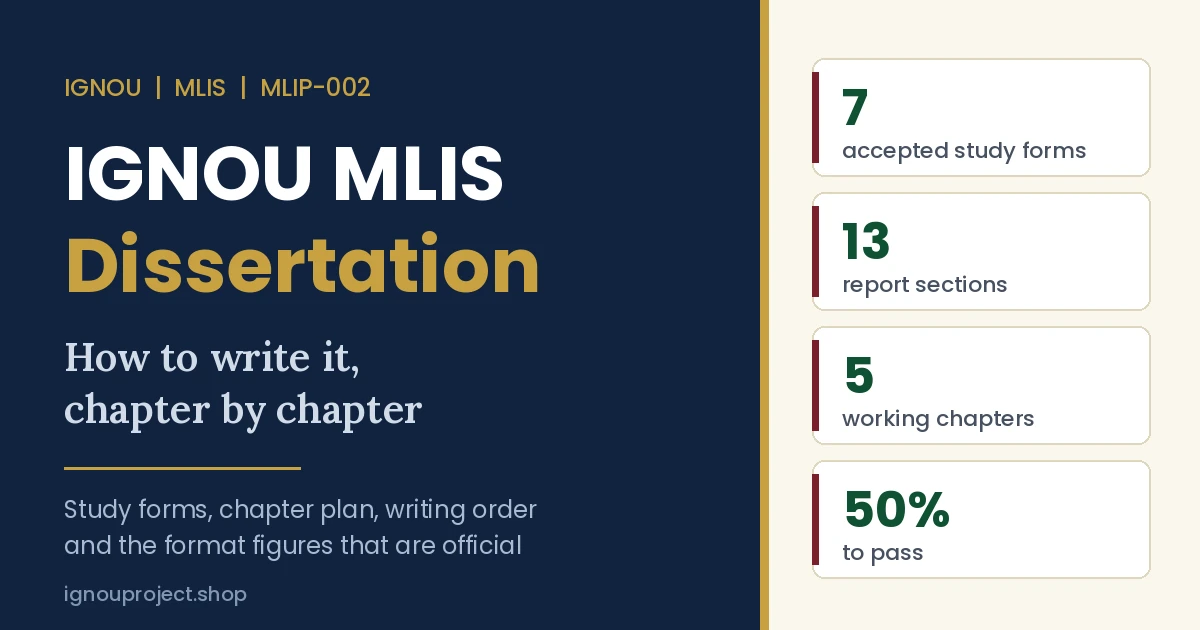
The IGNOU MLIS dissertation is MLIP-002, Project Work/Dissertation, a 4 credit, 100 mark course of the Master’s Degree in Library and Information Science. It must take one of seven accepted study forms, explain its research methodology adequately, follow the thirteen section format in the MLIS Programme Guide, and score 50 percent to pass.
Definition
What is the IGNOU MLIS dissertation, and what does it test?
The IGNOU MLIS dissertation refers to MLIP-002, Project Work/Dissertation, a compulsory core course of the Master’s Degree in Library and Information Science (MLIS) run by the Faculty of Library and Information Science, School of Social Sciences, Indira Gandhi National Open University. MLIP-002 carries 4 credits and 100 marks. It has no tutor marked assignment and no continuous evaluation, so the dissertation alone decides the result, and the pass mark is 50 percent. The MLIS Project/Dissertation Work Handbook accepts seven forms of study: action research, inter-institutional study, comprehensive case study, users’ survey or field study, survey of literature, users’ sensitisation, and information literacy. Annexure III of the July 2022 MLIS Programme Guide sets a thirteen section report running from Certificate to Appendices, and the handbook requires every report to explain its research methodology adequately. The report is written in English on A4 paper, typed in double space and bound.
Put simply, MLIP-002 tests whether a learner can run one small, honest piece of library and information science research and report it in a fixed shape. The rules for guide eligibility, the synopsis packet, fees and where the report is sent sit in the MLIP 2 rules and submission guide. This page is about the writing.
| Course code and title | MLIP-002, Project Work/Dissertation (also typed MLIP 2, MLIP-02, MLIP002) |
|---|---|
| Programme and school | MLIS; Faculty of Library and Information Science, School of Social Sciences |
| Credits and marks | 4 credits, 100 marks, counted as one full course |
| Assignment component | None; the dissertation carries all 100 marks |
| Pass mark | 50 percent |
| Programme duration | One year minimum, two years maximum; admission in July and January sessions |
| Deliverables | Approved synopsis first, then the bound dissertation with the approved proforma and a Certificate of Originality |
| Report format | Thirteen sections, Annexure III of the July 2022 Programme Guide |
| Language | English |
| Deadlines | Fixed by IGNOU notification each session; confirm the current one |
Choosing the form
Which type of MLIS dissertation should you write?
Choose the form that matches the evidence you can actually reach. The MLIS Project/Dissertation Work Handbook lists seven accepted forms and states a preference for emerging areas of library and information science. Each form implies its own data source and its own instrument, and the synopsis has to name both before approval. A learner working in a college library has records and users on hand; a learner without an institutional base is usually better served by a literature survey or a construction project such as a thesaurus.
| Form of study | Typical data | Typical instrument | Typical analysis |
|---|---|---|---|
| Action research | A system, interface or service being designed or improved | Requirement checklist, test log, feedback form | Before and after comparison of the service |
| Inter-institutional study | Two or more libraries, networks or services | Structured schedule filled at each institution | Side by side comparison tables |
| Comprehensive case study | One library, information centre or network | Records, annual reports, interview schedule, observation | Descriptive analysis against stated objectives |
| Users’ survey or field study | A defined user population and sample | Questionnaire, pre-tested on a few respondents | Frequencies, percentages, central tendency |
| Survey of literature | Publications on one subject over fixed years | Data sheet per record from a named database or journal set | Growth, authorship pattern, Bradford distribution |
| Users’ sensitisation | A user group before and after an orientation | Pre and post questionnaire | Change between the two rounds |
| Information literacy | A literacy programme and its learners | Skills checklist or short test | Comparison against programme objectives |
For topic lists, the handbook’s Appendix I gives twenty one illustrative areas, from library consortia and metadata practices in digital repositories to information seeking behaviour and scientometric studies, and describes the list as suggestive rather than exhaustive.
Chapter plan
How do the thirteen required sections become chapters?
Group them into five working chapters plus front and end matter, keeping the official order. Annexure III lists the report as Certificate, Acknowledgements, Table of Contents, Preface, Introduction, Review of Literature, Objectives, Methodology, Findings, Conclusion, Bibliography, Index and Appendices. It does not number chapters, so the grouping below is a convention. The sequence is what must hold, including the Preface and Index that templates often drop.
| Part of the report | Annexure III sections it holds | Also bound in or attached |
|---|---|---|
| Front pages | Certificate, Acknowledgements, Table of Contents, Preface | Approved proforma, approved synopsis, Certificate of Originality signed by learner and supervisor |
| Chapter 1 | Introduction | Background, problem statement, scope |
| Chapter 2 | Review of Literature | Prior studies grouped by theme |
| Chapter 3 | Objectives, Methodology | Population, sample, instrument, analysis plan |
| Chapter 4 | Findings | Tables and figures, each interpreted in text |
| Chapter 5 | Conclusion | Findings against objectives, suggestions, further research |
| End matter | Bibliography, Index, Appendices | Questionnaire or schedule, raw tables, permission letters |
Writing it
How to write each chapter of the MLIS dissertation
Methodology first, because the synopsis already holds it
Start with Chapter 3. The approved synopsis already states the rationale, sampling, instruments and limitations, because the handbook asks for all four at proposal stage, along with the size of the population for any empirical study. Expand those into full paragraphs: who the population is, how the sample was drawn, how the questionnaire or data sheet was built and tested, and which measures will be used. The handbook requires each report to explain its research methodology adequately, so this chapter is where marks are most visibly earned or lost. Copy the objectives from the approved synopsis word for word. Both are bound into the front of the report, so any drift is visible at once.
BK Sahni, who has guided 5,00,000 students till date, advises checking one number across the whole report before binding: the sample size stated in the methodology should match the respondent count in every findings table, and both should agree with the population stated in the approved synopsis.
Findings: every table needs a sentence
Present the data in the order of the objectives, one objective per section. Each table or chart gets a number, a title and at least one sentence saying what it shows. Keep raw data and the blank questionnaire for the Appendices.
Review of Literature: themes, not a queue of summaries
Organise prior work by theme or by the variables in the objectives, and end the chapter by naming the gap the study fills. A chapter that summarises one paper per paragraph shows reading, not review.
Conclusion, then Introduction
The Conclusion answers each objective in turn, then adds suggestions for the library studied and directions for further research. The Introduction is easier once the study is finished: background, the problem, its relevance and the scope.
Preface, Bibliography and Index
The Preface is a short personal note on why the study was undertaken and how the report is arranged. For references, no single named style was found in the MLIS documents reviewed, but reproduced copies of the handbook show worked examples in an author, year, title pattern, including one for a doctoral dissertation. Pick one pattern and apply it to every entry. The Index comes last, as a short alphabetical list of key terms and names with page numbers.
Information gain
Which MLIS course material helps most while writing?
Three MLIS elective courses map almost directly onto the dissertation, and most MLIP-002 guides never mention them. The MLIS assignment booklet for the July 2024 and January 2025 sessions, published by the Faculty of Library and Information Science, lists six electives, MLIE-101 to MLIE-106, and its questions show what three of them teach:
- MLIE-102 Research Methodology: defining the research problem, types of sampling, hypotheses, interview technique, pilot surveys, the case study method, and the plan, format and contents of a research report. One of its assignment questions asks the learner to prepare a synopsis on a topic of choice.
- MLIE-104 Technical Writing: the writing process, reader analysis, review articles, editing and the use of visuals in a technical document.
- MLIE-105 Informetrics and Scientometrics: Bradford’s law, literature based indicators, scales of measurement, reliability and validity, measures of central tendency and methods of user studies.
A learner who chose other electives can still read these course blocks on eGyanKosh. The core course MLII-102, Information Processing and Retrieval, is also useful for construction projects, since its practical work includes database searching to build a bibliography and its units cover thesaurus construction and special classification systems.
Figures to trust
How long should the IGNOU MLIS dissertation be, and which format figures are official?
The only published length is about 80 to 120 double spaced typed pages, not exceeding approximately 20,000 words excluding appendices and exhibits, with 10 percent variation either side. That figure comes from the MLIS Project/Dissertation Work Handbook of 2007. Annexure III of the July 2022 Programme Guide sets the section format but states no page or word limit, so the handbook figure remains the working guide. Several circulating figures contradict the handbook or have no traceable source.
| Point | Published position | Circulating claim |
|---|---|---|
| Word basis | About 20,000 words excluding appendices and exhibits | 20,000 words including title page, acknowledgements and references |
| Line spacing | Double space | 1.5 line spacing |
| Binding | Bound form, A4 | Spiral binding between plastic sheets; no source found |
| Viva | Handbook states there is no viva voce for evaluation; the 2022 guide is silent | Viva preparation described as a required stage |
| Report goes to | The Registrar (SED), per the July 2022 Programme Guide | Director (SR&E), a title carried over from the 2007 handbook |
Where marks go
What makes an MLIS dissertation weak?
- Objectives that drift from the approved synopsis bound at the front.
- A methodology that describes, but does not justify, the sample and instrument.
- An undefined population. “Users of academic libraries” is not a population; “postgraduate users of one named university library in one session” is.
- Tables without interpretation in the Findings chapter.
- A literature review built as a list with no stated research gap.
- Missing Preface or Index, both of which Annexure III requires.
- Inconsistent references, or works cited in the text that never reach the Bibliography.
- Copied text. The learner and supervisor both sign the Certificate of Originality, so borrowed passages put two signatures on a false statement.
For the programme wide picture of synopsis and report requirements across IGNOU course codes, see the IGNOU project guide covering every programme.
Verify before you act
The facts on this page come from the MLIS Programme Guide, the MLIS Project/Dissertation Work Handbook and the MLIS assignment booklet. Check the current programme page on ignou.ac.in and the MLIS course material on egyankosh.ac.in before finalising anything. Submission dates and fee slabs change by notification each session.
Quick answers
IGNOU MLIS dissertation: frequently asked questions
Is the IGNOU MLIS dissertation the same as the MLIS project?
Yes. IGNOU names the course Project Work/Dissertation, code MLIP-002, so “MLIS project” and “MLIS dissertation” refer to the same 4 credit course. Learners also type the code as MLIP 2, MLIP-02, MLIP 002 or MLIP002. Use MLIP-002 on the proforma and the report.
How many words should the IGNOU MLIS dissertation have?
The MLIS Project/Dissertation Work Handbook gives about 80 to 120 double spaced typed pages, not exceeding approximately 20,000 words excluding appendices and exhibits, with 10 percent variation either side. The July 2022 Programme Guide sets no length, so confirm with your guide if the report falls well outside that range.
Can the MLIS dissertation be written in Hindi?
The MLIS Project/Dissertation Work Handbook states that the project or dissertation should be in English. The MLIS assignment booklet allows tutor marked assignments in English or Hindi, but that permission covers assignments, not MLIP-002. A learner wanting another language should ask the Programme Coordinator (MLIS) before writing.
Is there an official IGNOU MLIS dissertation sample PDF?
No official sample dissertation was found in the IGNOU and eGyanKosh documents reviewed. The official PDFs are the MLIS Programme Guide on ignou.ac.in and the MLIP-002 handbook on eGyanKosh, which carries the proforma, consent letter and topic appendix. Treat third party samples as structure references only.
Is there a viva for the IGNOU MLIS dissertation?
The MLIS Project/Dissertation Work Handbook states there will be no viva voce for evaluating the project or dissertation, and the July 2022 Programme Guide does not add one. Confirm the position for your session with the Programme Coordinator (MLIS).
Which research methodology suits an MLIS dissertation best?
The one that fits the chosen form of study and the evidence available. A users’ survey needs a defined population, a sampling method and a pre-tested questionnaire; a bibliometric survey needs a fixed database, subject and year range. MLIE-102 Research Methodology and MLIE-105 Informetrics and Scientometrics cover both.
ignouproject.shop is an independent study-help publisher operated by Shri Chakradhar Publication Pvt. Ltd. It is not affiliated with, endorsed by, or acting for Indira Gandhi National Open University. Programme rules, fees and dates are set by IGNOU and revised by notification. Always confirm the current requirement with your Regional Centre, the Programme Coordinator (MLIS) or the official IGNOU website before submitting anything.

Leave a Reply