
MBAFM (MMPP-001) · Choosing the Study Period
There is no prescribed number of years of data for an IGNOU MBAFM project. A trend or ratio analysis normally needs five completed financial years, three at the very least, and the period must end at the last year whose figures are actually published — because the title naming that period is fixed once the synopsis is approved.
The short answer
How many years of data does an IGNOU MBAFM project need?
Deciding how many years of data an IGNOU MBAFM project needs is a question of what the analysis has to show rather than a rule to look up. MBAFM refers to the IGNOU MBA in Financial Management, whose project course is MMPP-001, an eight-credit course equivalent to two courses and registered in Semester III. No official minimum period is published for it. In practice, a single year gives a snapshot and cannot demonstrate a trend at all; three years shows direction; five completed financial years is the conventional span for ratio and trend analysis, because it survives one unusual year without the conclusion collapsing. The harder constraint is availability. Indian financial years close on 31 March, and the figures for a year that has just closed are not published on the day it ends.
A synopsis drafted in April naming a period that runs “up to 2025-26” is naming data that does not exist yet. Since the approved title is fixed for the final report, that single wording choice can force a study on figures the learner cannot obtain.
Availability
When does each year of company data actually become public?
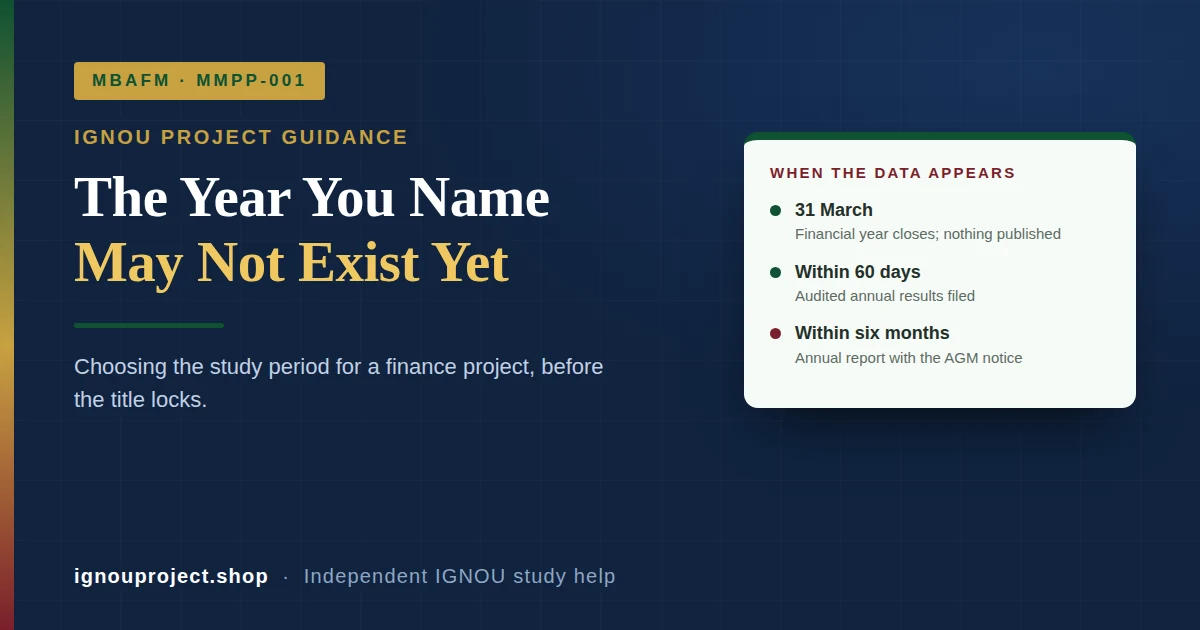
For listed Indian companies the calendar is set by regulation rather than by convenience, which makes it possible to plan around. Under Regulation 33 of the SEBI Listing Obligations and Disclosure Requirements Regulations, a listed entity files audited annual financial results within sixty days of the financial year end, so headline figures for a year closing 31 March are on the exchange by around the end of May. The full annual report, with the schedules and notes a ratio analysis usually needs, reaches shareholders with the notice of the annual general meeting, and the Companies Act, 2013 requires that meeting within six months of the year end.
| Stage | What exists | What it supports |
|---|---|---|
| Year closes, 31 March | Nothing published for that year | Nothing — the year cannot be the endpoint of your period yet |
| Audited annual results, within 60 days | Revenue, profit, headline balance-sheet items filed with the exchange | Basic profitability and growth ratios |
| Annual report, with the AGM notice | Full statements, schedules, notes, segment and cash-flow detail | Liquidity, solvency, turnover and structural analysis |
| Unlisted company | Accounts filed with the Registrar of Companies after the AGM | Obtainable from MCA records, but not freely published — plan for the delay and the cost |
Why the title matters
Why does the study period belong in the MBAFM title?
Finance titles name their period because the finding is meaningless without it: a study of a company’s financial performance across 2019-20 to 2023-24 is a different study from one across 2021-22 to 2025-26. That precision is what an evaluator looks for. It also carries a cost, because the report must be submitted on the approved title and the approval itself takes time. A proposal sent in April may not come back for two to three months, by which point the period written into the title is already a year older.
BK Sahni, who has guided 5,00,000 students till date, notes that MBAFM learners lose more time to an over-ambitious period than to any weakness in the analysis itself, because a title promising the year just closed cannot be delivered until that year is published. Ending the period one year earlier costs nothing academically and removes the dependency entirely.
Company choice
Does a listed or unlisted company change the answer?
It changes it completely. A listed company publishes on a fixed regulatory rhythm, so five years of comparable statements can be assembled before the synopsis is written. An unlisted company files its accounts with the Registrar of Companies rather than publishing them, so the figures exist but must be retrieved from official records, and the series may have gaps or inconsistent disclosure between years.
This is why a local firm the learner knows personally is often a harder subject than a large listed company they have never visited. Where a comparison is planned, the constraint tightens further: every company in the comparison needs the same years disclosed to the same depth, so the shortest available series sets the period for all of them. The wider chapter structure and submission route are covered in the MMPP-001 format and topics guide, and the course record sits on eGyanKosh.
Before you write it
What should the MBAFM synopsis state about the period?
- Name the years explicitly in the title and in the objectives, written as financial years rather than as a vague count.
- End at a published year. Open the annual report for the final year of your period before you name it, not after.
- Justify the span against the analysis — state why five years suits a trend, or why three suits a shorter comparison.
- Name the source for each year: the company’s own annual reports, exchange filings, or records obtained from official company filings.
- Check the shortest series first where two or more companies are compared, and set the period from that one.
- Allow for approval time by choosing a period that will still be defensible two or three months after the proposal is sent.
Frequently asked questions
Does IGNOU specify a minimum number of years for an MBAFM project?
No minimum period is published for MMPP-001. The span has to be justified in the methodology against the analysis being performed, which is why a trend study normally runs to five completed financial years and a shorter comparison may run to three.
Can an MBAFM project use only secondary data?
Yes. A financial performance study built on published annual reports and exchange filings is a recognised design, and no questionnaire is required for it. State the sources clearly in the methodology and cite each report used.
Can the study period be changed after the synopsis is approved?
The report has to be submitted on the approved title, and in a finance project the title normally contains the period, so changing it is not a simple edit. Settle the period before submission and confirm with your guide and Regional Centre if circumstances force a change.
Where can annual reports for an MBAFM project be obtained?
Listed companies publish annual reports on their own investor-relations pages and file results with the stock exchanges. For unlisted companies the accounts are filed with the Registrar of Companies and must be retrieved from official company records, which takes longer and may involve a fee.
If the company is chosen but the period is still open, that is the decision worth settling before the title is written rather than after approval. Details are on the ignouproject.shop pages.

BK Sahni iD 0009-0005-8092-459X
Founder, Shri Chakradhar Publication Pvt. Ltd. & its IGNOU Project study-help brand — helping IGNOU distance-learning students since 2010 (5,00,000+ students supported across MBA, MCom, MA & more). Author of IGNOU exam guides, solved assignments & project reference books.
Disclosure: Shri Chakradhar Publication Pvt. Ltd. and ignouproject.shop are independent third-party study-help services — not the official IGNOU website. Always verify final dates and rules on ignou.ac.in.
Leave a Reply