
MA Philosophy dissertation, MPYP-001
IGNOU MAPY Dissertation: Choosing and Writing Your Philosophical Method
An IGNOU MAPY dissertation (MPYP-001, a 4-credit Year 2 course in MA Philosophy) stands or falls on its method: how the chosen text or problem is read, argued and tested. That method is taught in MPYE-007 Research Methodology in Philosophy, a Year 1 elective that many learners reach Year 2 without having studied.
What the method has to do
What does an IGNOU MAPY dissertation need from its method?
The IGNOU MAPY dissertation refers to MPYP-001 Dissertation/Project work, a 4-credit project course in the second year of the Master of Arts (Philosophy) at Indira Gandhi National Open University, offered through the School of Inter-Disciplinary and Trans-Disciplinary Studies. The official course description sets three expectations: the learner philosophises in context at the end of postgraduate study, works independently with a guide using a research method, and develops one theme with a review of the relevant materials on the topic. None of that is survey work. The method is the procedure that turns reading into an argument: interpreting a text, testing a claim against its strongest objection, describing an experience, analysing a concept, or comparing two traditions. These methods are taught in MPYE-007 Research Methodology in Philosophy, a 4-credit elective listed in Year 1 of the same programme.
Because MPYE-007 is an elective, a learner can arrive at the IGNOU MAPY dissertation without ever having studied it. This page deals only with that gap: choosing the method and writing it down. For topics, the proposal, length, the evaluation fee and submission, the complete IGNOU MAPY project guide for MPYP-001 covers the course as a whole.
| Course | MPYP-001 Dissertation/Project work |
|---|---|
| Programme and school | Master of Arts (Philosophy), MAPY; School of Inter-Disciplinary and Trans-Disciplinary Studies (SOITS) |
| Credits and year | 4 credits, listed under Year 2 |
| Official aim | Philosophise in context, work independently with a guide, develop a theme with a review of relevant materials |
| Where methods are taught | MPYE-007 Research Methodology in Philosophy, 4 credits, Year 1 elective |
| Methods in MPYE-007 papers | Hermeneutics (Western and Indian), dialectic, phenomenology, deconstruction, empirical method, writing a research report |
| Length | Set by the guide, per the MPYE-007 unit on research papers; confirm it in writing |
| Rules for your session | Fixed by the notice for each session; confirm with your Regional Centre |
Matching question to method
Which philosophical method fits your MAPY dissertation question?
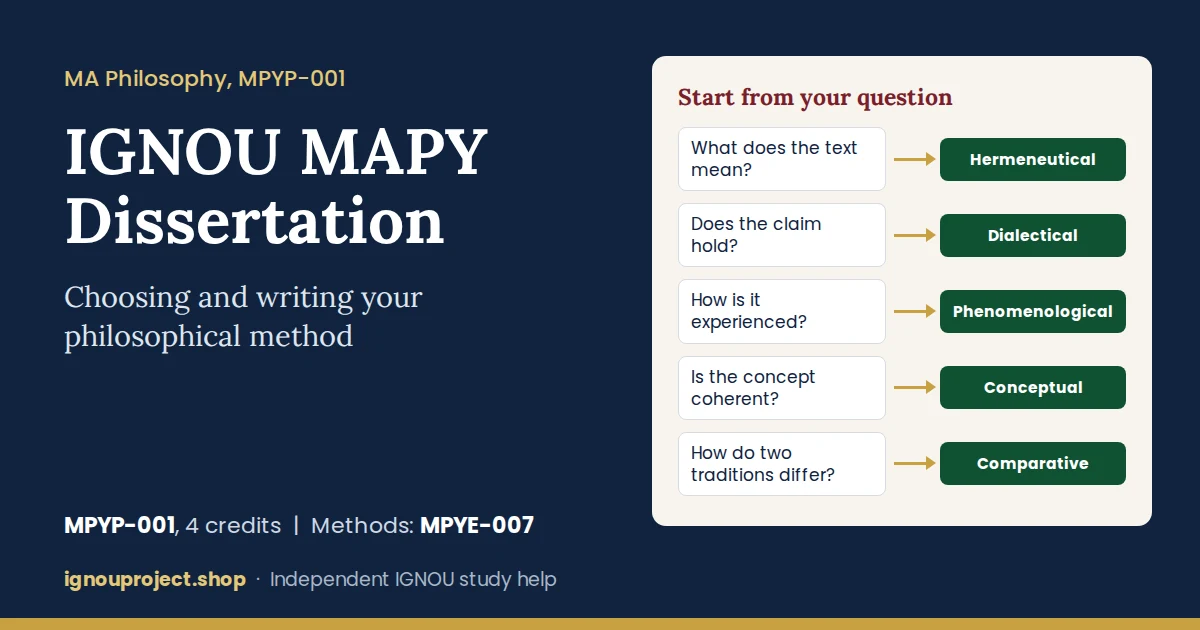
Choose the method from the kind of question the dissertation asks. A question about what a text means calls for hermeneutics; a question about whether a claim holds calls for dialectic; a question about how something is lived or felt calls for phenomenology. MPYE-007 Research Methodology in Philosophy treats these as separate methods with separate procedures, and its recent question papers on ignou.ac.in ask about each one by name. In practice, write the research question in one sentence, find its row below, and check the last column before drafting anything.
| If the question asks | Method | What the analysis chapters do | Where it goes wrong |
|---|---|---|---|
| What does this text or thinker mean by X? | Hermeneutical | Read each passage against the whole work and return from the whole to the part (the hermeneutical circle); place the text in its context | A book summary presented as interpretation |
| What does a term or passage mean in an Indian text? | Indian hermeneutics | Separate primary meaning (abhidha), secondary meaning (lakshana) and suggested meaning (vyanjana); follow the commentarial tradition | Reading a Sanskrit term through one English translation only |
| Does this claim or position hold? | Dialectical | State the thesis, set out the strongest opposing view, test both, arrive at a qualified position | A weak opponent set up only to be defeated |
| How is this experienced from the inside? | Phenomenological | Describe the experience as it appears, setting aside theories about its causes, then draw out its structure | Personal opinion presented as description |
| Is this concept clear and coherent? | Conceptual analysis | Define terms, find necessary conditions, test the definition against counterexamples | A dictionary definition standing in for analysis |
| How do two thinkers or traditions differ on X? | Comparative | Set one shared question, present each side in its own terms, then compare point by point | Treating similar-sounding terms as equivalent |
Where the survey template came from
Why do some MAPY dissertation guides ask for a Results chapter?
Because the research-paper template in the first unit of MPYE-007 Research Methodology in Philosophy was adapted from a life-sciences journal format, not written for philosophy. The unit lists the parts of a paper as title page, abstract, introduction, materials and methods, results, discussion and bibliography, and says the form follows the requirements of the Journal of Biological Chemistry, citing a university biology-lab writing guide. It even specifies 8.5 by 11 inch paper.
Several help pages have copied that list into MAPY advice, and one page ranking for MPYP-01 suggests topics such as the effect of social media on academic stress, a psychology survey rather than a philosophy dissertation. The same MPYE-007 unit contains the safeguard that those pages leave out: its general guidelines apply except where the guide gives explicitly different instructions.
So translate the science headings instead of copying them:
- Materials and methods becomes sources and method: the primary texts, the translations used and the method chosen above.
- Results becomes the analysis chapters, where the method is actually applied.
- Discussion becomes critical evaluation, where objections are answered and a position is taken.
BK Sahni, who has guided 5,00,000 students till date, notes that a philosophy proposal carrying a hypothesis, a sample size and a Results heading tells the supervisor that a template, not a question, shaped the plan, and it is often the first thing the supervisor asks to change.
Writing it down
How do you write the methodology section of an IGNOU MAPY dissertation?
The methodology section of an MPYP-001 dissertation is short, yet it tells the evaluator how to read every chapter that follows, and a trimmed version serves the proposal too. Six moves cover it:
- Name the method and say, in one sentence, why the research question needs it.
- Name the primary texts, with the edition or translation used and the translator.
- Describe the review of relevant materials: which commentators and scholars, and what the review is for. The official MPYP-001 description asks for this review explicitly.
- Say what each analysis chapter does with the method, chapter by chapter.
- State the limits: language, scope, and texts deliberately left out.
- Agree it with the guide before drafting the second chapter, since the official description has the learner working independently with a guide.
Worked example: an illustration, not a prescribed topic
This dissertation uses the hermeneutical method to interpret Gandhi’s idea of Sarvodaya in his own writings, chiefly Hind Swaraj and Sarvodaya, his Gujarati paraphrase of Ruskin’s Unto This Last, reading each passage against the work as a whole. Chapter 4 applies the dialectical method, setting Sarvodaya against the objection that it neglects individual rights, and tests both. Secondary literature is limited to studies in English, and the Gujarati originals are read in translation, which is stated as a limitation.
The theme comes from MPYE-015 Gandhian Philosophy, a MAPY elective; any course in the programme can supply one the same way.
If MPYE-007 was skipped
What if you did not take MPYE-007 Research Methodology in Philosophy?
Read its units on eGyanKosh before drafting the methodology. Nothing in the documents reviewed for this page makes MPYE-007 a prerequisite for MPYP-001, yet the dissertation assumes what MPYE-007 teaches. The ignou.ac.in MAPY programme page lists MPYE-007 as a Year 1 elective that prepares students for further research work, so a learner who chose other first-year electives meets MPYP-001 with no formal training in philosophical method. Read in this order:
- The unit on philosophical method, for how doubt becomes a question and a question becomes an argument.
- Hermeneutics, both Western and Indian, for any dissertation built on a text.
- Dialectic, for the evaluation chapter.
- Phenomenology, only if the question is about experience.
- The writing units on outlines, the table of contents, preliminary pages, footnotes, the bibliography and quoting. Recent MPYE-007 question papers ask about each of these.
The MPYP-001 collection on eGyanKosh, the IGNOU digital repository, also holds units of its own, including Systematic Research in Philosophy and Writing a Research Paper.
Method mistakes
Which method mistakes send a MAPY dissertation back for revision?
These are recurring patterns in philosophy dissertations, not an official IGNOU list of grounds for rejection.
- Method named, not used. The methodology says hermeneutical, but the chapters summarise. Open each analysis chapter by stating the interpretive question it answers.
- Commentators doing the thinking. Chapters built from secondary sources, with the primary text quoted rarely. Put the primary text first and bring in commentators to support or oppose a reading.
- A straw opponent. Dialectic run against a weak objection. State the objection as its strongest defender would.
- False equivalence. Two traditions compared through words that only sound alike. Define each term inside its own system before comparing.
- Silently corrected quotations. MPYE-007 raises whether errors in an original should be corrected when quoted. The widely used convention is to quote exactly and mark the error with [sic]; confirm the guide’s preference.
- A survey bolted on. A questionnaire attached to a conceptual question. Drop it unless the question itself is empirical, and ask the guide first.
Short answers
IGNOU MAPY dissertation: frequently asked questions
Can one MAPY dissertation use two methods?
Yes. Nothing in the documents reviewed restricts an MPYP-001 dissertation to one method. The usual pairing is hermeneutics for the text chapters and dialectic for the evaluation chapter, as long as the methodology section says which chapter uses which method.
Is MPYE-007 compulsory before the MAPY dissertation?
No such rule was found in the documents reviewed. The ignou.ac.in MAPY programme page lists MPYE-007 Research Methodology in Philosophy as a Year 1 elective and MPYP-001 under Year 2. Confirm any course-choice rule with your Regional Centre.
Can the MAPY dissertation include a survey or interviews?
The documents reviewed do not rule it out, but the official MPYP-001 description frames the work as developing a theme through a review of relevant materials. Use empirical data only when the research question is itself empirical, and only with the guide’s agreement.
Is MPYP 1 the same course as MPYP-001?
Yes. MPYP-001, MPYP-01, MPYP 1, MPYP1 and MPYP001 all refer to the same course, Dissertation/Project work in the MAPY programme. Use the official form, MPYP-001, on the proposal and the report.
Where are the method units for the MAPY dissertation?
On eGyanKosh, under the MAPY collections: MPYE-007 Research Methodology in Philosophy in the first-year material, and MPYP 001 Dissertation / Project work in the second-year material.
Check before you write: confirm course details on the official IGNOU MAPY programme page, read the method units on egyankosh.ac.in, and follow the submission notice for your own session.
Learners who have a method agreed but are stuck on the chapters can find independent project help on this site; the proposal, the approval and the final text still rest with the learner and the guide.
Disclosure: this article is published by ignouproject.shop, an independent study-help service of Shri Chakradhar Publication Pvt. Ltd. It is not the official website of IGNOU or the School of Inter-Disciplinary and Trans-Disciplinary Studies. It summarises published university material for guidance only; official IGNOU notifications prevail over anything written here.

BK Sahni iD 0009-0005-8092-459X
Founder, Shri Chakradhar Publication Pvt. Ltd. & its IGNOU Project study-help brand, helping IGNOU distance-learning students since 2010 and having guided 5,00,000 students till date across MBA, MCom, MA & more. Author of IGNOU exam guides, solved assignments & project reference books.
Disclosure: Shri Chakradhar Publication Pvt. Ltd. and ignouproject.shop are independent third-party study-help services, not the official IGNOU website. Always verify final dates and rules on ignou.ac.in.
Leave a Reply